CBSE JEE Main & Advanced Chemistry: Carboxylic Acids And Its Derivatives Important Questions & Complete Chapter Notes
Published: October 21, 2026
Author: NEET & JEE STUDY HUB
🎯 Curriculum & Exam Overview
Carboxylic acids and their derivatives are central to organic synthesis, focusing on the reactivity of the carbonyl group and the nucleophilic acyl substitution mechanism. This chapter is high-yield because it integrates functional group interconversions and acidity trends, which are frequently tested in JEE competitive patterns.
1. 📚 Quick Revision Notes & Core Theory
1
Carboxylic acids are defined by the -COOH group, where the acidity is determined by the stability of the carboxylate anion (RCOO⁻) via resonance.
2
Nucleophilic Acyl Substitution is the fundamental mechanism where a nucleophile replaces a leaving group (L) in the derivative R-CO-L.
3
The reactivity order for acyl derivatives toward nucleophilic substitution follows: Acid chlorides > Anhydrides > Esters > Amides, dictated by the leaving group ability and resonance stabilization.
⚡ High-Yield Formula & Reaction Sheet
- Hell-Volhard-Zelinsky (HVZ) Reaction: R-CH2-COOH + X2/Red P → R-CH(X)-COOH; halogenation at the alpha-carbon of carboxylic acids.
- Decarboxylation: R-COONa + NaOH/CaO (Sodalime) → R-H + Na2CO3; essential for shortening the carbon chain length.
⚠️ Common Board Trap Alert
Students often confuse the acidity order of substituted carboxylic acids by ignoring the inductive effect (-I effect) of electron-withdrawing groups at the alpha position versus the resonance effect.
📺 High-yield video lesson for this chapter will premiere on @qbnexa_official.
▶ Subscribe Channel
3. 📝 Interactive Chapter DPP & Practice Questions
Question 1 • MCQ
🔥 AP EAPCET (2024)
4 Mark(s)
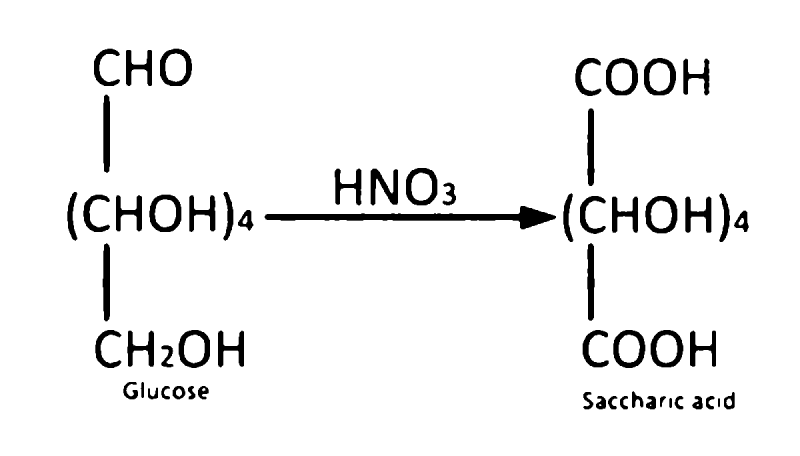
When glucose is oxidised with nitric acid the compound formed is
(A) Gluconic acid
(B) $n$-hexanoic acid
(C) Sacharic acid
(D) Cyanohydrin
💡 View Step-by-Step Solution & Answer Key
Correct Answer: (c)
Explanation: When glucose is oxidised with nitric acid, saccharic acid is formed.
Question 2 • MCQ
🔥 AP EAPCET (2025)
4 Mark(s)
$ \text { The final product }(C) \text { in the given reaction sequence is } $
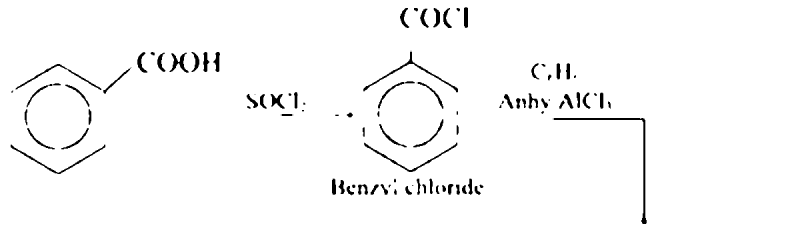
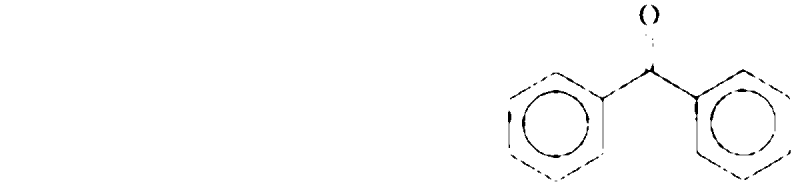
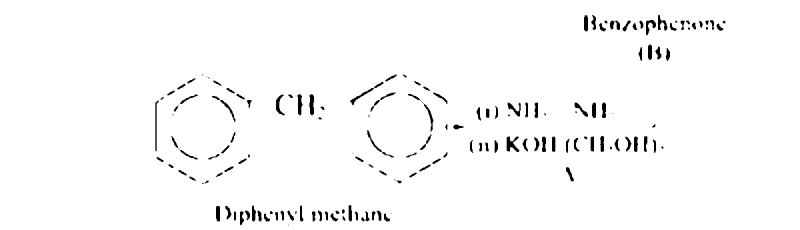
$ \mathrm{C}_6 \mathrm{H}_5 \mathrm{COOH} \xrightarrow{\mathrm{SOCl}_2}(A) \xrightarrow[\text { anhy } \cdot \mathrm{AlCl}_3]{\mathrm{C}_6 \mathrm{H}_6}(B) \xrightarrow[\text { (ii) } \mathrm{KOH}_4 /\left(\mathrm{CH}_2 \mathrm{OH}\right)_2]{\text { (i) } \mathrm{NH}_2-\mathrm{NH}_2}(C) $
(A) benzophenone
(B) diphenyl methane
(C) diphenylmethanol
(D) benzoic acid
💡 View Step-by-Step Solution & Answer Key
Correct Answer: (b)
Explanation: $ \text { The complete reaction sequence is as follows } $
Question 3 • MCQ
🔥 MHT CET (2025)
4 Mark(s)
Identify the product ' B ' in following reaction.
Dry ice $\xrightarrow[\text { dry ether }]{\mathrm{CH}_3 \mathrm{MgBr}} \mathrm{A} \xrightarrow{\mathrm{H}_3 \mathrm{O}^{+}} \mathrm{B}$
(A) Methanoic acid
(B) Ethanoic acid
(C) Methanol
(D) Ethanol
💡 View Step-by-Step Solution & Answer Key
Correct Answer: (b)
Explanation: 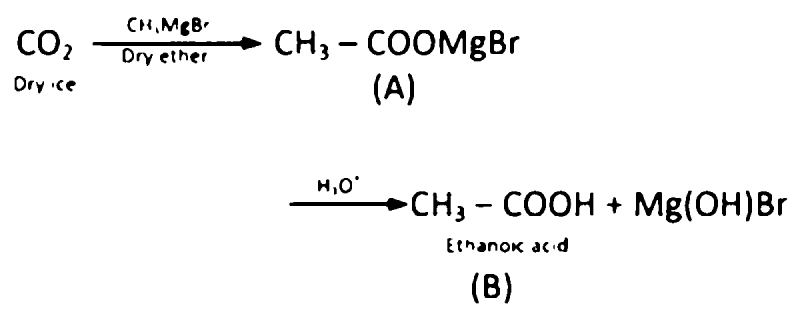
Question 4 • Assertion-Reason
🔥 AP EAPCET (2024)
1 Mark(s)
**Assertion (A) :** Carboxylic acids are more acidic than phenols
**Reason (R) :** Resonance structures of carboxylate ion are equivalent, while resonance structures of phenoxide ion are not equivalent.
(A) Both (A) and (R) are correct and (R) is the correct explanation of $(A)$.
(B) Both $(A)$ and $(R)$ are correct But $(R)$ is not the corred explanation of (A).
(C) (A) is correct but (R) is incorrect.
(D) (A) is incorrect but (R) is correct.
💡 View Step-by-Step Solution & Answer Key
Correct Answer: (a)
Explanation: Both A and R are correct and R is the correct explanation of A.
Question 5 • MCQ
🔥 MHT CET (2023)
4 Mark(s)
Identify '$\mathrm{A}$' in the following reaction.
A+ Acetic anhydride $\xrightarrow{\mathrm{H}^{+}}$ Aspirin + Acetic acid
(A) Acrylic acid
(B) Oxalic acid
(C) Salicylic acid
(D) Phthalic acid
💡 View Step-by-Step Solution & Answer Key
Correct Answer: (c)
Explanation: 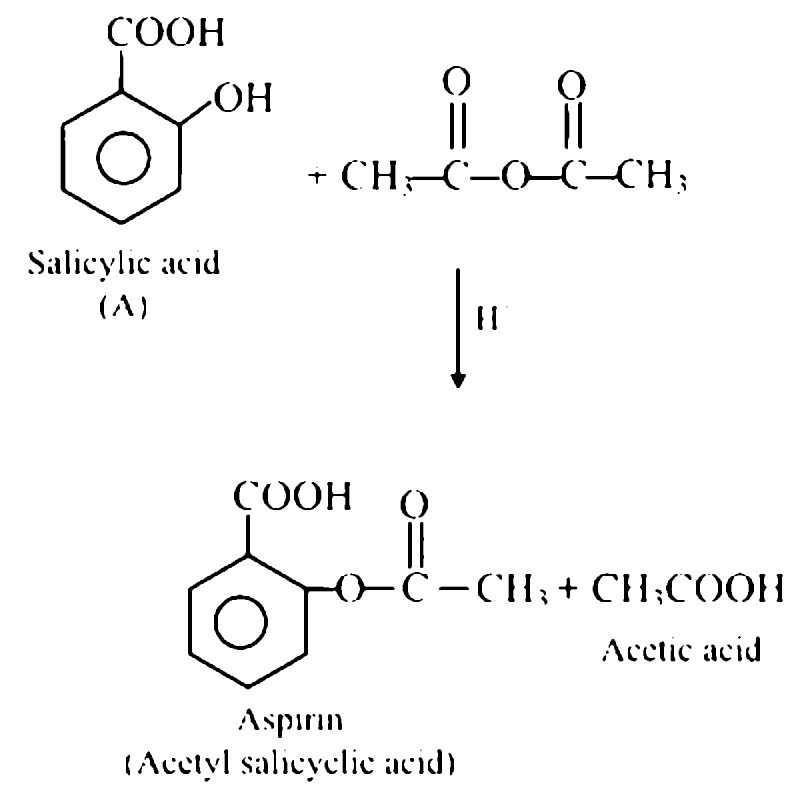
4. ❓ Frequently Asked Questions (Exam Strategy)
❓ Why are carboxylic acids stronger acids than alcohols?
The carboxylate anion formed after deprotonation is resonance-stabilized by two equivalent oxygen atoms. In contrast, the alkoxide ion from alcohols lacks resonance stabilization, making the acid release H+ more readily.
❓ Which derivative is the most reactive toward nucleophilic attack and why?
Acid chlorides are the most reactive due to the poor resonance donation of the chlorine lone pair into the carbonyl carbon. Additionally, the chloride ion is an excellent leaving group, facilitating faster substitution.
❓ Does the presence of electron-donating groups increase or decrease acidity?
Electron-donating groups decrease acidity by destabilizing the negative charge on the carboxylate anion through the +I effect. Conversely, electron-withdrawing groups increase acidity by dispersing the negative charge.
Official Complete Study Package
JEE Main & Advanced High-Yield Chapter Question Bank
Get full digital access to 500+ chapter-wise questions, comprehensive question banks, and authentic exam solutions.
Verified NCERT Curriculum • Instant Digital Access • 100% Satisfaction
💬
Join the Official Study Community for daily question drops & discussion
Join Channel
🎓Explore All QBNEXA Curriculum Hubs
Need more chapters and complete test sets?
Access our complete 12 Lakhs MCQ repository, solved past papers, and error-free test series.
← Back to Home
