CBSE JEE Main & Advanced Chemistry: Biomolecules Important Questions & Complete Chapter Notes
Published: October 21, 2026
Author: NEET & JEE STUDY HUB
🎯 Curriculum & Exam Overview
Biomolecules encompass the essential organic compounds like carbohydrates, proteins, and nucleic acids that form the chemical foundation of living organisms. This chapter is high-yield for JEE as it integrates structural organic chemistry with functional biological mechanisms, appearing frequently in both physical and organic reasoning segments.
1. 📚 Quick Revision Notes & Core Theory
1
Carbohydrates are polyhydroxy aldehydes or ketones, or substances that yield these on hydrolysis, classified into monosaccharides, oligosaccharides, and polysaccharides.
2
The Alpha-Helix and Beta-pleated sheet structures of proteins are stabilized by hydrogen bonding between the carbonyl oxygen and the amide hydrogen of the polypeptide backbone.
3
Nucleic acids (DNA/RNA) consist of a phosphate group, a pentose sugar (ribose/deoxyribose), and nitrogenous bases linked via phosphodiester bonds.
⚡ High-Yield Formula & Reaction Sheet
- D-Glucose + HI (excess) → n-Hexane: Proof of the straight-chain structure of glucose.
- D-Glucose + Br2 water → Gluconic acid: Oxidation of the aldehydic group to a carboxylic acid, indicating the presence of a -CHO group.
⚠️ Common Board Trap Alert
Students often confuse the anomeric carbon (C1 in glucose) with other chiral centers; remember that alpha and beta anomers differ only in configuration at C1, which is the carbon involved in hemiacetal formation.
📺 High-yield video lesson for this chapter will premiere on @qbnexa_official.
▶ Subscribe Channel
3. 📝 Interactive Chapter DPP & Practice Questions
Question 1 • MCQ
4 Mark(s)
The presence or absence of hydroxy group on which number of carbon atom of sugar differentiates RNA and DNA.
💡 View Step-by-Step Solution & Answer Key
Correct Answer: a
Explanation: 2.00
In RNA molecule, sugar is
Question 2 • MCQ
4 Mark(s)
$C_{4}$
– epimer of
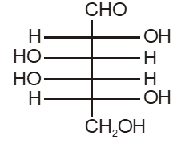
is -
(A) -galactose
(B) -Mannose
(C) -Glucose
(D) L-Fructose
💡 View Step-by-Step Solution & Answer Key
Correct Answer: c
Explanation: D-Glucose
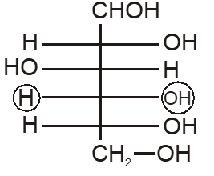 Epimers are diastereomers that contain more than one chiral center but differ from each other in the absolute configuration at only one chiral center.
Question 3 • MCQ
🔥 TS EAMCET (2024)
4 Mark(s)
Which of the following vitamin is also called pyridoxine?
(A) $\mathrm{B}_6$
(B) $\mathrm{B}_{12}$
(C) $\mathrm{B}_2$
(D) $\mathrm{B}_1$
💡 View Step-by-Step Solution & Answer Key
Correct Answer: (a)
Explanation: Vitamin $\mathrm{B}_6$ is also called as pyridoxine.
Vitamin $\mathrm{B}_{12}$ is also called as cyanocobalamin.
Vitamin $B_2$ is also called as Riboflavin.
Vitamin $B_1$ is also called as Thiamine.
Question 4 • MCQ
🔥 COMEDK (2023)
4 Mark(s)
Which of the following hexoses will form the same osazone when treated with excess phenyl hydrazine?
(A) D-glucose, D-fructose and D-galactose
(B) D-glucose, D-fructose and D-mannose
(C) D-glucose, D-mannose and D-galactose
(D) D-fructose, D-mannose and D-galactose
💡 View Step-by-Step Solution & Answer Key
Correct Answer: (b)
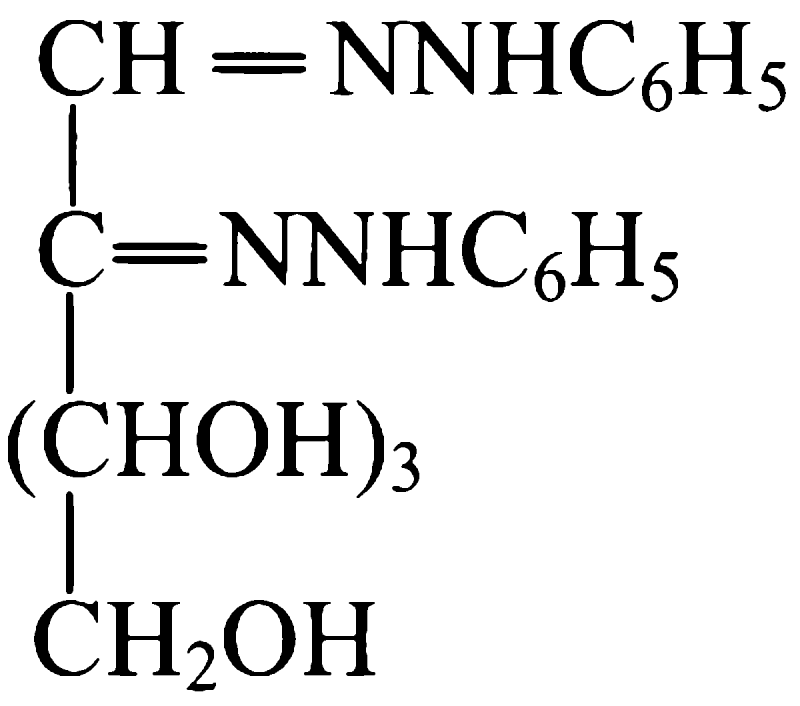
Explanation: D-glucose, D-fructose and D-mannose form the same osazone treated with excess phenyl hydrazine because they differ only Ist and 2nd carbon atoms which are transformed to the same form.
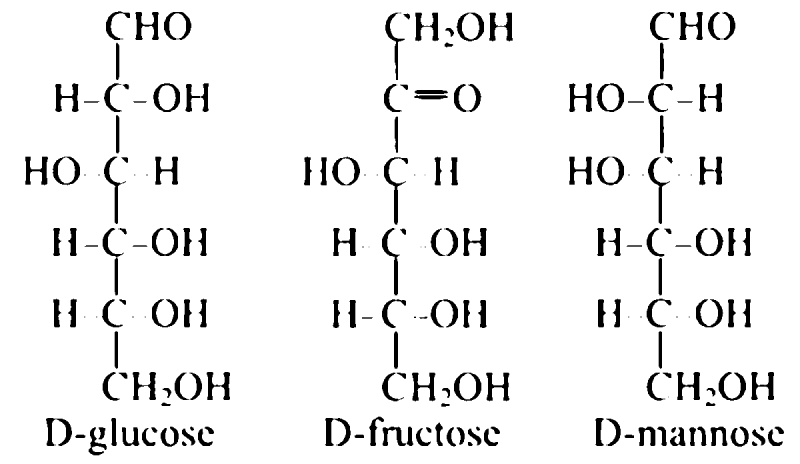
They form same osazone
Question 5 • Numerical
🔥 JEE Main (2026)
4 Mark(s)
A non-volatile, non-electrolyte solid solute when dissolved in 40 g of a solvent, the vapour pressure of the solvent decreased from 760 mm Hg to 750 mm Hg . If the same solution boils at 320 K, then the number of moles of the solvent present in the solution is ______. (Nearest integer)
[Given : boiling point of the pure solvent $=319.5 K, K_{b}$ of the solvent $=0.3\,\text{K}\,\text{kg}\,\text{mol}^{-1}$ ]
💡 View Step-by-Step Solution & Answer Key
Correct Answer: 5
Explanation: $\frac{P^{\circ} - Ps}{Ps} = i.$ molality $\times \;\frac{M.solvent}{1000}$
$\Delta T_b = i . K_b$ . molality $\Rightarrow$ molality $= \frac{0.5}{0.3}$
(Molecular Mass) = $\frac{600}{75} \text{g}$
Moles $= \frac{40}{\frac{600}{75}} = 5$
4. ❓ Frequently Asked Questions (Exam Strategy)
❓ What is the difference between nucleosides and nucleotides?
A nucleoside is composed of a nitrogenous base attached to a pentose sugar, whereas a nucleotide consists of a nucleoside linked to a phosphoric acid group. Nucleotides serve as the monomeric building blocks for nucleic acids.
❓ Why is sucrose called a non-reducing sugar?
Sucrose is a non-reducing sugar because its two monosaccharide units (glucose and fructose) are linked through a glycosidic bond involving their reducing groups (C1 of glucose and C2 of fructose). Consequently, it cannot undergo oxidation by Fehling’s or Tollens' reagents.
❓ What is denaturation of proteins?
Denaturation is the loss of a protein's biological activity due to physical (e.g., heat) or chemical (e.g., pH change) stress which unfolds the secondary and tertiary structures. The primary structure remains intact, but the protein loses its specific 3D shape.
Official Complete Study Package
JEE Main & Advanced High-Yield Chapter Question Bank
Get full digital access to 500+ chapter-wise questions, comprehensive question banks, and authentic exam solutions.
Verified NCERT Curriculum • Instant Digital Access • 100% Satisfaction
💬
Join the Official Study Community for daily question drops & discussion
Join Channel
🎓Explore All QBNEXA Curriculum Hubs
Need more chapters and complete test sets?
Access our complete 12 Lakhs MCQ repository, solved past papers, and error-free test series.
← Back to Home
