
Chemical Bonding explains the formation of stable molecules through electrostatic forces and orbital overlaps, forming the bedrock of inorganic and organic chemistry. It carries high weightage because concepts like VSEPR, Hybridization, and MO Theory are fundamental to predicting molecular geometry and reactivity in advanced JEE topics.
1. 📚 Quick Revision Notes & Core Theory
- Bond Order = 1/2 [Number of bonding electrons (Nb) - Number of antibonding electrons (Na)]
- Formal Charge = [Total valence electrons in free atom] - [Total non-bonding electrons] - 1/2 [Total bonding electrons]
3. 📝 Interactive Chapter DPP & Practice Questions
💡 View Step-by-Step Solution & Answer Key
Correct Answer: d
Explanation: O$_{2}$ < O$_{3}$ < H$_{2}$O$_{2}$ Bond lengths of O – O in O$_{2}$ is 1.21Å , H$_{2}$O$_{2}$ is 1.48Å and O$_{3}$ is 1.28Å. Therefore,correct order of the O – O bond length is H$_{2}$O$_{2}$ > O$_{3}$ > O$_{2}$.
💡 View Step-by-Step Solution & Answer Key
Correct Answer: (c)
Explanation: Concept: VSEPR theory predicts molecular shapes based on lone pairs and bond pairs. Hybridisation corresponds to the steric number (bond pairs + lone pairs). Explanation: For $\mathrm{IF}_3$ : Iodine has 7 valence electrons. Three bonds and two lone pairs give steric number 5. Thus $sp^3d$ hybridisation and T‑shaped geometry. Correct. For $\mathrm{IF}_5$ : Iodine forms five bonds and has one lone pair. Steric number 6 leads to $sp^3d^2$ hybridisation and square pyramidal shape. Correct. For $\mathrm{IF}_7$ : Iodine forms seven bonds and has no lone pair. Steric number 7 gives $sp^3d^3$ hybridisation and pentagonal bipyramidal shape. Correct. For $\mathrm{ClO}_4^-$ : Chlorine has 7 valence electrons plus one negative charge. Four bonds and no lone pair give steric number 4. Hybridisation is $sp^3$ , geometry is tetrahedral, not square planar. Hence D is incorrect. 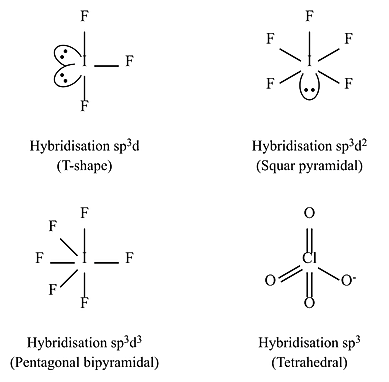 Answer: A, B and C Only (Option C).
💡 View Step-by-Step Solution & Answer Key
Correct Answer: (c)
Explanation: Explanation of Bond Order Calculation **Bond Order (B.O.)** is calculated using the formula: $ \text{Bond Order} = \frac{1}{2} (\text{number of electrons in bonding orbitals} - \text{number of electrons in antibonding orbitals}) $ Let's analyze each set: Set (a): $\mathrm{B}_2, \mathrm{CN}^-, \mathrm{O}_2^{2-}$ **$\mathrm{B}_2$**: $ \text{Number of bonding electrons} = 4, \text{Number of antibonding electrons} = 2 $ $ \text{B.O.} = \frac{1}{2}(4-2) = 1 $ **$\mathrm{CN}^-$**: $ \text{Number of bonding electrons} = 10, \text{Number of antibonding electrons} = 4 $ $ \text{B.O.} = \frac{1}{2}(10-4) = 3 $ **$\mathrm{O}_2^{2-}$**: $ \text{Number of bonding electrons} = 10, \text{Number of antibonding electrons} = 8 $ $ \text{B.O.} = \frac{1}{2}(10-8) = 1 $ Total Bond Order for Set (a): $ 1 + 3 + 1 = 5 $ Set (b): $\mathrm{O}_2, \mathrm{F}_2, \mathrm{O}_2^{2+}$ **$\mathrm{O}_2$**: $ \text{Number of bonding electrons} = 10, \text{Number of antibonding electrons} = 6 $ $ \text{B.O.} = \frac{1}{2}(10-6) = 2 $ **$\mathrm{F}_2$**: $ \text{Number of bonding electrons} = 10, \text{Number of antibonding electrons} = 8 $ $ \text{B.O.} = \frac{1}{2}(10-8) = 1 $ **$\mathrm{O}_2^{2+}$**: $ \text{Number of bonding electrons} = 10, \text{Number of antibonding electrons} = 4 $ $ \text{B.O.} = \frac{1}{2}(10-4) = 3 $ Total Bond Order for Set (b): $ 2 + 1 + 3 = 6 $ Set (c): $\mathrm{O}_2^-, \mathrm{N}_2, \mathrm{O}_2^+$ **$\mathrm{O}_2^-$**: $ \text{Number of bonding electrons} = 10, \text{Number of antibonding electrons} = 7 $ $ \text{B.O.} = \frac{1}{2}(10-7) = 1.5 $ **$\mathrm{N}_2$**: $ \text{Number of bonding electrons} = 10, \text{Number of antibonding electrons} = 4 $ $ \text{B.O.} = \frac{1}{2}(10-4) = 3 $ **$\mathrm{O}_2^+$**: $ \text{Number of bonding electrons} = 10, \text{Number of antibonding electrons} = 5 $ $ \text{B.O.} = \frac{1}{2}(10-5) = 2.5 $ Total Bond Order for Set (c): $ 1.5 + 3 + 2.5 = 7 $ Set (d): $\mathrm{C}_2, \mathrm{O}_2, \mathrm{He}_2^{2+}$ **$\mathrm{C}_2$**: $ \text{Number of bonding electrons} = 8, \text{Number of antibonding electrons} = 4 $ $ \text{B.O.} = \frac{1}{2}(8-4) = 2 $ **$\mathrm{O}_2$**: $ \text{Number of bonding electrons} = 10, \text{Number of antibonding electrons} = 6 $ $ \text{B.O.} = \frac{1}{2}(10-6) = 2 $ **$\mathrm{He}_2^{2+}$**: $ \text{Number of bonding electrons} = 2, \text{Number of antibonding electrons} = 0 $ $ \text{B.O.} = \frac{1}{2}(2-0) = 1 $ Total Bond Order for Set (d): $ 2 + 2 + 1 = 5 $ Conclusion Set (c) has the maximum total bond order sum of $7$.
💡 View Step-by-Step Solution & Answer Key
Correct Answer: d
Explanation: All are correct Hydrogen bonding is a special type of dipole-dipole attraction between molecules, not a covalent bond to a hydrogen atom. It results from the attractive force between a hydrogen atom covalently bonded to a very electronegative atom such as a N, O, or F atom and another very electronegative atom. At high pressure or in the vapor phase, formic acid consists of hydrogen bonded dimers rather than individual molecules.
💡 View Step-by-Step Solution & Answer Key
Correct Answer: (c)
Explanation: As the size of the cation decrease, lattice enthalpy increases. Hence, $\mathrm{BeF}_2$ exhibits the highest lattice enthalpy among the given.
4. ❓ Frequently Asked Questions (Exam Strategy)
❓ Why does H2O have a bent geometry instead of linear?
❓ What is the significance of Hybridization in bonding?
❓ Can a molecule have a fractional bond order?
JEE Main & Advanced High-Yield Chapter Question Bank
Get full digital access to 500+ chapter-wise questions, comprehensive question banks, and authentic exam solutions.
Verified NCERT Curriculum • Instant Digital Access • 100% Satisfaction