
General Organic Chemistry (GOC) serves as the foundational pillar for all subsequent organic units, emphasizing the electronic effects that dictate chemical reactivity. Its high weightage stems from the direct application of resonance, hyperconjugation, and inductive effects in predicting reaction mechanisms and stability in competitive and board assessments.
JEE Main 2027 Engineering Focus: High-Yield Problem Solving & Negative Marking Defense
- Session 1 Registration Timeline: Registration for JEE Main 2027 Session 1 opens in November on jeemain.nta.nic.in. January exam performance sets your prime percentile baseline.
- Negative Marking Safeguard (-1): Eliminate blind guesswork. Prioritize question selection, dimensional checks, and options elimination to maximize net marks.
- Multi-Concept Problem Linkages: JEE questions integrate multiple domains (e.g. Calculus with Mechanics, or Thermodynamics with Equilibrium) into single composite problems.
- Timed Shift PYQ Practice: Solve at least 15-20 recent shift questions (2021-2026) under a strict 2.5-minute timer per numerical/MCQ.
1. 📚 Quick Revision Notes & Core Theory
- Stability of Carbocations: Tertiary > Secondary > Primary > Methyl (Governed by +I effect and hyperconjugation).
- Resonance Energy: Difference in energy between the most stable resonance structure and the resonance hybrid; higher values indicate greater stability.
3. 📝 Interactive Chapter DPP & Practice Questions
💡 View Step-by-Step Solution & Answer Key
Correct Answer: (c)
Explanation: Stability of carbanions A carbanion is a nucleophile, which stability and reactivity determined by several factors. The inductive effect, electronegative atoms adjacent to the charge will stabilise the charge. Hybridisation of the charge-bearing atom The greater the $s$-character of the charge bearing atom, the more stable the anion. The extent of conjugation of the anion Resonance effects can stabilise the anion. This is especially true, when the anion is stabilised as a result of aromaticity. $ \left(\mathrm{C}_6 \mathrm{H}_5\right)_2 \mathrm{CH}^{-}>\mathrm{CH}_2=\mathrm{CH}-\mathrm{CH}_2^{-}>\mathrm{HC} \equiv \mathrm{C}^{-}> $ $ \begin{array}{lll} s p^2 \text { more stable } & \text { Stable due } & \text { More } \quad \mathrm{H}_2 \mathrm{C}=\mathrm{CH}^{-} \\ \text {due to } & \text { to conjugation } & s \text {-character } \\ \text { aromaticity } & \text { of charge } & s p \text {-hybridised } \end{array} $ Therefore, IV $>$ II $>$ I $>$ III Hence, correct option is (c).
💡 View Step-by-Step Solution & Answer Key
Correct Answer: (b)
Explanation: The delocalisation of $\sigma$ electrons of $\mathrm{C}-\mathrm{H}$ bond of an alkyl group linked directly to an atom of unsaturated system or to an atom having unshared $p$-orbital (as in benzene) is observed in hyperconjugation effect. 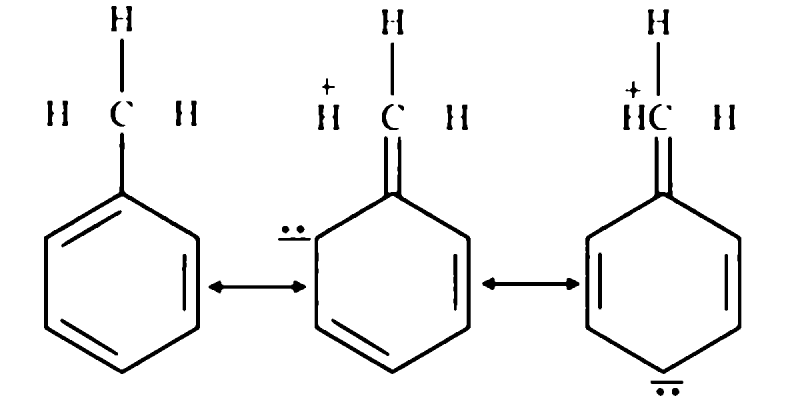 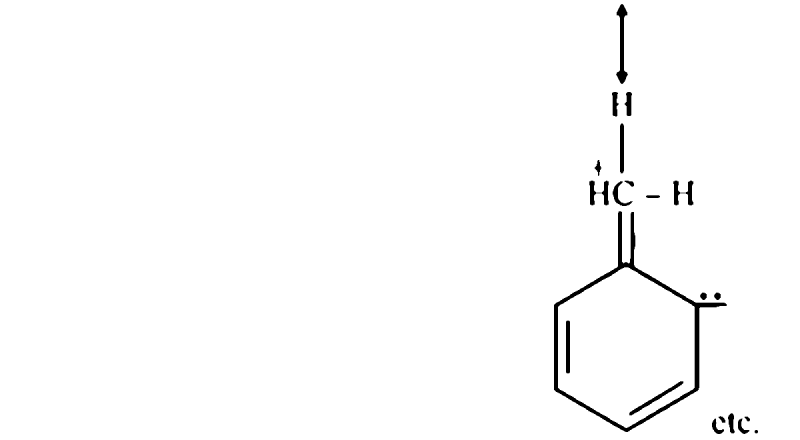
💡 View Step-by-Step Solution & Answer Key
Correct Answer: (d)
Explanation: An alkyl group exerts electron releasing inductive effect ( +I ) which stabilizes positive charge on atom bonded to it. As we move from conjugate acid of ammonia $\left(\mathrm{NH}_4^{+}\right)$to that of tertiary amine $\left(\mathrm{R}_3 \stackrel{+}{\mathrm{N}}-\mathrm{H}\right)$, the number of alkyl groups $(\mathrm{R})$ bonded to nitrogen goes on increasing steadily. This results in increasing stabilization of the positive charge. Order of stabilization: $ \stackrel{+}{\mathrm{N}} \mathrm{H}_4
💡 View Step-by-Step Solution & Answer Key
Correct Answer: (c)
Explanation: ---
💡 View Step-by-Step Solution & Answer Key
Correct Answer: (a)
Explanation: The key to radical stability is how well the unpaired electron can be delocalized. Here’s a quick comparison: Methyl radical, $\dot{\mathrm{C}}\mathrm{H}_3$ (B) – No resonance, only 3 hyperconjugative C–H bonds. Vinyl radical, $\mathrm{CH}_2=\dot{\mathrm{C}}\mathrm{H}$ (D) – Radical on an sp² carbon, very little stabilization. Tertiary radical, $(\mathrm{CH}_3)_3\dot{\mathrm{C}}$ (C) – Hyperconjugation from 9 C–H bonds, moderately stabilized. Diphenylmethyl (benzhydryl) radical, $(\mathrm{C}_6\mathrm{H}_5)_2\dot{\mathrm{C}}\mathrm{H}$ (A) – Unpaired electron is delocalized over two aromatic rings (resonance), giving the greatest stabilization. Because resonance stabilization (especially over two phenyl rings) outweighs hyperconjugation, the most stable radical here is option A.
4. ❓ Frequently Asked Questions (Exam Strategy)
❓ How many questions appear from JEE Main Chemistry: General Organic Chemistry High-Yield Practice Questions, Formulas & PYQ Breakdown (2026-27) in JEE Main Session 1?
❓ What is the best approach to avoid negative marks in JEE Main Chemistry: General Organic Chemistry High-Yield Practice Questions, Formulas & PYQ Breakdown (2026-27)?
❓ How do electronic effects influence the acidic strength of carboxylic acids?
❓ What is the difference between electromeric and resonance effects?
❓ Why is hyperconjugation considered a significant factor in alkene stability?
JEE Main & Advanced High-Yield Chapter Question Bank
Get full digital access to 500+ chapter-wise questions, comprehensive question banks, and authentic exam solutions.
Verified NCERT Curriculum • Instant Digital Access • 100% Satisfaction