
Comprehensive chapter breakdown covering core theoretical principles, foundational laws, and structured step-by-step problem-solving methods strictly aligned with the updated 2026-27 curriculum.
JEE Main 2027 Engineering Focus: High-Yield Problem Solving & Negative Marking Defense
- Session 1 Registration Timeline: Registration for JEE Main 2027 Session 1 opens in November on jeemain.nta.nic.in. January exam performance sets your prime percentile baseline.
- Negative Marking Safeguard (-1): Eliminate blind guesswork. Prioritize question selection, dimensional checks, and options elimination to maximize net marks.
- Multi-Concept Problem Linkages: JEE questions integrate multiple domains (e.g. Calculus with Mechanics, or Thermodynamics with Equilibrium) into single composite problems.
- Timed Shift PYQ Practice: Solve at least 15-20 recent shift questions (2021-2026) under a strict 2.5-minute timer per numerical/MCQ.
1. 📚 Quick Revision Notes & Core Theory
- Primary Governing Equation: Verify dimensions and stoichiometry across both sides.
- Proportionality & Limiting Conditions: Identify critical boundary states and constants.
3. 📝 Interactive Chapter DPP & Practice Questions
💡 View Step-by-Step Solution & Answer Key
Correct Answer: a
Explanation: CH$_{2}$OHCH$_{2}$OH
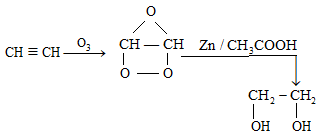 This is reductive ozonolysis of ethyne in which alkyne gets converted to vicinal diols.
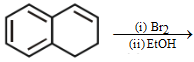
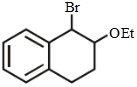

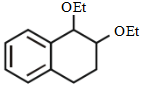
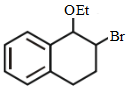
💡 View Step-by-Step Solution & Answer Key
Correct Answer: c
Explanation: 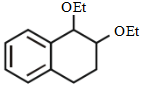 Mechanism :
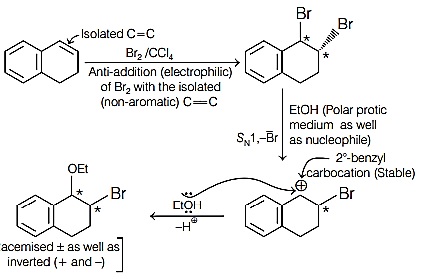
💡 View Step-by-Step Solution & Answer Key
Correct Answer: (b)
Explanation: $CH_3-\overset{\mathrm{CH}_3}{\overset{\vert}{\mathrm{C}}}\mathrm{H}-\overset{\mathrm{CH}_3}{\overset{\vert}{\mathrm{C}}}\mathrm{H}-\mathrm{CH}_3$ Since it contains only two types of $\mathrm{H}$ -atoms hence it will give only two mono chlorinated compounds viz. $\underset{\text{1 - chloro-2,3-dimethyl butane}}{\mathrm{Cl.CH}_2-\overset{\overset{\mathrm{CH}_3}{\overset{\vert}{\mathrm{C}}}}{\mathrm{H}}-\overset{\mathrm{CH}_3}{\overset{\vert}{\mathrm{C}}}\mathrm{H}-\mathrm{CH}_3}$ and $\mathrm{CH}_3-\overset{\mathrm{CH}_3}{\overset{\vert}{\underset{\mathrm{Cl}}{\underset{\vert}{\mathrm{C}}}}}-\overset{\overset{\mathrm{CH}_3}{\overset{\vert}{\mathrm{C}}}}{\mathrm{H}}-\mathrm{CH}_3$ 2 - chloro - 2, 3-dimethyl butane
💡 View Step-by-Step Solution & Answer Key
Correct Answer: (d)
Explanation: When chlorobenzene is heated with 6% solution of NaOH at 623 K and under pressure 300 atm to form sodium phenoxide. Further on acidified with dilute HCl, it will form phenol. 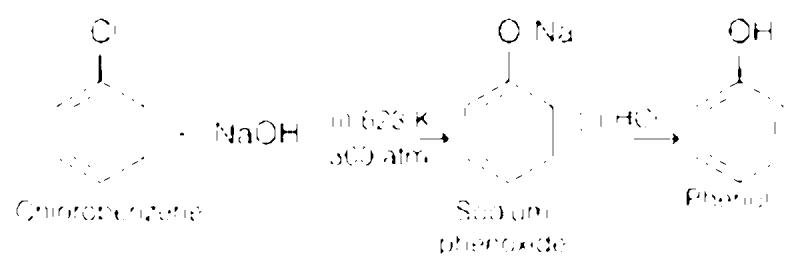
💡 View Step-by-Step Solution & Answer Key
Correct Answer: c
Explanation: methane
Aluminum carbide (Al$_{4}$C$_{3}$), in the form of pale yellow crystals, can be made by heating a mixture of the elements at temperatures above 1000 °C. It reacts with water or dilute acids to form methane.

4. ❓ Frequently Asked Questions (Exam Strategy)
❓ How many questions appear from JEE Main Chemistry: Hydrocarbons High-Yield Practice Questions, Formulas & PYQ Breakdown (2026-27) in JEE Main Session 1?
❓ What is the best approach to avoid negative marks in JEE Main Chemistry: Hydrocarbons High-Yield Practice Questions, Formulas & PYQ Breakdown (2026-27)?
❓ What are the most scoring topics in JEE Main Chemistry: Hydrocarbons High-Yield Practice Questions, Formulas & PYQ Breakdown (2026-27)?
❓ How should I revise JEE Main Chemistry: Hydrocarbons High-Yield Practice Questions, Formulas & PYQ Breakdown (2026-27) for upcoming exams?
❓ Are step-by-step solutions included in this question bank?
JEE Main & Advanced High-Yield Chapter Question Bank
Get full digital access to 500+ chapter-wise questions, comprehensive question banks, and authentic exam solutions.
Verified NCERT Curriculum • Instant Digital Access • 100% Satisfaction