Kinetic Energy is a cornerstone concept in JEE Main Physics, forming the bedrock of the Kinetic Theory of Gases and thermodynamics. Mastering this chapter is absolutely crucial for Target JEE 2027 aspirants, as it frequently features in the exam, testing your understanding of molecular motion, energy distribution, and gas laws. A strong grasp here can significantly boost your overall score and conceptual clarity for advanced topics.This comprehensive PYQ PDF for Kinetic Energy is your ultimate tool to conquer this high-yield chapter for JEE 2027. It provides meticulously solved previous year questions, exposing you to common examiner traps and efficient problem-solving strategies. Dive in to solidify your understanding, enhance your speed, and ensure you're fully prepared to tackle any Kinetic Energy question on exam day.
Kinetic Energy
Q1. Following statements are given
(1) The average kinetic energy of a gas molecule decreases when the temperature is reduced.
(2) The average kinetic energy of a gas molecule increases with increase in pressure at constant temperature.
(3) The average kinetic energy of a gas molecule decreases with increases in volume.
(4) Pressure of a gas increases with increase in temperature at constant volume.
(5) The volume of gas decreases with increase in temperature.
Choose the correct answer from the options given below:
📝 Daily Practice Problem (DPP)🟡 Medium🧠 Applying📌 Kinetic Energy
(A)(1) and (4) only
(B)(1), (2) and (4) only
(C)(2) and (4) only
(D)(1), (2) and (5) only
👉 View Correct Answer & Step-by-Step Solution (Option A)
Correct Option: (A)
(1) and (4) only
$K E_{\text{avg}\&\text{nbsp};} = \frac{3}{2} k_{B} T$
$P \propto T \left(V = \&\text{nbsp};\text{constant}\&\text{nbsp};\right)$
Q2. In a certain region of outer space there are only 100 molecules per
${cm}^3$ on an average. The temperature there is about 3 _K_. What is the average pressure of this very dilute gas?
📝 Daily Practice Problem (DPP)🔴 Advanced🧠 Applying📌 Kinetic Energy
(A)$4.14 \times 10^{-15} {~Pa}$
(B)$1.14 \times 10^{-15} {~Pa}$
(C)$8.28 \times 10^{-14} {~Pa}$
(D)$9.50 \times 10^{-14} {~Pa}$
👉 View Correct Answer & Step-by-Step Solution (Option A)
Correct Option: (A)
$4.14 \times 10^{-15} {~Pa}$
We know that the gas pressure is given as
$P = \frac{1}{3} \rho v_{r m s}^{2}$
Now we can write the density of gas as $\rho = m_{0} \&\text{nbsp}; N$, where $m_{0}$ is the mass of the gas molecule and _N_ is the number of molecules in $1 \text{ } m^{3}$ of the gas.
In the present case, $N = 100 \times 1 0^{6}$
Or $P = \frac{1}{3} \left(100 \times 1 0^{6}\right) m_{0} v_{r m s}^{2}$
As we know _rms_ velocity of gas molecules is given as
$v_{r m s} = \sqrt{\frac{3 R T}{M}} = \sqrt{\frac{3 k T}{m_{0}}} \left[A s M = m_{0} N_{a v} \&\text{nbsp};\&\text{nbsp}; a n d \&\text{nbsp}; \frac{R}{N_{A v}} = k\right]$
So we have
$P = \frac{1}{3} \times \left(100 \times 1 0^{6}\right) \times 3 k T \left(a s \&\text{nbsp}; T = 3 k\right)$
$P = 4.14 \times 1 0^{- 15} \&\text{nbsp}; P a$
Q3. What will be the average value of energy along one degree of freedom for an ideal gas in thermal equilibrium at a temperature _T_ ? (_k$_{B}$_ is Boltzmann constant)
📝 Daily Practice Problem (DPP)🟡 Medium🧠 Understanding📌 Kinetic Energy
(A)$\frac{1}{2}k_BT$
(B)$\frac{2}{3}k_BT$
(C)$\frac{3}{2}k_BT$
(D)$k_BT$
👉 View Correct Answer & Step-by-Step Solution (Option A)
Correct Option: (A)
$\frac{1}{2}k_BT$
Energy associated with each degree of freedom per molecule $\frac{1}{2} k_{B} T$
Q4. Given below are two statements:
Statement I: In a diatomic molecule, the rotational energy at a given temperature obeys Maxwell's distribution.
Statement II : In a diatomic molecule, the rotational energy at a given temperature equals the translational kinetic energy for each molecule.
In the light of the above statements, choose the correct answer from the options given below:
📝 Daily Practice Problem (DPP)🟢 Easy🧠 Understanding📌 Kinetic Energy
(A)oth Statement I and Statement II are true.
(B)oth Statement I and Statement II are false.
(C)Statement I is true but Statement II is false.
(D)Statement I is false but Statement II is true.
👉 View Correct Answer & Step-by-Step Solution (Option C)
Correct Option: (C)
Statement I is true but Statement II is false.
$K_{R} = k T$
$K_{T } = \frac{3}{2} k T$
$K_{T} f o r e a c h m o l e c u l e = \frac{3}{4} k T$
Translational kinetic energy will be equal to rotational kinetic energy corresponds to each degree of freedom
So, statement 1 is true and statement 2 is false
Q5. Number of molecules in a volume of 4 cm$^{3}$ of a perfect monoatomic gas at some temperature T and at a pressure of 2 cm of mercury is close to
(Given, mean kinetic energy of a molecule at T is 4 × 10$^{–14}$ erg, g = 980 cm/s$^{2}$, density of mercury = 13.6 g/cm$^{3}$)
📝 Daily Practice Problem (DPP)🟡 Medium🧠 Applying📌 Kinetic Energy
(A)5.8 × 10$^{16}$
(B)4.0 × 10$^{16}$
(C)4.0 × 10$^{18}$
(D)5.8 × 10$^{18}$
👉 View Correct Answer & Step-by-Step Solution (Option C)
Correct Option: (C)
4.0 × 10$^{18}$
Given, height, h = 2cm
Kinetic energy, U = 4 × 10<$^{–14}$ erg
Density of mercury, ρ = 13.6g / cm<$^{3}$
Volume, V = 4cm<$^{3}$
g = 980 cm/s<$^{2}$
According to gas equation,
pV = NKT ⇒ N = $\frac{p V}{K T}$
For monoatomic gas,
Energy,
$U = \frac{3}{2} K T \Rightarrow K T = \frac{2}{3} U$
Now, $N = \frac{3 p V}{2 U}$
So, $N = \frac{3 g \rho h V}{2 U} \&\text{nbsp};\&\text{nbsp};\&\text{nbsp};\&\text{nbsp};\&\text{nbsp};\&\text{nbsp}; \left(\because Pr e s s u r e , \&\text{nbsp}; p = \rho g h\right) \&\text{nbsp};\&\text{nbsp};\&\text{nbsp};\&\text{nbsp};\&\text{nbsp};\&\text{nbsp};\&\text{nbsp}; \ldots \left(i\right)$
Substituting the given values in equation (i), we get
$N = \frac{3 \times 980 \times 13.6 \times 2 \times 4}{2 \times 4 \times 10^{- 14}} = 3.99 \times 10^{18} \approx 4 \times 10^{18}$
So, correct option is (c).
Q6. The kinetic energy of rotation of diatomic gas at 500K will be (k = 1.38 × 10$^{–23}$Joule/k)
📝 Daily Practice Problem (DPP)🟡 Medium🧠 Evaluating📌 Kinetic Energy
(A)2.02 × 10$^{–21}$ Joule/molecule
(B)6.90 × 10$^{–21}$ Joule/molecule
(C)8.25 × 10$^{–23}$ Joule/molecule
(D)3.98 × 10$^{–23}$ Joule/molecule
👉 View Correct Answer & Step-by-Step Solution (Option B)
Correct Option: (B)
6.90 × 10$^{–21}$ Joule/molecule
$\begin{matrix}A d i a t o m i c g a s m o l e c u l e p o s s e s s e s t w o r o t a t i o n a l d e g r e e s o f \\ f r e e d o m . \\ H e n c e , t o t a l r o t a t i o n a l k i n e t i c e n e r g y \\ = 2 \frac{1}{2} k T = k T \\ = 1.38 10^{ 23} 500 \\ = 690 10^{ 23} J / m o l e c u l e \\ = 6.90 10^{ 21} J / m o l e c u l e\end{matrix}$
Q7. An ideal gas is filled in a container of volume 20 m$^{3}$. If the mean kinetic energy of the gas is 1.5×10$^{3}$ J, then find the pressure in Nm$^{–2}$
📝 Daily Practice Problem (DPP)🟡 Medium🧠 Evaluating📌 Kinetic Energy
👉 View Correct Answer & Step-by-Step Solution (Option D)
Correct Option: (D)
$\begin{matrix}M e a n K i n e t i c E n e r g y = \frac{3}{2} P V \\ 1.5 10^{3} = \frac{3}{2} P \left(20\right) \\ P = \frac{2}{3} \frac{1.5 10^{3}}{20} = 50 N / m^{2}\end{matrix}$
Q8. A closed container of volume 0.8m$^{3}$ contains a mixture of two ideal gases M and N, at a temperature of 327ºC and pressure of 2×10$^{5}$Nm$^{–2}$. The total mass of the mixture is 138 g. If the molar masses of gas M and N are 5 and 4 g per mole, respectively, then find the mass of the gas M in the container.
📝 Daily Practice Problem (DPP)🟡 Medium🧠 Evaluating📌 Kinetic Energy
(A)50g
(B)104g
(C)94g
(D)47g
👉 View Correct Answer & Step-by-Step Solution (Option A)
Q9. The average kinetic energy of a gas at –23 _℃_ and 75 cm pressure is 5×10$^{–14}$ _erg_ for H$_{2}$. The mean kinetic energy of the O$_{2}$ at 227 _℃_ and 150 _cm_ pressure will be
📝 Daily Practice Problem (DPP)🟡 Medium🧠 Applying📌 Kinetic Energy
(A)80 x 10$^{–14}$ _erg_
(B)20 x 10$^{–14}$ _erg_
(C)40 x 10$^{–14}$ _erg_
(D)10 x 10$^{–14}$ _erg_
👉 View Correct Answer & Step-by-Step Solution (Option D)
Correct Option: (D)
10 x 10$^{–14}$ _erg_
$\begin{matrix}\begin{matrix}A v e r a g e k i n e t i c e n e r g y\end{matrix} \\ \begin{matrix}E = \frac{3}{2} k T \frac{E_{1}}{E_{2}} = \frac{T_{1}}{T_{2}} = \frac{\left(273 23\right)}{\left(273 + 227\right)} = \frac{250}{500} = \frac{1}{2}\end{matrix} \\ E_{2} = 2 E_{1} = 2 5 1 0^{ 14} = 10 1 0^{ 14} e r g\end{matrix}$
Q10. CO$_{2}$ (O-C-O) is a triatomic gas. Mean kinetic energy of one gram gas will be (If N-Avogadro’s number, k-Boltzmann’s constant and molecular weight of CO$_{2}$ = 44)
📝 Daily Practice Problem (DPP)🟡 Medium🧠 Evaluating📌 Kinetic Energy
(A)${\displaystyle \left(\frac{3}{88}\right)\mathrm{N}\mathrm{k}\mathrm{T}}$
(B)${\displaystyle \left(\frac{5}{88}\right)\mathrm{N}\mathrm{k}\mathrm{T}}$
(C)${\displaystyle \left(\frac{6}{88}\right)\mathrm{N}\mathrm{k}\mathrm{T}}$
(D)${\displaystyle \left(\frac{7}{88}\right)\mathrm{N}\mathrm{k}\mathrm{T}}$
👉 View Correct Answer & Step-by-Step Solution (Option D)
Correct Option: (D)
${\displaystyle \left(\frac{7}{88}\right)\mathrm{N}\mathrm{k}\mathrm{T}}$
$\begin{matrix}\begin{matrix}\begin{matrix}M e a n k i n e t i c e n e r g y f o r n m o l e g a s = n . \frac{f}{2} R T\end{matrix}\end{matrix} \\ \begin{matrix}\begin{matrix} E = n \frac{7}{2} R T = \left(\frac{m}{M}\right) \frac{7}{2} N k T = \frac{1}{44} \left(\frac{7}{2}\right) N k T\end{matrix}\end{matrix} \\ \begin{matrix}\begin{matrix}= \frac{7}{88} N k T \left[A s f = 7 a n d M = 44 f o r C O_{2}\right]\end{matrix}\end{matrix}\end{matrix}$
Q11. The average kinetic energy of a gas molecule can be determined by knowing
📝 Daily Practice Problem (DPP)🟢 Easy🧠 Understanding📌 Kinetic Energy
(A)the number of molecules in the gas.
(B)the pressure of the gas only.
(C)the temperature of the gas only.
(D)None of the above.
👉 View Correct Answer & Step-by-Step Solution (Option C)
Correct Option: (C)
the temperature of the gas only.
Kinetic energy ∝ Temperature
Q12. The root mean square speed of hydrogen molecules of an ideal hydrogen gas kept in a gas chamber at 0 _℃_ is 3180 _m_/_s_. The pressure on the hydrogen gas is (Density of hydrogen gas is 8.99 × 10$^{–2}$ _kg/m$^{3}$_, 1 atm = 1.01 × 10$^{5}$ _N/m$^{2}$_)
📝 Daily Practice Problem (DPP)🟡 Medium🧠 Evaluating📌 Kinetic Energy
(A)1.0 _atm_
(B)1.5 _atm_
(C)2.0 _atm_
(D)3.0 _atm_
👉 View Correct Answer & Step-by-Step Solution (Option D)
Correct Option: (D)
3.0 _atm_
$v_{r m s} = \sqrt{\frac{3 P}{\rho}} \Rightarrow P = \frac{v_{r m s}^{2} \times \rho}{3} = \frac{\left(3180\right)^{2} \times 8.99 \times 10^{- 2}}{3}$
= 3.03 × 10<$^{5}$ _N__/m_<$^{2}$ = 3 atm.
Q13. The temperature at which the average translational kinetic energy of a molecule is equal to the energy gained by an electron in accelerating from rest through a potential difference of 1 volt is
📝 Daily Practice Problem (DPP)🟡 Medium🧠 Evaluating📌 Kinetic Energy
(A)4.6× 10$^{$^{3}$}$ K
(B)11.6× 10$^{$^{3}$}$ K
(C)23.32× 10$^{$^{3}$}$ K
(D)7.7× 10$^{$^{3}$}$ K
👉 View Correct Answer & Step-by-Step Solution (Option D)
Correct Option: (D)
7.7× 10$^{$^{3}$}$ K
$\begin{matrix}\frac{3}{2} k T = 1 e V T = \frac{2}{3} \frac{e V}{k} = \frac{\frac{2}{3} 1.6 10^{ 19}}{1.38 10^{ 23}} \\ = 7.7 10^{3} K\end{matrix}$
Q14. If masses of all molecules of a gas are halved and their speeds are doubled, then the ratio of initial and final pressures is
📝 Daily Practice Problem (DPP)🟡 Medium🧠 Applying📌 Kinetic Energy
(A)1 : 2
(B)2 : 1
(C)4 :1
(D)1 : 4
👉 View Correct Answer & Step-by-Step Solution (Option A)
Correct Option: (A)
1 : 2
Q15. The kinetic energy of one gram molecule of a gas at normal temperature and pressure is (R = 8.31 _J/mol-K_)
📝 Daily Practice Problem (DPP)🟢 Easy🧠 Applying📌 Kinetic Energy
(A)$^{4}$ _J_
(B)1.3× 10$^{2}$ _J_
(C)2.7× 10$^{2}$ _J_
(D)3.4× 10$^{3}$ _J_
👉 View Correct Answer & Step-by-Step Solution (Option D)
Correct Option: (D)
3.4× 10$^{3}$ _J_
$\begin{matrix}K i n e t i c e n e r g y p e r g m o l e E = \frac{f}{2} R T \\ I f n o t h i n g i s s a i d a b o u t g a s , t h e n w e s h o u l d c a l c u l a t e t h e t r a n s l a t i o n a l \\ k i n e t i c e n e r g y \\ \begin{matrix}i . e . , E_{T r a n s} = \frac{3}{2} R T = \frac{3}{2} 8 .31 \left(273 + 0\right)\end{matrix} \\ \begin{matrix}= 3 . 4 1 0^{3} J\end{matrix}\end{matrix}$
Q16. If r.m.s. velocity of a gas is _V$_{rms}$_ = 1840 _m/s_ and its density ρ = 8.99 × 10$^{–2}$ kg/m$^{3}$, the pressure of the gas will be
📝 Daily Practice Problem (DPP)🟢 Easy🧠 Evaluating📌 Kinetic Energy
(A)1.01 _N_/_m_$^{2}$
(B)1.01 x 10$^{–3}$ _N/m_$^{2}$
(C)1.01 x 10$^{5}$ _N_/_m_$^{2}$
(D)1.01 x 10$^{7}$ _N_/_m_$^{2}$
👉 View Correct Answer & Step-by-Step Solution (Option C)
Correct Option: (C)
1.01 x 10$^{5}$ _N_/_m_$^{2}$
$\Rightarrow P = \frac{\rho V_{r m s}^{2}}{3}$
By substituting the given values, we get
$= \frac{8.99 \times 10^{- 2} \times 1840 \times 1840}{3} = 1.01 \times 1 0^{5} \text{ } N / m^{2}$
Q17. A gas is filled in a closed container and its molecules are moving in horizontal direction with uniform acceleration. Neglecting acceleration due to gravity, the pressure inside the container is
📝 Daily Practice Problem (DPP)🟢 Easy🧠 Understanding📌 Kinetic Energy
(A)uniform everywhere.
(B)less in the front.
(C)less at the back.
(D)less at the top.
👉 View Correct Answer & Step-by-Step Solution (Option A)
Correct Option: (A)
uniform everywhere.
When gas is filled in a closed container, it exerts pressure on the walls of the vessel. According to kinetic theory, this pressure is developed due to the collisions of the moving molecules on the walls of the vessels. Whenever a molecule collides with the wall, it returns with changed momentum, and an equal momentum is transferred to the wall. According to Newton’s law of motion, the rate of change of momentum of the ball is equal to the force exerted on the wall. Since the gas contains many molecules that are colliding with the walls of the vessel, they exert a steady force on the walls. This force measured per unit area gives pressure, which is the same as the molecules are moving in the horizontal direction with constant acceleration.
Q18. A gas mixture consists of molecules of type 1,2 and 3, with molar masses m$_{1}$>m$_{2}$>m$_{3}$. V$_{rms}$ and K.E are the r.m.s. speed and average kinetic energy of the gases. Which of the following is true?
📝 Daily Practice Problem (DPP)🟡 Medium🧠 Applying📌 Kinetic Energy
(A)(V$_{rms}$)$_{1}$ < (V$_{rms}$)$_{2}$ < (V$_{rms}$)$_{3}$ and (K.E)$_{1}$ = (K.E)$_{2}$ = (K.E$_{3}$)
(B)(V$_{rms}$)$_{1}$ = (V$_{rms}$)$_{2}$ ≤ (V$_{rms}$)$_{3}$ and (K.E)$_{1}$ = (K.E)$_{2}$ = (K.E)$_{3}$
(C)(V$_{rms}$)$_{1}$ > (V$_{rms}$)$_{2}$ < (V$_{rms}$)$_{3}$ and (K.E)$_{1}$ < (K.E)$_{2}$ > (K.E$_{3}$)
(D)(V$_{rms}$)$_{1}$ > (V$_{rms}$)$_{2}$ > (V$_{rms}$)$_{3}$ and (K.E)$_{1}$ < (K.E)$_{2}$ > (K.E)$_{3}$
👉 View Correct Answer & Step-by-Step Solution (Option A)
Correct Option: (A)
(V$_{rms}$)$_{1}$ < (V$_{rms}$)$_{2}$ < (V$_{rms}$)$_{3}$ and (K.E)$_{1}$ = (K.E)$_{2}$ = (K.E$_{3}$)
$\begin{matrix}v_{r m s} \frac{1}{\sqrt{M}} \left(v_{r m s}\right)_{1} < \left(v_{r m s}\right)_{2} < \left(v_{r m s}\right)_{3} \\ a l s o i n m i x t u r e t e m p r a t u r e o f e a c h g a s w i l l b e s a m e h e n c e k i n e t i c \\ e n e r g y a l s o r e m a i n s s a m e .\end{matrix}$
Q19. The kinetic energy of translation of 20 _g_ of oxygen at 47 °_C_ is (molecular wt. of oxygen is 32 _g/mol_ and R = 8.3_J/mol/K_)
📝 Daily Practice Problem (DPP)🟡 Medium🧠 Evaluating📌 Kinetic Energy
(A)2490 _joules_
(B)2490 _ergs_
(C)830 _joules_
(D)124.5 _joules_
👉 View Correct Answer & Step-by-Step Solution (Option A)
Correct Option: (A)
2490 _joules_
$\begin{matrix}K i n e t i c E n e r g y \left(K . E\right) = \frac{3}{2} n R T \\ G i v e n , T = 47 ^{} C \\ = 47 + 273 = 320 K \\ N o w , \\ K E = \frac{3}{2} n R T \\ = \frac{3}{2} \left(\frac{m}{M}\right) R T \left( n = \frac{m}{M}\right) \\ = \frac{3}{2} \left(\frac{20}{32}\right) 8.3 320 \\ K E = 2490 J\end{matrix}$
Q20. A sealed container with negligible coefficient of volumetric expansion contains helium (a monoatomic gas). When it is heated from 300 _K_ to 600 _K_, the average _K.E_. of helium atoms is
📝 Daily Practice Problem (DPP)🟢 Easy🧠 Understanding📌 Kinetic Energy
(A)halved.
(B)unchanged.
(C)oubled.
(D)increased by factor 4.
👉 View Correct Answer & Step-by-Step Solution (Option C)
Correct Option: (C)
doubled.
Kinetic energy ∝ Temperature.
Hence if the temperature is doubled, kinetic energy will also be doubled.
Q21. The mean kinetic energy of one mole of gas per degree of freedom (on the basis of kinetic theory of gases) is
📝 Daily Practice Problem (DPP)🟡 Medium🧠 Evaluating📌 Kinetic Energy
(A)${\displaystyle \frac{1}{2}\phantom{\rule{\;}{0ex}}kT}$
(B)${\displaystyle \frac{3}{2}\phantom{\rule{\;}{0ex}}kT}$
(C)${\displaystyle \frac{3}{2}\phantom{\rule{\;}{0ex}}RT}$
(D)${\displaystyle \frac{1}{2}\phantom{\rule{\;}{0ex}}RT}$
👉 View Correct Answer & Step-by-Step Solution (Option D)
Correct Option: (D)
${\displaystyle \frac{1}{2}\phantom{\rule{\;}{0ex}}RT}$
$\begin{matrix}T h e m a i n k i n e t i c e n e r g y o f o n e m o l e o f g a s n d e g r e e o f f r e e d o m \\ E = \frac{n}{2} R T \\ T h e m e a n k i n e t i c e n e r g y o f o n e m o l e o f g a s p e r d e g r e e o f f r e e d o m \\ E^{'} = \frac{E}{n} = \frac{\frac{n}{2} R T}{n} \\ E^{'} = \frac{1}{2} R T\end{matrix}$
Q22. Calculate the total number of collisions between molecules in 1.00 s in 1.00 L of nitrogen gas at standard temperature and pressure (0 °C, 1.00 atm). Use 1.88 × 10$^{-10}$ m as the effective radius of a nitrogen molecule. (The number of collisions per second is the reciprocal of the collision time). Keep in mind that each collision involves two molecules, so if one molecule collides one in a certain period of time, the collision of the molecule it hit cannot be counted.
📝 Daily Practice Problem (DPP)🔴 Advanced🧠 Logical Thinking📌 Kinetic Energy
(A)2.68 × 10$^{22}$
(B)1.11 × 10$^{32}$
(C)8.30 × 10$^{9}$
(D)1.25 × 10$^{9}$
👉 View Correct Answer & Step-by-Step Solution (Option B)
Correct Option: (B)
1.11 × 10$^{32}$
$\begin{matrix}W e h a v e b e e n t o l d t h a t n u m b e r o f c o l l i s i o n s p e r s e c o n d i s t h e r e c i p r o c a l o f \\ t h e c o l l i s i o n t i m e t h e r e f o r e , w e n e e d t o f i n d t h e t i m e o f c o l l i s i o n \\ T \left(T h e m e a n f r e e t i m e\right) . \\ T = \frac{k_{B} T}{4 \sqrt{2} r^{2} P v_{e m s}} \left(M e a n f r e e t i m e l a w\right) \\ T = \frac{k_{B} T}{4 \sqrt{2} r^{2} P v_{r m s}} \\ N o t e t h a t , v_{r m s} = \sqrt{\frac{3 R T}{M}} \\ N o t e t h a t , t h e g i v e n g a s i s t h e n i t r o g e n v_{r m s} = \sqrt{\frac{3 R T}{M_{N_{2}}}} . . . . . \left(2\right) \\ N o t e t h a t , M_{N_{2}} = 2 M_{N} = 2 14.01 = 28.02 g / m o l \\ M_{N_{2}} = 28.02 10^{ 3} k g / m o l \\ P u t t h e v a l u e o f M_{N_{2}} f r o m \left(3\right) i n t o \left(2\right) , \\ v_{r m s} = \sqrt{\frac{3 8.31 273}{28.02 10^{ 3}}} , v_{r m s} = 493 m / s . . . . \left(4\right) \\ P u t t h e v a l u e o f v_{r m s} f r o m \left(4\right) i n t o \left(1\right) , \\ T = \frac{1.38 10^{ 23} 273}{4 \sqrt{2} \left[1.88 10^{ 10}\right]^{2} 1.01 10^{5} 493} , T = 1.205 10^{ 10} s . . . . . \left(5\right) \\ N o w w e c a n f i n d t h e n u m b e r o f c o l l i s i o n s i n 1 .0 s b y g e t t i n g t h e r e c i p r o c a l \\ o f t h e c o l l i s i o n t i m e , \end{matrix}$
$\begin{matrix}N_{c o l l i s i o n s} = \frac{ t}{} = \frac{1.0}{} \\ N_{c o l l i s i o n s} = ^{ 1} = \left[1.205 10^{ 10}\right]^{ 1} \\ N_{c o l l i s i o n s} = 8.30 10^{9} c o l l i s i o n . . . . . \left(6\right) \\ N o t e t h a t , t h e v a l u e o f t h e p r e c e d i n g e q u a t i o n i s t h e n u m b e r o f c o l l i s i o n s f o r \\ o n e m o l e c u l e i n o n e s e c o n d . S o , t o f i n d t h e t o t a l n u m b e r o f c o l l i s i o n s w e n e e d \\ t o f i n d t h e t o t a l n u m b e r o f m o l e c u l e s . \\ T o f i n d t h e n u m b e r o f n i t r o g e n m o l e c u l e s i n 1 .0 L a t t e m p e r a t u r e o f 273 K \\ a n d a p r e s s u r e o f 1.0 a t m , \\ P V = N k_{B} T \left(I d e a l g a s l a w\right) \\ N = \frac{P V}{k_{B} T} \\ N = \frac{1.01 10^{5} 10^{ 3}}{1.38 10^{ 23} 273} \\ N = 2.681 10^{22} m o l e c u l e . . . . . . \left(7\right) \\ N o t e t h a t , e a c h c o l l i s i o n i n v o l v e s t w o m o l e c u l e s \\ w e a r e s u p p o s i n g t h a t e v e r y t w o m o l e c u l e s w i l l c o l l i d e , a n d w e w i l l n e g l e c t t h e \\ c o l l i s i o n s w i t h t h e w a l l s o f t h e c o n t a i n e r . \\ T h e r e f o r e , w e w i l l d i v i d e t h e n u m b e r o f m o l e c u l e s b y 2 . T h i s w i l l g i v e u s t h e \\ n u m b e r o f c o l l i s i o n s s i m u l t a n e o u s l y i n a n i n f i n i t e s i m a l t i m e , W e w i l l m u l t i p l y \\ t h e r e s u l t b y t h e n u m b e r o f c o l l i s i o n s i n o n e s e c o n d \left[e q u a t i o n \left(6\right)\right] . \\ N_{n e t , c o l l i s i o n s} = \frac{N}{2} N_{c o l l i s i o n s} \left(N f r o m \left(7\right) , a n d N_{c o l l i s i o n s } f r o m \left(6\right)\right) \\ N o t e t h a t , e a c h c o l l i s o n i n v o l v e d t w o m o l e c u l e s , t h a t^{'} s w h y w e h a n d t o d i v i d e t h e \\ n u m b e r o f m o l e c u l e s b y 2. \\ N_{n e t , c o l l i s i o n s} = \frac{2.681 10^{22}}{2} 8.30 10^{9} \\ N_{n e t , c o l l i s i o n s} = 1.113 10^{32} C o l l i s i o n s\end{matrix}$
Q23. The temperature of a gas is -68°C . At what temperature will the average kinetic energy of its molecules be twice that of at -68°C ?
📝 Daily Practice Problem (DPP)🟡 Medium🧠 Applying📌 Kinetic Energy
(A)137°C
(B)127°C
(C)100°C
(D)105°C
👉 View Correct Answer & Step-by-Step Solution (Option A)
Correct Option: (A)
137°C
$\begin{matrix}A v e r a g e k i n e t i c t h e o r y o f o n e m o l e c u l e i s E = \frac{3}{2} k T \\ w h e r e i s B o l t z m a n n c o n s t a n t a n d t h e a b s o l u t e t e m p e r a t u r e . \\ G i v e n , T_{1} = 68^{} C = 273 68 = 205 K , \\ E_{1} = E , E_{2} = 2 E \\ \frac{E_{1}}{E_{2}} = \frac{T_{1}}{T_{2}} \\ T_{2} = \frac{T_{1} E_{2}}{E_{1}} \\ T_{2} = \frac{205 2 E}{E} = 410 K\end{matrix}$
$T_{2} = 410 273 = 13 7^{0} C$
Q24. The relation between the gas pressure _P_ and average kinetic energy per unit volume _E_ is
📝 Daily Practice Problem (DPP)🟢 Easy🧠 Understanding📌 Kinetic Energy
(A)$P = \frac{1}{2} E$\frac{7}{2} RT$
(B)70 _K$_{B}$T_
(C)35 _RT_
(D)35 _K$_{B}$T_
👉 View Correct Answer & Step-by-Step Solution (Option D)
Correct Option: (D)
35 _K$_{B}$T_
Degree of freedom(_f_) = 5 + 2(3_N_ – 5)
_f_ = 5 + 2(3 × 2 –1) = 7
energy of one molecule =$\textrm{ }\textrm{ } \frac{f}{2} K_{B} T$
energy of 10 molecules =
Q33. If _n_ is the number density and _d_ is the diameter of the molecule, then the average distance covered by a molecule between two successive collisions (i.e. mean free path) is represented by :
**[JEE Main 2024, 05th April, Second Shift]**
🔥 JEE Main 2024, 05th April, Second Shift🟡 Medium🧠 Applying📌 Kinetic Energy
(A)$\frac{1}{\sqrt{2 n \pi d^2}}$
(B)$\sqrt{2} n \pi d^2$
(C)$\frac{1}{\sqrt{2} n \pi d^2}$
(D)$\frac{1}{\sqrt{2} n^2 \pi^2 d^2}$
👉 View Correct Answer & Step-by-Step Solution (Option C)
Correct Option: (C)
$\frac{1}{\sqrt{2} n \pi d^2}$
n = number of molecule per unit volume
d = diameter of the molecule
$\lambda = \frac{1}{\sqrt{2} \pi \left(\&\text{nbsp}; d\right)^{2} n} \text{ } \text{ } \text{ } \text{ } \text{ } \text{ }$(By Theory)
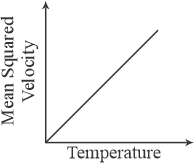
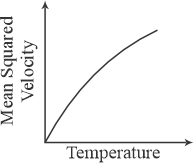
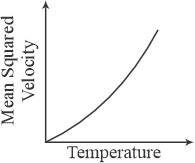
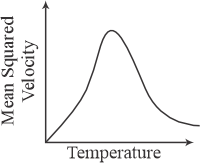
Q34. For a particular ideal gas which of the following graphs represents the variation of mean squared velocity of the gas molecules with temperature?
**[JEE Main 2025, 28th January, First Shift]**
🔥 JEE Main 2025, 28th January, First Shift🟢 Easy🧠 Remembering📌 Kinetic Energy
👉 View Correct Answer & Step-by-Step Solution (Option A)
Correct Option: (A)
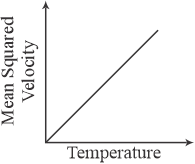
$V_{m s} = \sqrt{\frac{3 R T}{M}}$
$V_{r m s}^{2} = 3 R T / M$
Hence we can conclude that $V_{r m s}^{2}$ is directly proportional to temperature
y = mx
⇒ Graph will be straight line
Q35. A vessel contains a mixture of 1 mole of oxygen and 2 moles of nitrogen at 300 _K_. Find the ratio of average rotational kinetic energies per O$_{2}$ molecule to per N$_{2}$ molecule.
📝 Daily Practice Problem (DPP)🟡 Medium🧠 Applying📌 Kinetic Energy
👉 View Correct Answer & Step-by-Step Solution
Correct Answer: 1
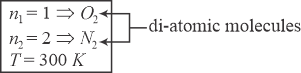
Average rotation kinetic energy per molecule $= \frac{f}{2} k T = \frac{2}{2} k T = k T$
$\frac{\left(K . E\right)_{O_{2}}}{\left(K . E\right)_{N_{2}}} = \frac{k T}{k T} = 1.$
Q36. At what temperature (in degree centigrade), the molecules of a gas have twice the average kinetic energy they have at 20°C ?
📝 Daily Practice Problem (DPP)🟡 Medium🧠 Applying📌 Kinetic Energy
👉 View Correct Answer & Step-by-Step Solution
Correct Answer: 313
_T_<$_{1}$ = 20°_C_ = 273 + 20 = 293 _K_
_$E_{1} = \frac{3}{2} k T_{1} \text{ } a n d \text{ } E_{2} = \frac{3}{2} k T_{2}$_
__E_<$_{2}$ = 2_E_<$_{1}$_
$\frac{3}{2} k T_{2} = 2 \times \frac{3}{2} k T_{1}$
_T_<$_{2}$ = 2_T_<$_{1}$ = 2 × 293 = 586 _K_
_T_<$_{2}$ = 586 – 273 = 313°_C_
Q37. A gas is filled in a container with pressure _P$_{o}$_. If the mass of each molecule is halved and speeds are doubled, then the resulting pressure will be _nP_$_{o}$. Find the value of _n_.
📝 Daily Practice Problem (DPP)🟡 Medium🧠 Applying📌 Kinetic Energy
👉 View Correct Answer & Step-by-Step Solution
Correct Answer: 2
$P_{0} = \frac{m n V_{r m s}^{2}}{3 V}$
$I f \text{ } m^{1} \text{ } = \frac{m}{2} \text{ } \text{ } a n d \text{ } \text{ } V_{r m s}^{1} \text{ } = \text{ } 2 V_{r m s}$
$P^{'} = 2 P 0$
Q38. A flask contains hydrogen and oxygen in the ratio of 2:1 by mass at temperature 27° _C_. The ratio of average kinetic energy per molecule of hydrogen and oxygen respectively is
**[JEE Main 2023, 30th January, Second Shift]**
🔥 JEE Main 2023, 30th January, Second Shift🟡 Medium🧠 Applying📌 Kinetic Energy
(A)1 : 4
(B)4 : 1
(C)2 : 1
(D)1 : 1
👉 View Correct Answer & Step-by-Step Solution (Option D)
Correct Option: (D)
1 : 1
Average kinetic energy per molecule is given as $K_{a v} = \frac{f}{2} k_{B} T$
$\frac{\left(K_{a v}\right)_{H_{2}}}{\left(K_{a v}\right)_{O_{2}}} = \frac{f_{H_{2}}}{f_{O_{2}}}$
Ratio = 1 : 1
Q39. One mole of a diatomic gas undergoes a process
$\;P=\frac{P_0}{1+\left(\dfrac{V}{V_0}\right)^3}$, where are constants. The translational kinetic energy of the gas when is given by
📝 Daily Practice Problem (DPP)🔴 Advanced🧠 Analysing📌 Kinetic Energy
(A)$\frac{5 P_0 V_0}{4}$
(B)$\frac{3 P_0 V_0}{4}$
(C)$\frac{3 P_0 V_0}{2}$
(D)$\frac{5 P_0 V_0}{2}$
👉 View Correct Answer & Step-by-Step Solution (Option B)
Correct Option: (B)
$\frac{3 P_0 V_0}{4}$
$P = \frac{P}{1 + \left(\frac{V}{V_{0}}\right)^{3}} = \frac{P_{0}}{2}$
$T = \frac{P_{0} V_{0}}{2 R}$
Therefore, translational kinetic energy is equal to
$\frac{3}{2} R T = \frac{3 R}{2} \frac{P_{0} V_{0}}{2 R} = \frac{3 P_{0} V_{0}}{4}$
Q40. The average kinetic energy per molecule of helium gas at temperature _T_ is _E_ and the molar gas constant is _R_. Then Avogadro's number is equal to
📝 Daily Practice Problem (DPP)🔴 Advanced🧠 Analysing📌 Kinetic Energy
(A)$\frac{R T}{2 E}$
(B)$\frac{3 R T}{E}$
(C)$\frac{E}{2 R T}$
(D)$\frac{3 R T}{2 E}$
👉 View Correct Answer & Step-by-Step Solution (Option D)
Correct Option: (D)
$\frac{3 R T}{2 E}$
Average kinetic energy per unit molecule $E = \frac{3}{2} k T$
$\therefore k = \frac{2 E}{3 T}$
But Avogadro number $= N_{A} = \frac{R}{k} = \frac{R}{\left(\frac{2 E}{3 T}\right)}$
$\therefore N_{A} = \frac{3 R T}{2 E} .$
Q41. The average kinetic energy of a helium atom at 30℃ is
📝 Daily Practice Problem (DPP)🟢 Easy🧠 Evaluating📌 Kinetic Energy
(A)Less than 1 _eV_
(B)few _keV_
(C)50 – 60 _eV_
(D)13.6 _eV_
👉 View Correct Answer & Step-by-Step Solution (Option A)
Correct Option: (A)
Less than 1 _eV_
= 6.27 × 10<$^{–21}$ _J_
= 0.039 _eV_ < 1 _eV_
Q42. Some gas at 300 _K_ is enclosed in a container. Now, the container is placed on a fast-moving train. While the train is in motion, the temperature of the gas
📝 Daily Practice Problem (DPP)🟢 Easy🧠 Analysing📌 Kinetic Energy
(A)rises above 300 _K_.
(B)falls below 300 _K_.
(C)remains unchanged.
(D)ecomes unsteady.
👉 View Correct Answer & Step-by-Step Solution (Option C)
Correct Option: (C)
remains unchanged.
According to kinetic theory, molecules of a liquid are in a state of continuous random motion. They continuously collide against the walls of the container. During each collision, certain momentum is transferred to the walls of the container. So, kinetic energy of molecules increases, hence due to random motion, the temperature increase. So, random motion of molecules and not ordered motion cause rise of temperature.
Q43. The kinetic energy of translation of the molecules in 75 g of
gas at 17°C is :
📝 Daily Practice Problem (DPP)🟡 Medium🧠 Understanding📌 Kinetic Energy
(A)10279.718 J
(B)14391.605 J
(C)2055.944 J
(D)6167.831 J
👉 View Correct Answer & Step-by-Step Solution (Option D)
Correct Option: (D)
6167.831 J
Given values from the question:
Mass of $\text{CO}_{2}$ = 75 g
Temperature = $17^{\circ}\text{C}$
We will also use the following constants:
Molar mass of $\text{CO}_{2}$ (M) = 44 g/mol
Universal gas constant (R) = 8.314 J/(mol·K)
The formula for the translational kinetic energy of a gas is given by: $ KE_{\text{trans}} = \frac{3}{2} nRT\!$
where 'n' is the number of moles and 'T' is the absolute temperature in Kelvin.
Step 1: Convert the temperature from Celsius to Kelvin.
$T(K)=T(^{\circ}\text{C})+273.15=17+273.15=290.15\!$
Step 2: Calculate the number of moles (n) of $\text{CO}_{2}$.
Using the formula for 1.705: $n=\frac{\text{Given Mass}}{\text{Molar Mass}}=\frac{75}{44}=1.705\!$
The number of moles is 1.705.
Step 3: Calculate the translational kinetic energy.
Now, substitute all the values into the kinetic energy formula :
$KE_{\text{trans}}=\frac{3}{2}\ \times\ 1.705\ \times\ 8.314\ \times\ 290.15=6167.831\ J\!$
The calculated translational kinetic energy is 6167.831 J.
Q44. The temperature at which the kinetic energy of oxygen molecules becomes double than its value at
C is :
📝 Daily Practice Problem (DPP)🟡 Medium🧠 Applying📌 Kinetic Energy
(A)$861^{\circ} C$861 ^{\circ} C$
(B)$315^{\circ} C$315 ^{\circ} C$
(C)$438^{\circ} C$438 ^{\circ} C$
(D)$215^{\circ} C$215 ^{\circ} C$
👉 View Correct Answer & Step-by-Step Solution (Option B)
Correct Option: (B)
$315 ^{\circ} C$
The average kinetic energy (KE) of gas molecules is directly proportional to the absolute temperature in Kelvin.
i.e. $ KE \propto T\!$
This means that to double the kinetic energy, the absolute temperature must also be doubled.
Given the initial temperature:
$T_{initial}=21^{\circ}\text{C}\!$
Step 1: Convert the initial temperature from Celsius to Kelvin.
Using : $T(K)=T(^{\circ}\text{C})+273\!$
$\Rightarrow T_{initial}(K)=21+273=294\ \!$
The initial temperature is 294 K.
Step 2: Calculate the final absolute temperature required to double the kinetic energy.
$\Rightarrow T_{final}(K)=2\ \times\ 294=588\!$
The final temperature in Kelvin is 588 K.
Step 3: Convert the final temperature from Kelvin back to Celsius.
$\Rightarrow T(^{\circ}\text{C})=T(K)-273=588-273=315\!$
The final temperature in Celsius is $315 ^{\circ} C$ .
Q45. The average kinetic energy of a monoatomic molecule is 0.429 eV at temperature : (Use
📝 Daily Practice Problem (DPP)🟢 Easy🧠 Applying📌 Kinetic Energy
(A)$1657.971 \&\text{nbsp}; \&\text{nbsp};\text{K}$1657.971\ \text{ K}\!$
(B)$828.986 \&\text{nbsp}; \&\text{nbsp};\text{K}$828.986\ \text{ K}\!$
(C)$3315.942 \&\text{nbsp}; \&\text{nbsp};\text{K}$3315.942\ \text{ K}\!$
(D)$13263.768 \&\text{nbsp}; \&\text{nbsp};\text{K}$13263.768\ \text{ K}\!$
👉 View Correct Answer & Step-by-Step Solution (Option C)
Correct Option: (C)
$3315.942\ \text{ K}\!$
Given values:
$E=0.429\text{ eV}=0.429\ \times\ 1.6\ \times\ 10^{-19}\text{ J}\!$
$K_B=1.38\ \times\ 10^{-23}\text{ J/K}\!$
The formula for the average kinetic energy of a monoatomic molecule is: $ E = \frac{3}{2} K_B T\!$
Now, rearrange the kinetic energy formula to solve for the temperature (T):
$\Rightarrow T=\frac{2E}{3K_B}=\frac{2\ \times\ \left(0.429\ \times\ 1.6\ \times\ 10^{-19}\right)\ }{3\ \times\ 1.38\ \times\ 10^{-23}}\!$
$\Rightarrow T=3315.942\ \text{ K}\!$
Therefore, the temperature is 3315.942 K.
Q46. A gaseous mixture consists of 2 moles of oxygen and 4 moles of neon at temperature T. Neglecting all vibrational modes, the total internal energy of the system will be
**[JEE Main 2023, 10th April, Second Shift]**
🔥 JEE Main 2023, 10th April, Second Shift🟡 Medium🧠 Applying📌 Kinetic Energy
(A)16RT
(B)8RT
(C)11RT
(D)4RT
👉 View Correct Answer & Step-by-Step Solution (Option C)
Correct Option: (C)
11RT
$U = n_{1} C_{v 1} T + n_{2} C_{v 2} T$
$= \frac{R}{\gamma_{1} - 1} T + \frac{4 R}{\gamma_{2} - 1} T$
$= \frac{2 R}{\frac{7}{5} - 1} T + \frac{4 R}{\frac{5}{3} - 1} T$
$= R T \left[5 + 6\right]$
$U = 11 R T$
Q47. A flask contains Hydrogen and Argon in the ratio 2 : 1 by mass. The temperature of the mixture is
$\;30^{\circ} C$. The ratio of average kinetic energy per molecule of the two gases ( _K_ argon / _K_ hydrogen) is :
(Given : Atomic Weigth of _Ar_ = 39.9 )
**[JEE Main 2023, 15th April, First Shift]**
🔥 JEE Main 2023, 15th April, First Shift🟡 Medium🧠 Applying📌 Kinetic Energy
(A)1
(B)2
(C)39.9
(D)$\frac{39.9}{2}$
👉 View Correct Answer & Step-by-Step Solution (Option A)
Correct Option: (A)
$K E = \frac{1}{2} m V_{a v g}^{2}$
$k E = \frac{1}{2} m \left(\sqrt{\frac{8 R T}{\pi m}}\right)^{2}$
$k E = \frac{4 R T}{\pi}$
$k E = \frac{4 R T}{\pi}$only depends on temperature.
$\frac{K E_{H_{2}}}{K E_{A r}} = 1$
Q48. Three vessels of equal volume contain gases at the same temperature and pressure. The first vessel contain neon (monoatomic), the second contains chlorine (diatomic) and third contains uranium hexafloride (polyatomic). Arrange these on the basis of their root mean square
$\;V_{rms}\;$and choose the correct answer from the options given below :
**[JEE Main 2023, 11th April, First Shift]**
🔥 JEE Main 2023, 11th April, First Shift🟡 Medium🧠 Applying📌 Kinetic Energy
(A)$V _{ ms }( {\rm dia} )< V _{ rms }( {\rm poly} )< V _{ mms }({\rm mono} )$
(B)$V _{ ms }( {\rm mono} )= V _{ rms }( {\rm dia} )= V _{ rms }({\rm poly })$
(C)$V _{ rms }({\rm mono })> V _{ rms }({\rm dia })> V _{ rms } ({\rm poly})$
(D)$V _{ ms }({\rm mono })< V _{{rms }}({\rm dia })< V _{ {rms }}({\rm poly })$
👉 View Correct Answer & Step-by-Step Solution (Option C)
Correct Option: (C)
$V _{ rms }({\rm mono })> V _{ rms }({\rm dia })> V _{ rms } ({\rm poly})$
$V_{r m s \text{ }} \alpha \frac{1}{\sqrt{M}}$
$M_{P o l y a t o m i c} > M_{D i a t o m i c} > M_{m o n o a t o m i c}$
$\Rightarrow V_{r m s \left(m o n o\right)} > V_{r m s \left(D i a\right)} > V_{r m s \left(p o l y\right)}$
Q49. The kinetic energy of one mole gas at 300 _K_ temperature, is _E_ and at 400 _K_ temperature kinetic energy is
$E{\rq}$. The value of is
📝 Daily Practice Problem (DPP)🟡 Medium🧠 Applying📌 Kinetic Energy
(A)1.33
(B)2
(C)$\sqrt{\left(\frac{4}{3}\right)}$
(D)$\frac{16}{9}$
👉 View Correct Answer & Step-by-Step Solution (Option A)
Correct Option: (A)
1.33
The kinetic energy of gas, $E = \frac{3}{2} n R T \Rightarrow E \propto T$
$\therefore \frac{E ^{'}}{E} = \frac{T ^{'}}{T} = \frac{400}{300}$
$\Rightarrow \frac{E ^{'}}{E} = \frac{4}{3} = 1.33$
Q50. The pressure _P_ of an ideal gas and its kinetic energy _E_ per unit volume are related as
📝 Daily Practice Problem (DPP)🟢 Easy🧠 Applying📌 Kinetic Energy
(A)${P}=\frac{1}{2} {E}$
(B)_P_ = _E_
(C)$P=\frac{3}{5} E$
(D)$P=\frac{2}{3} E$
👉 View Correct Answer & Step-by-Step Solution (Option D)
Correct Option: (D)
$P=\frac{2}{3} E$
From Kinetic Theory of Gases.
$K \cdot E = \frac{3}{2} R T$
From the Ideal Gas Equation
_P V_ = _R T_ ( for 1 mole )
Substituting the value of _R T_ from the above equations of the kinetic theory of gases we get,
$\frac{K \cdot E}{V} = \frac{3}{2} P$
$\Rightarrow P = \frac{2}{3} \left(\frac{K \cdot E}{V}\right) = \frac{2}{3} E$
Q51. One mole of an ideal gas at STP is heated in an insulated closed container until the average speed of its molecules is doubled. Its pressure would therefore increase by factor.
📝 Daily Practice Problem (DPP)🟡 Medium🧠 Applying📌 Kinetic Energy
(A)1.5
(B)$\sqrt{2}$
(C)2
(D)4
👉 View Correct Answer & Step-by-Step Solution (Option D)
Correct Option: (D)
4
$v_{\text{avg}\&\text{nbsp};} \propto \sqrt{T}$
$\frac{\left(V_{\text{avg}\&\text{nbsp};}\right)_{2}}{\left(V_{\text{avg}\&\text{nbsp};}\right)_{1}} = \sqrt{\frac{T_{2}}{T_{1}}}$
$\frac{2 \cdot \left(V_{\text{avg}\&\text{nbsp};}\right)_{1}}{\left(V_{\text{avg}\&\text{nbsp};}\right)_{1}} = \sqrt{\frac{T_{2}}{T_{1}}}$
$2 = \sqrt{\frac{T_{2}}{T_{1}}}$
$\Rightarrow T_{2} = 4 T_{1}$
From _P V_ = _n R T_
Closed container ⇒ V = Constant
_P_ ∝ _T_
$\frac{P_{2}}{P_{1}} = \frac{T_{2}}{T_{1}}$
$P_{2} = P_{1} \left(\frac{T_{2}}{T_{1}}\right) = P_{1} \left(\frac{4 T_{1}}{T_{1}}\right)$
$P_{2} = 4 P_{1}$
Q52. The mean free path of molecules of a certain gas at STP is 1500d, where d is the diameter of the gas molecules, while maintaining the standard pressure, the mean free path of the molecules at 373 K is approximately :
**[JEE Main 2023, 13th April, Second Shift]**
🔥 JEE Main 2023, 13th April, Second Shift🟡 Medium🧠 Applying📌 Kinetic Energy
(A)1500 d
(B)2049 d
(C)750 d
(D)1098 d
👉 View Correct Answer & Step-by-Step Solution (Option B)
Correct Option: (B)
2049 d
Mean Free path $\left(\overset{ˉ}{\lambda}\right) = \frac{1}{\sqrt{2} \pi n d^{2}} = \frac{K_{B} T}{\sqrt{2} \pi d^{2} P}$
Clearly $\overset{ˉ}{\lambda} \propto T$
$\frac{\overset{\overline}{\lambda^{'}}}{\overset{ˉ}{\lambda}} = \frac{373}{273}$
$\overset{ˉ}{\lambda} ^{'} = \frac{373}{273} \times \overset{ˉ}{\lambda} = \frac{373}{273} \times 1500 \textrm{ }\textrm{ } d = 2049.45 \textrm{ }\textrm{ } d$
Q53. If the r. m. s speed of chlorine molecule is
$\;490\; m / s\; at \;27^{\circ} C$, the r.m.s speed of argon molecules at the same temperature will be (Atomic mass of argon =39.9 u, molecular mass of chlorine = 70.9 u)
**[JEE Main 2023, 12th April, First Shift]**
🔥 JEE Main 2023, 12th April, First Shift🟡 Medium🧠 Applying📌 Kinetic Energy
(A)751.7 m/s
(B)551.7 m/s
(C)651.7 m/s
(D)451.7 m/s
👉 View Correct Answer & Step-by-Step Solution (Option C)
Correct Option: (C)
651.7 m/s
$V_{r m s} \times \frac{1}{\sqrt{M}}$
$\Rightarrow \frac{V_{\text{rms}\&\text{nbsp};} \&\text{nbsp};\text{of}\&\text{nbsp};\text{Ar}\&\text{nbsp};}{490} = \sqrt{\frac{70.9}{39.9}}$
$\Rightarrow V_{r m s} o f \text{ } A r g o n = 490 \times 1.3 = 651.7 \text{ } m / s$
Q54. The temperature at which the kinetic energy of oxygen molecules becomes double than its value at 27$^{o}$C is.
**[JEE Main 2023, 8th April, Second Shift]**
🔥 JEE Main 2023, 8th April, Second Shift🟡 Medium🧠 Applying📌 Kinetic Energy
(A)627$^{o}$C
(B)927$^{o}$C
(C)1227$^{o}$C
(D)327$^{o}$C
👉 View Correct Answer & Step-by-Step Solution (Option D)
Correct Option: (D)
327$^{o}$C
$\Rightarrow 600 = 273 + t$
$\Rightarrow t = 600 - 273 = 32 7^{\circ} C$
Q55. The temperature of an ideal gas is increased from 200 K to 800 K. If r.m.s. speed of gas at 200K is _v_$_{0}$. Then, r.m.s. speed of the gas at 800 K will be :
**[JEE Main 2023, 6th April, Second Shift]**
🔥 JEE Main 2023, 6th April, Second Shift🟡 Medium🧠 Applying📌 Kinetic Energy
(A)$\frac{ v _0}{4}$
(B)$v _0$
(C)$4 v_0$
(D)$2 v _0$
👉 View Correct Answer & Step-by-Step Solution (Option D)
Correct Option: (D)
$2 v _0$
$v_{r m s} = \sqrt{\frac{3 R T}{M}}$
$\begin{matrix}\frac{v^{'}}{v_{0}} = \sqrt{\frac{800}{200}} = 2 \\ \Rightarrow v^{'} = 2 v_{0}\end{matrix}$
Q56. The number of air molecules per
$\;cm ^3\;$ increased from . The ratio of collision frequency of air molecules before and after the increase in number respectively is:
**[JEE Main 2023, 6th April, First Shift]**
🔥 JEE Main 2023, 6th April, First Shift🟡 Medium🧠 Applying📌 Kinetic Energy
(A)0.25
(B)0.50
(C)0.75
(D)1.25
👉 View Correct Answer & Step-by-Step Solution (Option A)
Correct Option: (A)
0.25
Collision frequency,
$f = \frac{v}{\lambda}$
$\&\text{nbsp};\text{or}\&\text{nbsp}; f = \frac{v}{\left(\frac{1}{\sqrt{2} \pi d^{2} n_{v}}\right)} = \sqrt{2} \pi d^{2} v n_{v}$
$\text{ } \therefore f \propto n_{v} \text{ }$, where $\text{ } n_{v} =$ no. density
or $\text{ } \frac{f_{1}}{f_{2}} = \frac{n_{v_{1}}}{n_{v_{2}}} \Rightarrow \frac{f_{1}}{f_{2}} = \frac{3 \times 1 0^{19}}{12 \times 1 0^{19}} = \frac{1}{4} = 0.25$
Q57. A container is divided into two chambers by a partition . The volume of first chamber is 4.5 litre and second chamber is 5.5 litre. The first chamber contain 3.0 moles of gas at pressure 2.0 _atm_ and second chamber contain 4.0 moles of gas at pressure 3.0 _atm_. After the partition is removed and the mixture attains equilibrium, then, the common equilibrium pressure existing in the mixture is x ×10$^{–1}$ atm. Value of 2x is ______.
📝 Daily Practice Problem (DPP)🟡 Medium🧠 Applying📌 Kinetic Energy
👉 View Correct Answer & Step-by-Step Solution
Q58. The kinetic energy of translation of the molecules in 50 _g_ of
$CO_2$ gas at 17°C is :
**[JEE Main 2025, 28th January, Second Shift]**
🔥 JEE Main 2025, 28th January, Second Shift🟡 Medium🧠 Understanding📌 Kinetic Energy
(A)3986.3 _J_
(B)4102.8 _J_
(C)4205.5 _J_
(D)3582.7 _J_
👉 View Correct Answer & Step-by-Step Solution (Option B)
Correct Option: (B)
4102.8 _J_
$\left(\right. K E \left.\right)_{\text{Translational}\&\text{nbsp};} = \left[\frac{3}{2} K T\right] \times$ no. of molecule
No. of molecule $= \left[\frac{50}{44} \times 6.023 \times 1 0^{23}\right]$
$\left(\right. K E \left.\right)_{\text{Translational}\&\text{nbsp};} = 4108.644 \&\text{nbsp}; J$
Q59. The ratio of vapour densities of two gases at the same temperature is
$\frac{4}{25},$ then the ratio of r.m.s. velocities will be :
**[JEE Main 2025, 28th January, Second Shift]**
🔥 JEE Main 2025, 28th January, Second Shift🟢 Easy🧠 Understanding📌 Kinetic Energy
(A)$\frac{25}{4}$
(B)$\frac{2}{5}$
(C)$\frac{5}{2}$
(D)$\frac{4}{25}$
👉 View Correct Answer & Step-by-Step Solution (Option C)
Correct Option: (C)
$\frac{5}{2}$
$\frac{\rho_{1}}{\rho_{2}} = \frac{4}{25}$
Ratio of rms velocities $= \sqrt{\frac{\rho_{2}}{\rho_{1}}} = \frac{5}{2}$
Q60. The helium and argon are put in the flask at the same room temperature ( 300 _K_). The ratio of average kinetic energies (per molecule) of helium and argon is :
(Give : Molar mass of helium = 4 _g_/mol, Molar mass of argon = 40 _g_/mol)
**[JEE Main 2025, 7th April, Second Shift]**
🔥 JEE Main 2025, 7th April, Second Shift🟡 Medium🧠 Applying📌 Kinetic Energy
(A)1 : 10
(B)10 : 1
(C)$1: \sqrt{10}$
(D)1 : 1
👉 View Correct Answer & Step-by-Step Solution (Option D)
Correct Option: (D)
1 : 1
By the equipartition of energy per molecule
where $k_{B}$ is the Boltzmann's constant.
Hence, for the same given temperature $\left(T = 300 K\right)$
$K . E . \propto f$ (degree of freedom)
For He and Ar _f_ = 3
$\frac{K \cdot E_{H e}}{\text{ } K \cdot E_{A r}} = \frac{1}{1}$
Q61. A box contains _N_ molecules of a perfect gas at temperature
$\;T_1\;$and pressure. The number of molecules in the box is doubled keeping the total kinetic energy of the gas same as before. If the new pressure isand temperature, then
📝 Daily Practice Problem (DPP)🔴 Advanced🧠 Applying📌 Kinetic Energy
(A)$P_2=P_1,\; T_2=T_1$
(B)$P_2=P_1,\; T_2=\frac{T_1}{2}$
(C)$P_2=2 P_1, \;T_2=T_1$
(D)$P_2=2 P_1, \;T_2=\frac{T_1}{2}$
👉 View Correct Answer & Step-by-Step Solution (Option B)
Correct Option: (B)
$P_2=P_1,\; T_2=\frac{T_1}{2}$
$E = \frac{3}{2} N k T$
Initially
$E_{1} = \frac{3}{2} N_{1} k T_{1}$
and finally
$E_{2} = \frac{3}{2} N_{2} k T_{2}$
But according to the problem _E_<$_{1}$ = _E_<$_{2}$ and _N_<$_{2}$ = 2_N_<$_{1}$
$\frac{3}{2} N_{1} k T_{1} = \frac{3}{2} \left(2 N_{1}\right) k T_{2}$
$\Rightarrow T_{2} = \frac{T_{1}}{2}$
Since the kinetic energy is constant
$\frac{3}{2} N_{1} k T_{1} = \frac{3}{2} N_{2} k T$
$\Rightarrow N_{1} T_{2} = N_{2} T_{2}$
⸫ _NT_ = constant
From ideal gas equation of _N_ molecules _PV_ = _NkT_
$\Rightarrow P_{1} V_{1} = P_{2} V_{2}$
$\therefore P_{1} = P_{2}$
(as _V_<$_{1}$ = _V_<$_{2}$ and _NT_ = constant)
Q62. ${O}_2\;$is 16 times heavier that. If at same temperature themolecules have average kinetic energy E than at the same temperature the average kinetic energy ofmolecules will be -
📝 Daily Practice Problem (DPP)🔴 Advanced🧠 Analysing📌 Kinetic Energy
(A)_E_/4
(B)4_E_
(C)_E_
(D)_E_/16
👉 View Correct Answer & Step-by-Step Solution (Option C)
Correct Option: (C)
_E_
As the kinetic energy is given by
$K . E . = \frac{3}{2} k_{B} T ;$
_k<$_{B}$_ = Boltzmann constant
T = Temperature
The kinetic energy per molecule of the gas depends only upon the temperature, therefore kinetic energy will remain the same i.e. _E_.
Q63. The temperature at which the r.m.s velocity of oxygen molecules equal that of nitrogen molecules at
$\;100^{\circ} {C}\;$is nearly :
📝 Daily Practice Problem (DPP)🟢 Easy🧠 Understanding📌 Kinetic Energy
(A)426.3 _K_
(B)456.3 _K_
(C)436.3 _K_
(D)446.3 _K_
👉 View Correct Answer & Step-by-Step Solution (Option A)
Correct Option: (A)
426.3 _K_
Given that _V_<$_{rms}$(_O_<$_{2}$) = _V_<$_{rms}$(_N_<$_{2}$)
$\Rightarrow \sqrt{\frac{3 R T_{1}}{M_{1}}} = \sqrt{\frac{3 R T_{2}}{M_{2}}}$
Where _M_<$_{1}$ is Molar mass of _O_<$_{2}$ = 32 and _M_<$_{2}$ is Molar mass of _N_<$_{2}$ = 28
thus _O_<$_{2}$ is at _T_<$_{1}$ temperature
⇒ _N_<$_{2}$ is at _T_<$_{2}$ = 373 _K_ temperature
$T_{1} = \frac{M_{1}}{M_{2}} \times T_{2}$
$T_{1} = \frac{32}{28} \times 373$
_T_<$_{1}$ = 426.3 _K_
Q64. A gas is filled in a container at pressure
$\;P_0$. If the mass of molecules is halved and their rms speed is doubled, then the resultant pressure will be
📝 Daily Practice Problem (DPP)🟡 Medium🧠 Analysing📌 Kinetic Energy
(A)$P_0$
(B)$4P_0$
(C)$2P_0$
(D)$P_0/2$
👉 View Correct Answer & Step-by-Step Solution (Option C)
Correct Option: (C)
$2P_0$
$P_{0} = \frac{1}{3} \frac{N m}{V} v_{r m s}^{2}$
(_m_ = mass of each molecule, _V_ = volume of the gas)
$\text{Now} , m^{'} = \frac{1}{2} m$
$V_{r m s}^{^{'}} = 2 v_{r m s}$
$P^{'} = \frac{1}{3} \frac{N m . 4 v_{r m s}^{2}}{2 V} = 2. \frac{1}{3} \frac{N m}{V} v_{r m s}^{2} = 2 P_{0}$
Q65. Two monoatomic ideal gas at temperature
$\;T_1\;$andare mixed. There is no loss of energy. If the masses of molecules of the two gases are andand number of their molecules areandrespectively. The temperature of the mixture will be :
📝 Daily Practice Problem (DPP)🟢 Easy🧠 Understanding📌 Kinetic Energy
(A)$\frac{{T}_1+{T}_2}{{n}_1+{n}_2}$
(B)$\frac{{T}_1}{{n}_1}+\frac{{T}_2}{{n}_2}$
(C)$\frac{{n}_2 {~T}_1+{n}_1 {~T}_2}{{n}_1+{n}_2}$
(D)$\frac{n_1 T_1+n_2 T_2}{n_1+n_2}$
👉 View Correct Answer & Step-by-Step Solution (Option D)
Correct Option: (D)
$\frac{n_1 T_1+n_2 T_2}{n_1+n_2}$
Since there is no loss of energy
∴ Sum of change of internal energies must be zero
i.e. ∆_U_<$_{1}$ + ∆_U_<$_{2}$ = 0
$\Rightarrow n_{1} C_{v} \left[T - T_{1}\right] + n_{2} C_{v} \left[T - T_{2}\right] = 0$
$\Rightarrow \left(n_{1} + n_{2}\right) T = n_{1} T_{1} + n_{2} T_{2}$
$\Rightarrow T = \frac{n_{1} T_{1} + n_{2} T_{2}}{n_{1} + n_{2}}$
Q66. A sealed container with negligibie thermal coefficient of expansion contains helium (a monoatomic gas). When it is heated from 300 _K_ to 600 _K_, the average kinetic energy of helium atoms is:
📝 Daily Practice Problem (DPP)🟢 Easy🧠 Remembering📌 Kinetic Energy
(A)halved
(B)left unchanged
(C)doubled
(D)increases by a factor of $\;\sqrt{2}$
👉 View Correct Answer & Step-by-Step Solution (Option C)
Correct Option: (C)
doubled
Q67. When the temperature of a gas is increased:
📝 Daily Practice Problem (DPP)🟡 Medium🧠 Applying📌 Kinetic Energy
(A)its molecular kinetic energy increases
(B)molecular potential energy decreases and molecular kinetic energy also decreases; total energy remaining constant
(C)molecular potential energy increases and molecular kinetic energy decreases; total energy remaining constant
(D)its molecular potential energy increases
👉 View Correct Answer & Step-by-Step Solution (Option A)
Correct Option: (A)
its molecular kinetic energy increases
The internal energy of a gas is totally kinetic and this kinetic energy (translational) for a molecule of a gas is given by $\text{ } K = \frac{3}{2} k T$
Hence,$K \propto T$
As the temperature of the gas is increased, its molecular kinetic energy increases.
Q68. One gram mole of nitrogen occupies
$\;2 \times 10^4 {cc}\;$at a pressure of. The average energy of a nitrogen molecule (in erg) will be: (Avogadro's number)
📝 Daily Practice Problem (DPP)🟡 Medium🧠 Analysing📌 Kinetic Energy
(A)$14 \times 10^{-13}$
(B)$10 \times 10^{-12}$
(C)$10^6$
(D)$2 \times 10^6$
👉 View Correct Answer & Step-by-Step Solution (Option A)
Correct Option: (A)
$14 \times 10^{-13}$
Average KE$\text{ } = \frac{1}{2} m v_{r m s}^{2} = \frac{1}{2} m \cdot \frac{3 P}{\rho}$
$= \frac{1}{2} \frac{M}{N} \times \frac{3 P}{\rho}$
$= \frac{1}{2} \times \frac{28}{6 \times 1 0^{23}} \times \frac{3 \times 1 0^{6}}{\left(\frac{1}{2 \times 1 0^{4}}\right)} = 14 \times 1 0^{- 13} e r g$
Q69. The root-mean square velocity
$\;v_{ {rms }}$, the average velocityand the most probable velocity of the molecules of the gas are in the order
📝 Daily Practice Problem (DPP)🟢 Easy🧠 Remembering📌 Kinetic Energy
(A)$v_{\mathrm{mp}}>v_{\mathrm{av}}>v_{\mathrm{rms}}$
(B)$v_{ {rms }}>v_{ {av }}>v_{ {mp }}$
(C)$v_{\mathrm{av}}>v_{\mathrm{mp}}>v_{\mathrm{rms}}$
(D)$v_{\mathrm{mp}}>v_{\mathrm{rms}}>v_{\mathrm{av}}$
👉 View Correct Answer & Step-by-Step Solution (Option B)
Correct Option: (B)
$v_{ {rms }}>v_{ {av }}>v_{ {mp }}$
$v_{r m s} = \sqrt{\frac{3 k T}{m}} , \text{ } v_{a v} = \sqrt{\frac{8 k T}{m \pi}}$
and$v_{m p} = \sqrt{\frac{2 k T}{m}}$
$\therefore v_{r m s} > v_{a v} > v_{m p}$
Q70. The average kinetic energy of a molecule of the gas is
**[JEE Main 2023, 01st February, First Shift]**
🔥 JEE Main 2023, 01st February, First Shift🟢 Easy🧠 Applying📌 Kinetic Energy
(A)dependent on the nature of the gas
(B)proportional to absolute temperature
(C)proportional to volume
(D)proportional to pressure
👉 View Correct Answer & Step-by-Step Solution (Option B)
Correct Option: (B)
proportional to absolute temperature
Average kinetic energy of a molecule of gas is given as $\frac{f}{2} K_{B} T$ where _f_ is degree of freedom. which is independent of pressure and volume and depend on the absolute temperature
Q71. The root mean square velocity of molecules of gas is
**[JEE Main 2023, 25th January, First Shift]**
🔥 JEE Main 2023, 25th January, First Shift🟢 Easy🧠 Remembering📌 Kinetic Energy
(A)Inversely proportional to square root of temperature $\left( {\sqrt {\frac{1}{T}} } \right)$
(B)Proportional to square of temperature (_T_$^{2}$)
(C)Proportional to square root of temperature $\left( {\sqrt T } \right)$
(D)Proportional to temperature (_T_)
👉 View Correct Answer & Step-by-Step Solution (Option C)
Correct Option: (C)
Proportional to square root of temperature $\left( {\sqrt T } \right)$
$v_{r m s} = \sqrt{\frac{3 R T}{M}}$
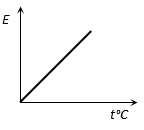
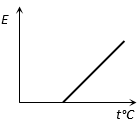
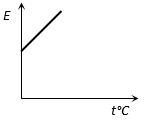
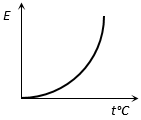
Q72. The graph which represents the variation of mean kinetic energy of molecules with temperature _t_℃ is
📝 Daily Practice Problem (DPP)🟡 Medium🧠 Analysing📌 Kinetic Energy
👉 View Correct Answer & Step-by-Step Solution (Option C)
Correct Option: (C)
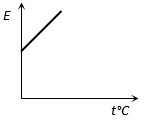
Mean kinetic energy of gas molecule
$E = \frac{f}{2} k T = \frac{f}{2} k \left(t + 273\right) = \left(\frac{f}{2} k\right) t + \frac{f}{2} 273 \text{ } k ;$
Comparing it with standard equation of straight
$l i n e \text{ } \&\text{nbsp}; y = m x + c . \text{ }$
$W e \&\text{nbsp}; g e t \text{ } m = \frac{f}{2} k \text{ } a n d \text{ } c \text{ } = \frac{f}{2} 273 \text{ } k$
So, the graph between and will be straight line with positive intercept on E axis and positive slope with tax is.
Q73. If the root mean square velocity of hydrogen molecule at a given temperature and pressure is 2 _km_/_s_, the root mean square velocity of oxygen at the same condition in _km_/_s_ is :
**[JEE Main 2024, 01st February, Second Shift]**
🔥 JEE Main 2024, 01st February, Second Shift🟡 Medium🧠 Applying📌 Kinetic Energy
👉 View Correct Answer & Step-by-Step Solution (Option C)
Correct Option: (C)
0.5
$V_{R M S} \propto \frac{1}{\sqrt{M}} \Rightarrow \frac{V_{O_{2}}}{V_{H_{2}}} = \sqrt{\frac{M_{H_{2}}}{M_{O_{2}}}} \Rightarrow \frac{V_{O_{2}}}{2} = \sqrt{\frac{2}{32}}$
$\Rightarrow V_{O_{2}} = \frac{2}{4} = 0.5 \&\text{nbsp}; k m / s$
Q74. The parameter that remains the same for molecules of all gases at a given temperature is :
[JEE Main 2024, 31st January, First Shift]
🔥 JEE Main 2024, 31st January, First Shift🟡 Medium🧠 Applying📌 Kinetic Energy
(A)momentum
(B)speed
(C)kinetic energy
(D)mass
👉 View Correct Answer & Step-by-Step Solution (Option C)
Correct Option: (C)
kinetic energy
Q75. At which temperature the r.m.s. velocity of a hydrogen molecule equal to that of an oxygen molecule at 47°C?
**[JEE Main 2024, 30th January, First Shift]**
🔥 JEE Main 2024, 30th January, First Shift🟡 Medium🧠 Applying📌 Kinetic Energy
(A)80 _K_
(B)20 _K_
(C)4 _K_
(D)-73 _K_
👉 View Correct Answer & Step-by-Step Solution (Option B)
Correct Option: (B)
20 _K_
**RMS velocity of a gas molecule is given by:**
****$V_{r m s} = \sqrt{\frac{3 R T}{M}}$
Let the temperature at which the velocity of hydrogen is equal to the velocity of oxygen at $47 \&\text{nbsp}; ° C$ be T
$\sqrt{\frac{3 R T}{2}} = \sqrt{\frac{3 R \left(273 + 47\right)}{32}}$
$\therefore T / 2 = \frac{\left(273 + 47\right)}{32}$
$\Rightarrow T = 20 \&\text{nbsp}; K$
Q76. The total kinetic energy of 1 mole of oxygen at 27°C is: [Use universal gas constant (R) = 8.31 J/mole K]
**[JEE Main 2024, 27th January, Second Shift]**
🔥 JEE Main 2024, 27th January, Second Shift🟡 Medium🧠 Applying📌 Kinetic Energy
(A)6232.5 _J_
(B)5670.5 _J_
(C)5942.0 _J_
(D)6845.5 _J_
👉 View Correct Answer & Step-by-Step Solution (Option A)
Correct Option: (A)
6232.5 _J_
Since Oxygen is diatomic
Kinetic energy $= \frac{5}{2} \text{ } R T$
$= \frac{5}{2} \times 8.31 \times 300$
= 6232.5 _J_
Q77. The average kinetic energy of a monoatomic molecule is 0.414 _eV_ at temperature : (Use
$\;K_B=\left.1.38 \times 10^{-23} {~J} / {mol}-{K}\right)$
**[JEE Main 2024, 27th January, First Shift]**
🔥 JEE Main 2024, 27th January, First Shift🟢 Easy🧠 Applying📌 Kinetic Energy
(A)3000 _K_
(B)3200 _K_
(C)1500 _K_
(D)1600 _K_
👉 View Correct Answer & Step-by-Step Solution (Option B)
Correct Option: (B)
3200 _K_
$E = \frac{3}{2} K_{B} T$
$0.414 \times 1.6 \times 1 0^{- 19} = \frac{3}{2} \times 1.38 \times 1 0^{- 23} T$
$T = 3200 \&\text{nbsp}; K$
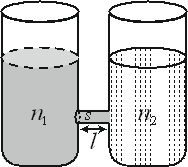
Q78. As shown schematically in the figure, two vessels contain water solutions (at temperature _T_) of potassium permanganate (_KMnO_$_{4}$) of different concentrations _n_$_{1}$ and _n_$_{2}$(_n_$_{1}$ >_n_$_{2}$) molecules per unit volume with Δ_n_ = (_n_$_{1}$ – _n_$_{2}$) << _n_$_{1}$. When they are connected by a tube of small length _l_ and cross-sectional area _S_, _KMnO_$_{4}$ starts to diffuse from the left to the right vessel through the tube. Consider the collection of molecules to behave as dilute ideal gases and the difference in their partial pressure in the two vessels causing the diffusion. The speed v of the molecules is limited by the viscous force –β_v_ on each molecule, where β is a constant. Neglecting all terms of the order (Δ_n_)$^{2}$, which of the following is/are correct? (_k$_{B}$_ is the Boltzmann constant)
**[JEE Adv. 2020]**
🔥 JEE Adv. 2020🟡 Medium🧠 Applying📌 Kinetic Energy
(A)the force causing the molecules to move across the tube is Δnk$_{B}$TS
(B)force balance implies n$_{1}$βvl = Δnk$_{B}$T
(C)total number of molecules going across the tube per sec is $\left( {\frac{{{\rm{\Delta }}n}}{l}} \right)\left( {\frac{{{k_B}T}}{\beta }} \right){\rm{S}}$
(D)rate of molecules getting transferred through the tube does not change with time
👉 View Correct Answer & Step-by-Step Solution (Option A)
Correct Option: (A)
the force causing the molecules to move across the tube is Δnk$_{B}$TS
Correct Answer is:* force balance implies n$_{1}$βvl = Δnk$_{B}$T
Correct Answer is:
total number of molecules going across the tube per sec is $\left( {\frac{{{\rm{\Delta }}n}}{l}} \right)\left( {\frac{{{k_B}T}}{\beta }} \right){\rm{S}}$
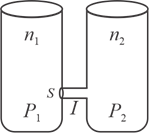
$\therefore P_{1} = n_{1} k_{B} T , P_{2} = n_{2} k_{B} T$
$\therefore \Delta F = \left(P_{1} - P_{2}\right) S$
$= \left(n_{1} - n_{2}\right) k_{B} T S$
$\Delta F = \Delta n_{B} T S$ ...(i)
∴ Balancing of force,
$\beta v \times \left(S I \times n_{1}\right) = \Delta \left(n k\right)_{B} T S$
$\Rightarrow n_{1} \beta v l = \Delta \left(n k\right)_{B} T$ ...(ii)
$\therefore v = \frac{\Delta \left(n k\right)_{B} T}{\beta n_{1} I}$
∴ Number of molecules per second
$\frac{\Delta \mathbf{N}}{\Delta t} = \frac{\left(v d t\right) \times \mathbf{S} \times \mathbf{n}_{1}}{d t}$
$= v S n_{1}$
$= \frac{\Delta \left(n k\right)_{B} T}{\beta n_{1} I} \times \left(\mathbf{S} \mathbf{n}\right)_{1}$
$\frac{\Delta N}{\Delta t} = \left(\frac{\Delta n}{I}\right) \left(\frac{k_{B} T}{\beta}\right) S$ ...(iii)
∴ Δ_n_ decreases with time, so rate of transfer decreases with time.
∴ Answer (A, B, C)
Q79. $\rm { Let \;} \bar{v}, v_{\rm {ms \;}} \rm { \;and\; } v_p\;$respectively denote the mean speed, root mean square speed and most probable speed of the molecules in an ideal monoatomic gas at absolute temperature T. The mass of a molecule is m. Then:–
📝 Daily Practice Problem (DPP)🟡 Medium🧠 Applying📌 Kinetic Energy
(A)No molecule can have energy greater than $\;\sqrt{2} v_{\mathrm{rms}}$
(B)No molecule can have speed less than $\;\frac{v_p}{\sqrt{2}}$
(C)$v_{\mathrm{p}}<\bar{v}<v_{\mathrm{rms}}$
(D)The average kinetic energy of a molecule is $\;\frac{3}{4} m v_p^2$
👉 View Correct Answer & Step-by-Step Solution (Option C)
Correct Option: (C)
$v_{\mathrm{p}}<\bar{v}
Q80. A vessel contains a mixture of one mole of oxygen and two moles of nitrogen at 300 K. The ratio of the average rotational kinetic energy per
$\;O_2\;$molecule to permolecule is :–
📝 Daily Practice Problem (DPP)🟡 Medium🧠 Applying📌 Kinetic Energy
(A)1 : 1
(B)1 : 2
(C)2 : 1
(D)epends on the moment of inertia of the two molecules
👉 View Correct Answer & Step-by-Step Solution (Option A)
Correct Option: (A)
1 : 1
Average rotational KE
$= 2 \times \frac{1}{2} k T$
(for diatomic gas) (f)
Q81. At what temperature is the rms velocity of a hydrogen molecule equal to that of an oxygen molecules at 47° C?
📝 Daily Practice Problem (DPP)🟡 Medium🧠 Applying📌 Kinetic Energy
(A)80 K
(B)–73 K
(C)3 K
(D)20 K
👉 View Correct Answer & Step-by-Step Solution (Option D)
Correct Option: (D)
20 K
$v_{r m s} = \sqrt{\frac{3 R T}{M}}$
Where T is the temperature of the gas molecules in kelvin and M is the molecular mass of the gas
$v_{H_{2}} = v_{O_{2}} \Rightarrow \sqrt{\frac{T_{H_{2}}}{M_{H_{2}}}} = \sqrt{\frac{T_{O_{2}}}{M_{O_{2}}}} \Rightarrow \frac{T_{H_{2}}}{2} = \frac{320}{32}$
$\Rightarrow T_{H_{2}} = 20 \&\text{nbsp}; K$
Q82. Cooking gas containers are kept in a lorry moving with uniform speed. The temperature of the gas molecules inside will-
📝 Daily Practice Problem (DPP)🟡 Medium🧠 Applying📌 Kinetic Energy
(A)increase
(B)ecrease
(C)remains same
(D)ecrease for some, while increase for others
👉 View Correct Answer & Step-by-Step Solution (Option C)
Correct Option: (C)
remains same
The temperature of gas molecules depends on the average kinetic energy associated with the disorderly motion (i.e., random motion) of the gas molecules.
The orderly kinetic energy of the molecules of the gas container will increase in the lorry, whereas disorderly kinetic energy will still remain the same;
hence the temperature of the gas molecules will remain unchanged.
Q83. Let
$\;\overline{\mathrm{v}}, \mathrm{v}_{\mathrm{ms}} \rm { \;and\; } \mathrm{v}_{\mathrm{p}}\;$respectively denote the mean speed, the root–mean–square speed, and the most probable speed of the molecules in an ideal monoatomic gas at absolute temperature T. The mass of a molecule is m:–
📝 Daily Practice Problem (DPP)🟡 Medium🧠 Applying📌 Kinetic Energy
(A)No molecule can have speed greater than $\rm \;\mathrm{V}_{\mathrm{rms}}$
(B)No molecule can have speed less than $\rm \;\frac{v_p}{\sqrt{2}}$
(C)$\rm \mathrm{v}_{\mathrm{p}}<\overline{\mathrm{v}}<\mathrm{v}_{\mathrm{rms}}$
(D)The average kinetic energy of a molecule is $\rm \;\frac{3}{4} \mathrm{mv}_{\mathrm{p}}^2$
👉 View Correct Answer & Step-by-Step Solution (Option C)
Correct Option: (C)
$\rm \mathrm{v}_{\mathrm{p}}<\overline{\mathrm{v}}<\mathrm{v}_{\mathrm{rms}}$
Correct Answer is:
The average kinetic energy of a molecule is$\rm \;\frac{3}{4} \mathrm{mv}_{\mathrm{p}}^2$
$v_{P} = \sqrt{\frac{2 R T}{M}} ; \overset{\overline}{v} = \sqrt{\frac{8 R T}{\pi M}} ; v_{r m s} = \sqrt{\frac{3 R T}{M}}$
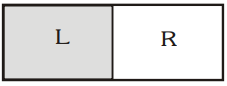
Q84. A vessel is partitioned in two equal halves by a fixed diathermic separator. Two different ideal gases are filled in left (L) and right (R) halves. The rms speed of the molecules in L part is equal to the mean speed of molecules in the R part. Then the ratio of the mass of a molecule in L part to that of a molecule in R part is:–
📝 Daily Practice Problem (DPP)🟡 Medium🧠 Applying📌 Kinetic Energy
(A)$\rm \sqrt{\frac{3}{2}}$
(B)$\rm \sqrt{\pi / 4}$
(C)$\rm \sqrt{2 / 3}$
(D)$\rm 3 \pi / 8$
👉 View Correct Answer & Step-by-Step Solution (Option D)
Correct Option: (D)
$\rm 3 \pi / 8$
$\left(v_{m s}\right)_{L} = \left(v_{\text{avg}\&\text{nbsp};}\right)_{R} \sqrt{\frac{3 R T}{M_{1}}} = \sqrt{\frac{8 R T}{\pi M_{2}}} \Rightarrow \frac{M_{1}}{M_{2}} = \frac{3 \pi}{8}$
Q85. Which of the following is the correct statement of the law of equipartition of energy
📝 Daily Practice Problem (DPP)🟡 Medium🧠 Understanding📌 Kinetic Energy
(A)the total energy of a gas is equally divided among all the molecules.
(B)The gas possess equal energies in all the three directions x,y and z-axis
(C)the total energy of a gas is equally divided between kinetic and potential energies.
(D)the total kinetic energy of a gas molecules is equally divided among translational and rotational kinetic energies
👉 View Correct Answer & Step-by-Step Solution (Option B)
Correct Option: (B)
The gas possess equal energies in all the three directions x,y and z-axis
Q86. In the kinetic theory of gases which of these statements is/are true?
(i) The pressure of a gas is proportional to the mean speed of the molecules.
(ii) The root mean square speed of the molecules is proportional to the pressure
(iii) The rate of diffusion is proportional to the mean speed of the molecules
(iv) The mean translational kinetic energy of a gas is proportional to its temperature in kelvin.
📝 Daily Practice Problem (DPP)🔴 Advanced🧠 Analysing📌 Kinetic Energy
(A)(ii) and (iii) only
(B)(i),(ii) and (iv) only
(C)(i) and (iii) only
(D)(iii) and (iv) only
👉 View Correct Answer & Step-by-Step Solution (Option D)
Correct Option: (D)
(iii) and (iv) only
Q87. A vessel contains 14 _g_ of nitrogen gas at a temperature of 27°C. The amount of heat to be transferred to the gap to double the _r_._m_._s_. speed of its molecules will be :
(Take
$R = 8.32\;J\;mo{l^{ - 1}}{k^{ - 1}}$)
📝 Daily Practice Problem (DPP)🟡 Medium🧠 Applying📌 Kinetic Energy
(A)2229_J_
(B)5616 _J_
(C)9360 _J_
(D)13,104 _J_
👉 View Correct Answer & Step-by-Step Solution (Option C)
Correct Option: (C)
9360 _J_
$\textrm{ }\textrm{ } v_{r m s \textrm{ }\textrm{ }} \propto \sqrt{T}$
$v_{r m s} \propto \sqrt{300 \textrm{ }\textrm{ } K} , v_{r m s_{f}} = 2 v_{r m s_{i}}$
$v_{r m s_{f}} \propto \sqrt{1200 \textrm{ }\textrm{ } K}$
$\textrm{ }\textrm{ } T_{f} = 1200 \textrm{ }\textrm{ } K , \textrm{ }\textrm{ } T_{i} = 300 \textrm{ }\textrm{ } K , n = \frac{14}{28} = \frac{1}{2}$
$Q = n C_{v} \Delta T = \frac{1}{2} \times \frac{5 R}{2} \times 900$
$Q = 9360 \textrm{ }\textrm{ } J$
Q88. A container filled of Nitrogen gas at pressure P$_{$^{0}$}$ = 105 N /m$^{2}$ and temperature 273 K was compressed adiabatically, and its volume become
$\frac{1}{{5}^{th}}$ of original value. Final rotational kinetic energy is approximately n × 10$^{–21}$ J. Find value of ‘n’.(Take ).
📝 Daily Practice Problem (DPP)🟡 Medium🧠 Applying📌 Kinetic Energy
👉 View Correct Answer & Step-by-Step Solution
Correct Answer: 7
In an adiabatic expansion, रुद्धोष्म प्रसार esa
TV$^{g–1}$ = constant नियतांक
$\begin{matrix}\text{T}_{0} \text{V}^{^{\gamma - 1}} = \text{T} \left(\frac{\text{V}}{5}\right)^{\gamma - 1} \\ \therefore \gamma = 1 + \frac{2}{5} \\ \Rightarrow \gamma - 1 = \frac{2}{5} \\ \therefore \textrm{ }\text{T} = \left(273\right) \times \left(5\right)^{\frac{2}{5}} \\ < \left(K E\right)_{rotatonal} > = \text{kT} \\ = 1.38 \times 10^{- 23} \times 273 \times \left(5\right)^{\frac{2}{5}} \\ = 7.158 \times 10^{- 21} \text{J}\textrm{ } = 7 \times 10^{- 21} \text{J} \left(\text{approx}\right) .\end{matrix}$
Q89. A monoatomic gas of mass 4.0 u is kept in an insulated container. The container is moving with a velocity 30 m/s. If the container is suddenly stopped, then a change in temperature of
$\frac{\mathit{x}}{\mathit{3}\mathit{R}}$ is observed in the gas. The value of x is ___________. (R = Gas Constant)
📝 Daily Practice Problem (DPP)🟡 Medium🧠 Applying📌 Kinetic Energy
👉 View Correct Answer & Step-by-Step Solution
Correct Answer: 3600

$k_{i} + u_{i} = k_{f} + u_{f}$
$\frac{1}{2} m_{gas} v^{2} + \frac{f}{2} nRT_{i} = 0 + \frac{f}{2} nRT_{f}$
$\frac{3}{2} nR \left(T_{f} - T_{i}\right) = \frac{1}{2} m_{gas} v^{2}$
$\frac{3}{2} \left(1\right) R \left(ΔT\right) = \frac{1}{2} \left(4\right) \left(30\right)^{2}$
$ΔT = \frac{1200}{R} = \frac{x}{3 R} \Rightarrow x = 3600$
Q90. $\begin{matrix}C o n s i d e r a g a s w i t h d e n s i t y \rho a n d c a s t h e r o o t m e a n s q u a r e v e l o c i t y \\ o f i t s m o l e c u l e s c o n t a i n e d i n a v o l u m e . I f t h e s y s t e m m o v e s a s w h o l e \\ w i t h v e l o c i t y v t h e n t h e p r e s s u r e e x e r t e d b y t h e g a s i s\end{matrix}%%MATHJAX_DISP_0%%1 3 ρ c ¯ 2$
(B)$\frac{1}{3} \rho \left(c + v\right)^{2}%%MATHJAX_DISP_1%%1 3 ρ ( c ¯ − v ) 2$
(D)$\frac{1}{3} \rho \left(c^{- 2} - v\right)^{2}%%MATHJAX_DISP_2%%20 ° C$. Considering only translational and rotational modes. The total internal energy of the system is $xR .%%MATHJAX_DISP_3%%x$
📝 Daily Practice Problem (DPP)🟡 Medium🧠 Applying📌 Kinetic Energy
👉 View Correct Answer & Step-by-Step Solution
Correct Answer: 370
$ΔU = \left(\frac{f_{1}}{2}\right) \left(\eta_{1}\right) \left(R\right) \left(T\right) + \left(\frac{f_{2}}{2}\right) \left(x_{2}\right) \left(R\right) \left(T\right)$
$ΔU = \left(\frac{5}{2}\right) \left(5\right) \left(R\right) \left(20\right) + \left(\frac{3}{2}\right) \left(4\right) \left(R\right) \left(20\right)$
$ΔU = 250 R + 120 R$
$ΔU = 370 R = xR$
$x = 370$
Q94. $\begin{matrix}F i n d t h e a v e r a g e k i n e t i c e n e r g y p e r m o l e c u l e o f a n i d e a l g a s a t \\ 327^{\circ} C \left(k = 1.38 \times 10^{- 23} J / K\right)\end{matrix}%%MATHJAX_DISP_4%%12.20 × 10 − 21 J$
(B)$1.242 \times 10^{- 20} J%%MATHJAX_DISP_5%%4.145 × 10 − 20 J$
(D)$1.19 \times 10^{- 22} J%%MATHJAX_DISP_6%%The average translational energy and the rms speed of molecules in a sample of oxygen gas at 400 K are 4 . 2 × 10 - 21 J and 502 m / s respectively . The corresponding values at 1200 K are nearly ( assuming ideal gas behavior )$
📝 Daily Practice Problem (DPP)🟡 Medium🧠 Applying📌 Kinetic Energy
(A)$12 . 6 \times 1 0^{– 21} J , 668 m / s%%MATHJAX_DISP_7%%12 . 6 × 10 – 21 J , 869 m / s$
(C)$6 . 21 \times 10^{– 21} J , 968 m / s%%MATHJAX_DISP_8%%6 . 21 × 10 – 21 J , 869 m / s$
👉 View Correct Answer & Step-by-Step Solution (Option B)
Correct Option: (B)
$12 . 6 \times 10^{– 21} J , 869 m / s$
$Average translational kinetic energy of a gas molecule , KE_{av} = \frac{3}{2} kT or KE_{av} \propto T$
$\therefore \frac{KE_{av}^{'}}{KE_{av}^{}} = \frac{T_{2}}{T_{1}} = \frac{1200}{400}$
$KE_{av}^{'} = 3 KE_{av} = 3 \times 4 . 2 \times 10^{- 21}$
$= 12 . 6 \times 10^{- 21} J$
$Also v_{rrns} = \sqrt{\frac{3 RT}{M}} or v_{rrns} \propto \sqrt{T}$
$\therefore \frac{v_{rms}^{'}}{v_{rms}} = \sqrt{\frac{1200}{400}}$
$\Rightarrow v_{rms}^{'} = \sqrt{3} v_{rms}$
$= 502 \sqrt{3}$
$= 869 . 464 m / s $
Q96. The time average of the kinetic energy of one molecule of a gas taken over a long period of time
📝 Daily Practice Problem (DPP)🟢 Easy🧠 Applying📌 Kinetic Energy
(A)Is proportional to the square root of the absolute temperature of the gas
(B)Is proportional to the absolute temperature of the gas
(C)Is proportional to the square of the absolute temperature of the gas
(D)oes not depend upon the absolute temperature of the gas
👉 View Correct Answer & Step-by-Step Solution (Option B)
Correct Option: (B)
Is proportional to the absolute temperature of the gas
$E = \frac{3}{2} k T E T$
Q97. $\begin{matrix}A n H C l m o l e c u l e h a s r o t a t i o n a l , v i b r a t i o n a l a n d t r a n s l a t i o n a l \\ m o t i o n s . A s s u m e t h a t m a s s o f H y d r o g e n a t o m i s 7 t i m e s o f \\ B o l t z m a n C o n s t a n t a n d R M S v e l o c i t y o f H C l m o l e c u l e i s \\ 20 m / s , t h e n i t s t e m p e r a t u r e w i l l b e : \left(\right. i n K e l v i n \left.\right)\end{matrix}%%MATHJAX_DISP_9%%T h e a v e r a g e o f N 2 m o l e c u l e a t a t e m p e r a t u r e T i s ( 0.016 e v ) . T h e t r a n s l a t i o n a l k i n e t i c e n e r g y o f H 2 m o l e c u l e a t s a m e t e m p e r a t u r e i s$
📝 Daily Practice Problem (DPP)🟢 Easy🧠 Remembering📌 Kinetic Energy
👉 View Correct Answer & Step-by-Step Solution
Correct Answer: 0.016
0.016
$\begin{matrix}T h e a v e r a g e t r a n s l a t i o n a l k i n e t i c e n e r g y p e r m o l c u l e i s \frac{3}{2} k T . \\ W h i c h d e p e n d o n t e m p e r a t u r e o n l y . T h e r e f o r t r a n s l a t i o n a l k i n e t i c \\ E n e r g y o f N_{2} a n d H_{2} b o t h w e l l b e e q u a l\end{matrix}$
Q99. $\begin{matrix}A n i d e a l g a s o c c u p i e d a v o l u m e 6 c m^{3} a t a p r e s s u r e 9 \times 10^{6} P a . \\ E n e r g y o f g a s i s\end{matrix}$$A n i d e a l g a s o c c u p i e d a v o l u m e 6 c m 3 a t a p r e s s u r e 9 × 10 6 P a . E n e r g y o f g a s i s$
📝 Daily Practice Problem (DPP)🟢 Easy🧠 Applying📌 Kinetic Energy
👉 View Correct Answer & Step-by-Step Solution
Correct Answer: 81 J
81 J
⚡ CBT Online Mock Testing • Target 2027
Attempt Chapter Test in Online CBT Test Series
20-minute timer, negative marking, instant score card, and All-India Rank comparison.
⚡ Start CBT Test
✅ Key Takeaways & Exam Summary
- Kinetic energy is the energy of motion, $KE = \frac{1}{2}mv^2$.
- The average translational kinetic energy of an ideal gas molecule is directly proportional to its absolute temperature ($KE_{avg} = \frac{3}{2} k_B T$).
- The pressure exerted by an ideal gas is related to the average kinetic energy of its molecules and their root mean square (RMS) speed ($P = \frac{1}{3} \rho v_{rms}^2$).
- According to the law of equipartition of energy, each degree of freedom contributes $\frac{1}{2} k_B T$ to the internal energy of a molecule.
- Monoatomic gases have 3 translational degrees of freedom, diatomic gases have 5 (3 translational + 2 rotational) at moderate temperatures.
- RMS speed ($v_{rms}$) is a measure of the typical speed of gas molecules and is given by $\sqrt{\frac{3RT}{M}}$.
- Kinetic energy is independent of the nature of the gas (mass of molecules) and depends only on temperature for a given number of molecules.
- Problems often involve converting units (e.g., erg to Joule, cm of mercury to Pascal).
📺 Official Video Masterclasses on YouTube
Subscribe to @qbnexa_official for step-by-step NCERT video solutions & live sessions.
Subscribe Channel →
🚀 Official WhatsApp Study Community
Join 20,000+ Students & Aspirants
Get daily NCERT flash notes, high-yield formula sheets, DPPs, and exam updates straight on WhatsApp.
👉 Join Free WhatsApp Channel
🏫 For Schools & Coaching Institutes • Target 2027
White-Label Question Banks & Test Papers
Get unbranded, editable Word & PDF question papers and DPPs with your coaching institute's brand logo. Powered by Qbnexa Education.
📞 WhatsApp Us
Frequently Asked Questions (FAQs)
what is kinetic energy and its formula
Kinetic energy is the energy an object possesses due to its motion. Its primary formula is $KE = \frac{1}{2}mv^2$, where 'm' is the mass and 'v' is the velocity. For gas molecules, the average translational kinetic energy is $KE_{avg} = \frac{3}{2} k_B T$, directly proportional to absolute temperature.
how to use the kinetic energy formula
To use the kinetic energy formula, identify the mass (m) and velocity (v) of the object. Substitute these values into $KE = \frac{1}{2}mv^2$. For gas-related problems, use $KE_{avg} = \frac{3}{2} k_B T$ to find average kinetic energy from temperature, or $P = \frac{1}{3} \rho v_{rms}^2$ to relate pressure to molecular motion.
total kinetic energy formula
The total kinetic energy of a system of particles is the sum of the kinetic energies of individual particles. For an ideal gas, the total internal energy (U) is often considered as the total kinetic energy, given by $U = n \frac{f}{2} RT$, where 'n' is moles, 'f' is degrees of freedom, 'R' is gas constant, and 'T' is temperature.
kinetic energy problems with solutions pdf
This document provides a comprehensive PDF of Kinetic Energy Previous Year Questions (PYQs) for JEE Main, complete with detailed step-by-step solutions. It covers various problem types, from conceptual understanding to complex numerical calculations, helping you master the chapter for JEE 2027.
kinetic theory of gases formula sheet jee
Key formulas for Kinetic Theory of Gases in JEE include: $KE_{avg} = \frac{3}{2} k_B T$, $P = \frac{1}{3} \rho v_{rms}^2$, $v_{rms} = \sqrt{\frac{3RT}{M}}$, and the law of equipartition of energy ($E_{DoF} = \frac{1}{2} k_B T$). These are essential for solving problems related to gas pressure, temperature, and molecular speeds.
🎯 Free Student Learning Hub
Boost Your Prep with Free Resources
- High-Resolution Chapter Mindmaps: Visual 1-page summaries for quick recall.
- 10-Year Chapterwise PYQ Banks: Authentic NTA & CBSE questions with step-by-step solutions.
- Formula & Definition Booklets: Curated high-yield cheat sheets.
Explore All Study Modules & Services →
🌐 TeachHire Educational Network Portals
Daily Curated Modules & Question Banks
💬
Daily Notes on WhatsApp: