🚀 JEE Main & Adv 99%ile
•
🎯 Target: 2-3 Questions (~8-12 Marks)
•
⚡ Rating: High Yield (9.0/10)
•
⏱️ Read Time: ~15-20 Mins
Mass Pulley Systems are a cornerstone of mechanics in JEE Main Physics, consistently featuring in the exam and offering high scoring potential for Target JEE 2027 aspirants. This chapter tests your fundamental understanding of Newton's Laws of Motion, free-body diagrams, and force analysis, making it indispensable for a strong performance.
Mastering this topic through authentic Previous Year Questions (PYQs) is crucial for developing both speed and accuracy. This comprehensive PDF provides step-by-step solutions to a variety of Mass Pulley System problems, helping you identify common examiner traps and build the confidence needed to tackle even the most complex questions in JEE Main 2027.

🤖
AI Direct Answer & Quick Concept Summary
Mass pulley systems involve blocks connected by strings over pulleys, used to change the direction of forces or to gain mechanical advantage. Problems typically involve applying Newton's laws of motion and conservation of energy to determine acceleration, tension, or work done, often considering friction and pulley mass for JEE Main 2027.
⚡ High-Yield Exam Rules & Formulas:
- Atwood Machine Acceleration: $a = \frac{(m_2 - m_1)g}{m_1 + m_2}$
- Tension in Atwood Machine: $T = \frac{2m_1 m_2 g}{m_1 + m_2}$
- Newton's Second Law: $\Sigma F = ma$ (applied to each block and pulley)
- Force for variable mass system (constant velocity): $F = v \frac{dm}{dt}$
🎯 DPP & Worksheet Scope: This DPP covers a range of problems including blocks on inclined planes, systems with friction, varying mass scenarios, and calculations of acceleration, tension, and work done, with a focus on JEE Main PYQ patterns.
🎓 JEE - qbnexa • Comprehensive Preparation
What We Offer Students & Aspirants
📝 Worksheets / DPPs: Printable PDF sets with solutions
💻 Online Test Series: Timed CBT chapter mocks & AIR rank
📚 Learning Resources: NCERT line-by-line notes & mindmaps
📱 Daily WhatsApp Updates: Flashcards & daily doubt sessions
📄 Official A4 Sample PDF
Target 2027
Download Official Sample Worksheet (Free Printable A4)
Download the verified official printable sample worksheet with core formulas and answer keys curated by Qbnexa Education.
📂 Free Sample PDF Preview (Google Drive)
🎯 Unlock Full 25-Question Exam Sheet & Complete Teacher Marking Scheme
Get the complete 25+ question OMR sheet with high-res figures, full derivations & step-by-step marking keys.
Mass Pulley Systems
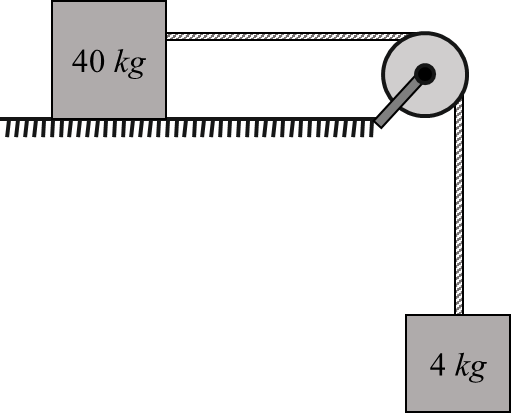
Q1. A block of mass 40 _kg_ slides over a surface, when a mass of 4 _kg_ is suspended through an inextensible massless string passing over frictionless pulley as shown below. The coefficient of kinetic friction between the surface and block is 0.02. The acceleration of block is. (Given _g_ = 10 _ms_$^{–2}$)
📝 Daily Practice Problem (DPP)🟡 Medium🧠 Applying📌 Mass Pulley Systems
(A)1 _ms_$^{-2}$
(B)$\frac{1}{5}m{s^{-2}}$
(C)$\frac{4}{5}m{s^{-2}}$
(D)$\frac{8}{{11}}m{s^{-2}}$
👉 View Correct Answer & Step-by-Step Solution (Option D)
Correct Option: (D)
$\frac{8}{{11}}m{s^{-2}}$
For 4 _kg_ block 4_g_ – _T_ = 4_a_
For 40 _kg_ block _T_ – 40_g_ × 0.02 = 40 _a_
Adding both equations
40 – 8 = 44_a_
$a = \frac{32}{44} = \frac{8}{11} m / s^{2}$
Q2. A light inextensible string that goes over a smooth fixed pulley as shown in the figure connects two blocks of masses 0.48 kg and 0.72 kg. Taking g = 10 m/s$^{2}$, find the work done (in joules) by the string on the block of mass 0.48 kg during the first second after the system is released from rest.
📝 Daily Practice Problem (DPP)🔴 Advanced🧠 Comprehension Skills📌 Mass Pulley Systems
(A)5.76 J
(B)2.33 J
(C)1.46 J
(D)7.34J
👉 View Correct Answer & Step-by-Step Solution (Option A)
Correct Option: (A)
5.76 J
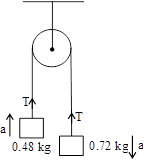
$a = \frac{\left(m_{2} - m_{1}\right) \textrm{ } g}{\left(m_{1} + m_{2}\right)}$
$= \frac{\left(0 .72 - 0 .48\right) g}{\left(0 .72 + 0 .48\right)}$
$a = \frac{g}{5}$
$S = \frac{1}{2} at^{2} = \frac{1}{2} \times \frac{g}{5} \left(1\right)^{2} = \left(\frac{g}{10}\right)^{}$
T = 0.48(g + a)
$ = 0 . 48 \left(g + \frac{g}{5} \right)$
$= \frac{0 .48 \times 6 g}{5}$
T = 5.76 N.
$Work done by tension = 5 . 76 \times \frac{10}{10}$
W = 5.76 J
Q3. Sand is being dropped gently on a conveyor belt at the rate of 0.7 kg/s . The force necessary to keep the belt moving with a constant velocity of 3 m/s will be
📝 Daily Practice Problem (DPP)🟢 Easy🧠 Applying📌 Mass Pulley Systems
(A)6.12 N
(B)0 N
(C)2.1 N
(D)6.3 N
👉 View Correct Answer & Step-by-Step Solution (Option C)
Correct Option: (C)
2.1 N
$F=\frac{d\left(mv\right)}{dt}$
$\Rightarrow F=m\frac{dv}{dt}+v\frac{dm}{dt}$
As velocity is given as 3 m/s and is constant, $\Rightarrow\frac{dv}{dt}=0$
$\Rightarrow F=v\frac{dm}{dt}$
$\Rightarrow F=3\times 0.7$
$\Rightarrow F=$ 2.1 N
Q4. In arrangement, a pulley fixed to the ceiling carries a string with blocks of mass m and 3 m attached to its ends. The masses of string and pulley are negligible. When the system is released, its centre of mass moves with what acceleration?
📝 Daily Practice Problem (DPP)🟡 Medium🧠 Logical Thinking📌 Mass Pulley Systems
(A)0
(B)$\frac{g}{4}$\;\frac{ g }{\sqrt{2}}$, then the ratio of the massesis :
**[JEE Main 2024, 06th April, First Shift]** {{PYQ: [JEE Main 2024, 06th April, First Shift]}} {Meta: TOPIC: Mass Pulley Systems; Difficulty: Medium; Blooms Taxonomy: Applying}
(A)$\frac{\sqrt{2}-1}{\sqrt{2}+1}$
(B)$\frac{1+\sqrt{5}}{\sqrt{5}-1}$
(C)$\frac{1+\sqrt{5}}{\sqrt{2}-1}$
(D)$\frac{\sqrt{3}+1}{\sqrt{2}-1}$
👉 View Correct Answer & Step-by-Step Solution (Option A)
Correct Option: (A)
$\frac{\sqrt{2}-1}{\sqrt{2}+1}$
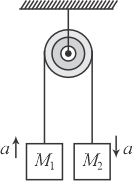
$a = \left(\frac{M_{2} - M_{1}}{M_{1} + M_{2}}\right) g$
$\frac{g}{\sqrt{2}} = \left(\frac{M_{2} - M_{1}}{M_{1} + M_{2}}\right) g$
$\left(M_{1} + M_{2}\right) = \sqrt{2} M_{2} - \sqrt{2} M_{1}$
$\frac{M_{1}}{M_{2}} = \left(\frac{\sqrt{2} - 1}{\sqrt{2} + 1}\right)$
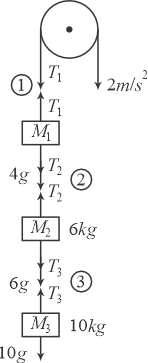
Q14. Three blocks M$_{1}$, M$_{2}$, M$_{3}$ having masses 4 _kg_, 6 _kg_ and 10 _kg_ respectively are hanging from a smooth pully using rope 1, 2 and 3 as shown in figure. The tension in the rope 1, T1 when they are moving upward with acceleration of 2_ms_$^{–2}$ is ............... _N_ (if g = 10 _m_/_s_$^{2}$)
**[JEE Main 2024, 05th April, First Shift]**
🔥 JEE Main 2024, 05th April, First Shift🟡 Medium🧠 Applying📌 Mass Pulley Systems
👉 View Correct Answer & Step-by-Step Solution
Correct Answer: 240
FBD of M$_{1}$ :
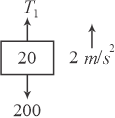
T$_{1}$ – 200 = (4 + 6 + 10) × 2
∴ T$_{1}$ = 240
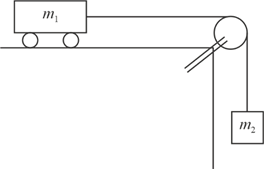
Q15. Consider a block and trolley system as shown in figure. If the coefficient of kinetic friction between the trolley and the surface is 0.04, the acceleration of the system in ms$^{–2}$ is:
(Consider that the string is massless and non stretchable and the pulley is also massless and frictionless):
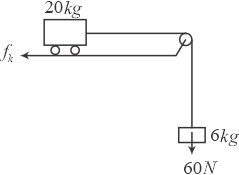
**[JEE Main 2024, 01st February, First Shift]**
🔥 JEE Main 2024, 01st February, First Shift🟡 Medium🧠 Applying📌 Mass Pulley Systems
👉 View Correct Answer & Step-by-Step Solution (Option C)
Q16. All surfaces shown in figure are assumed to be frictionless and all the pulleys and the string are light. The acceleration of the block of mass 2 _kg_ is:
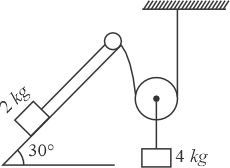
**[JEE Main 2024, 30th January, First Shift]**
🔥 JEE Main 2024, 30th January, First Shift🟡 Medium🧠 Applying📌 Mass Pulley Systems
(A)_g_
(B)$\frac{g}{2}$
(C)$\frac{g}{4}$
(D)$\frac{g}{3}$
👉 View Correct Answer & Step-by-Step Solution (Option D)
Correct Option: (D)
$\frac{g}{3}$
Q17. A light string passing over a smooth light fixed pulley connects two blocks of masses
$\;m_1\mathrm{\; and \;}m_2$. If the acceleration of the system is _g_/8, then the ratio of masses is
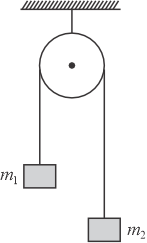
**[JEE Main 2024, 31st January, Second Shift]**
🔥 JEE Main 2024, 31st January, Second Shift🟡 Medium🧠 Applying📌 Mass Pulley Systems
(A)$\frac{9}{7}$
(B)$\frac{8}{1}$
(C)$\frac{5}{3}$
(D)$\frac{4}{3}$
👉 View Correct Answer & Step-by-Step Solution (Option A)
Correct Option: (A)
$\frac{9}{7}$
The acceleration of the pulley is
$a = \left(\frac{m_{1} - m_{2 \&\text{nbsp};}}{m_{1 \&\text{nbsp};} + m_{2 \&\text{nbsp};} \&\text{nbsp};}\right) g$
Q18. Two blocks of masses 2 _kg_ and 1 _kg_ respectively,are tied to the ends of a string which passes over alight friction less pulley as shown in the figure below. The masses are held at rest at the same horizontal level and then released. The distance traversed by the centre of mass in 2 s is ___________ _m_. (Take _g_ = 10 _m_/_s_)
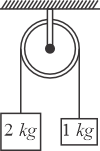
**[JEE Main 2026, 02nd April, Second Shift]**
🔥 JEE Main 2026, 02nd April, Second Shift🟡 Medium🧠 Applying📌 Mass Pulley Systems
(A)3.33
(B)3.12
(C)2.22
(D)1.42
👉 View Correct Answer & Step-by-Step Solution (Option C)
Correct Option: (C)
2.22
$a = \frac{\left(m_{2} - m_{1}\right)}{m_{1} + m_{2}} \&\text{nbsp}; g = \frac{\left(2 - 1\right)}{3} \times 10 = \frac{10}{3} \&\text{nbsp}; m / s^{2}$
$a_{c m} = \frac{\left(1\right) \left(10 / 3\right) - \left(2\right) \left(10 / 3\right)}{3} = \frac{- 10}{9} \&\text{nbsp}; m / s^{2} \left(\downarrow\right)$
$S_{c m} = u_{c m} t + \frac{1}{2} a_{c m} t^{2}$
$= 0 + \frac{1}{2} \left(\frac{10}{9}\right) \left(4\right) = \frac{20}{9} \&\text{nbsp}; m \&\text{nbsp}; \left(\right. d o w n w a r d \left.\right)$
$m$
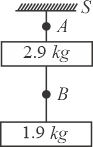
Q19. Two blocks of masses 2.9 _kg_ and 1.9 _kg_ are suspended from a rigid support _S_ by two inextensible wires each of length 1 _m_. The upper wire has negligible mass, and the lower wire has a uniform mass of 0.2 _kg_/_m_. The whole system of block, wire and support have an upward acceleration of 0.2 _m_/_s_$^{2}$. the tension at the mid-point of lower wire is ________. (_g_ = 9.8 _m_/_s_$^{2}$)
📝 Daily Practice Problem (DPP)🟡 Medium🧠 Applying📌 Mass Pulley Systems
(A)10 _N_
(B)20 _N_
(C)30 _N_
(D)50 _N_
👉 View Correct Answer & Step-by-Step Solution (Option B)
Correct Option: (B)
20 _N_
Net mass below point B = (1.9 +(0.20 × 0.5))
_m_ = 2 _kg_
Net tension of _B_: _T$_{B}$_ = (_m_) (_a_ + _g_)
= 2(0.2 + 9.8) = 20 _N_
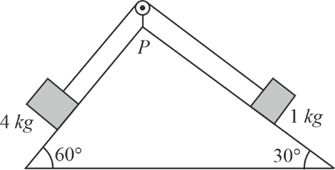
Q20. As per given figure, a weightless pulley _P_ is attached on a double inclined frictionless surface. The tension in the string (massless) will be (if _g_ = 10 _m_/_s_$^{2}$)
**[JEE Main 2023, 24th January, First Shift]**
🔥 JEE Main 2023, 24th January, First Shift🟡 Medium🧠 Applying📌 Mass Pulley Systems
(A)$\left( {4\sqrt 3 + 1} \right)N$
(B)$\left( {4\sqrt 3 - 1} \right)N$
(C)$4\left( {\sqrt 3 - 1} \right)N$
(D)$4\left( {\sqrt 3 + 1} \right)N$
👉 View Correct Answer & Step-by-Step Solution (Option D)
Correct Option: (D)
$4\left( {\sqrt 3 + 1} \right)N$
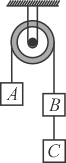
Q21. Three equal weights of mass 2 _kg_ each are hanging on a string passing over a fixed pulley as shown in the figure. What is the tension in the string connecting weights _B_ and _C_?
📝 Daily Practice Problem (DPP)🟡 Medium🧠 Applying📌 Mass Pulley Systems
(A)zero
(B)13 _N_
(C)3.3 _N_
(D)19.6 _N_
👉 View Correct Answer & Step-by-Step Solution (Option B)
Correct Option: (B)
13 _N_
The free body diagram of the system is shown.
For block _A_ : _T_ – _mg_ = _ma_
_T_ – 2_g_ = 2_a_
We get _T_ = 2_a_ + 2_g_
For block _B_ + _C_:
_mg_ + _mg_ – _T_ = (_m_ + _m_)_a_
2_g_ + 2_g_ – _T_ = (2 + 2)_a_
⇒ 4_g_ – _T_ = 4_a_
Or 4_g_ – 2_a_ – 2_g_ = 4_a_
Or 2_g_ = 6_a_
This gives $a = \frac{g}{3}$
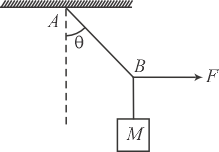
Q22. A mass _M_ is suspended by a rope from a rigid support at _A_ as shown in figure. Another rope is tied at the end _B_, and it is pulled horizontally with a force _F_. If the rope _AB_ makes an angle θ with the vertical in equilibrium, then the tension in the string _AB_ is:
📝 Daily Practice Problem (DPP)🟡 Medium🧠 Applying📌 Mass Pulley Systems
(A)$F \sin \theta$
(B)$F/ \sin \theta$
(C)$F \cos \theta$
(D)$F / \cos \theta$
👉 View Correct Answer & Step-by-Step Solution (Option B)
Correct Option: (B)
$F/ \sin \theta$
Resolving T vertically and horizontally,
We have
_T_ cosθ = _Mg_ … (1)
_T_ sinθ = _F_ … (2)
$T = \frac{F}{sin \theta}$
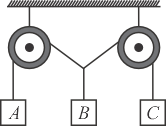
Q23. Three blocks _A_, _B_ and _C_ are suspended as shown in the figure. Mass of each blocks _A_ and _C_ is m. If system is in equilibrium and mass of _B_ is _M_, then
📝 Daily Practice Problem (DPP)🟡 Medium🧠 Applying📌 Mass Pulley Systems
(A)_M_ = 2 _m_
(B)_M_ < 2 _m_
(C)_M_ > 2 _m_
(D)_M_ = _m_
👉 View Correct Answer & Step-by-Step Solution (Option B)
Correct Option: (B)
_M_ < 2 _m_

_FBD_ of _B_
2_T_cosθ = _Mg_
_FBD_ of _C_
_T_ = _mg_
_$cos \theta = \frac{M}{2 m} \\$_
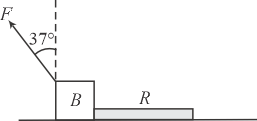
Q24. A block _B_ is tied to one end of a uniform rope _R_ as shown. The mass of block is 2 _kg_ and that of rope is 1 _kg_. A force _F_ = 15 _N_ is applied at angle 37° with vertical. The tension at the mid-point of rope is
📝 Daily Practice Problem (DPP)🔴 Advanced🧠 Applying📌 Mass Pulley Systems
(A)1.5 _N_
(B)2 _N_
(C)3 _N_
(D)4.5 _N_
👉 View Correct Answer & Step-by-Step Solution (Option A)
Correct Option: (A)
1.5 _N_
FBD of given system can be consider is the form of blocks.
(so, block will not move upward)
⇒ _F_ sin37° = 9_N_
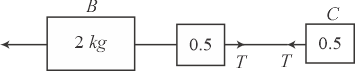
Here the acceleration will be in the direction of the force
9 = _ma_
9 = 3_a_
⇒ _a_ = 3 _ms_$^{–2}$
Tension at the midpoint
and _T_ = 0.5 _a_ (on block _c_)
_T_ = 1.5 _N_
Q25. Two masses m and 2 m are connected by a light string going over a pulley (disc) of mass 30m with radius _r_ = 0.1 m. The pulley is mounted in a vertical plane and it is free to rotate about its axis. The 2 m mass is released from rest and its speed when it has descended through a height of 3.6 m is _______ m/s. (Assume string does not slip and _g_ = 10 m/s$^{2}$)
**[JEE Main 2026, 22nd January, Second Shift]**
🔥 JEE Main 2026, 22nd January, Second Shift🟡 Medium🧠 Applying📌 Mass Pulley Systems
👉 View Correct Answer & Step-by-Step Solution
Correct Answer: 2
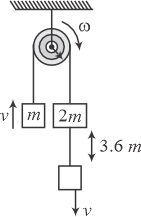
Using energy conservation
$\frac{1}{2} m v^{2} + \frac{1}{2} 2 m v^{2} + \frac{1}{2} \frac{30 m R^{2}}{2} \times \frac{v^{2}}{R^{2}} = m g h$
9 _mv_<$^{2}$ = _mgh_
$v = \sqrt{\frac{g h}{9}} = \sqrt{\frac{10 \times 3.6}{9}}$
$v = \sqrt{4} = 2 \&\text{nbsp}; m / s$
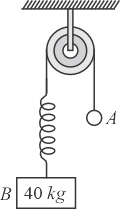
Q26. In the given figure, ball A is released from rest when the spring is in its natured length. For the block B of mass 40 kg to leave contact with the ground, the minimum mass of A must be
📝 Daily Practice Problem (DPP)🟡 Medium🧠 Analysing📌 Mass Pulley Systems
(A)20 kg
(B)30 kg
(C)40 kg
(D)50 kg
👉 View Correct Answer & Step-by-Step Solution (Option A)
Correct Option: (A)
20 kg

$\begin{matrix}T h e \text{ } s p r i n g \text{ } w i l l \text{ } e x e r t \text{ } m a x i m u m \text{ } f o r c e \text{ } w h e n \text{ } t h e \text{ } b a l l \text{ } i s \text{ } a t \text{ } i t s \text{ } l o w e s t \text{ } p o s i t i o n . \\ I f \text{ } t h e \text{ } b a l l \text{ } h a s \text{ } d e s c e n d e d \text{ } t h r o u g h \text{ } a \text{ } d i s t a n c e \text{ } x \text{ } t o \text{ } r e a c h \text{ } t h e \text{ } p o s i t i o n , \\ m g x = \frac{1}{2} k x^{2} \Rightarrow x = \frac{2 m g}{k} \\ F o r \text{ } t h e \text{ } b l o c k \text{ } t o \text{ } l e a v e \text{ } c o n t a c t , \\ k x = M g \\ \Rightarrow k \left(\frac{2 m g}{k}\right) = M g = 40 \text{ } g \\ \Rightarrow m = 20 \text{ } k g .\end{matrix}$
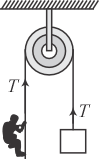
Q27. In order to raise a mass of 100 kg a man of mass 60 kg fastens a rope to it and passes the rope over a smooth pulley. He climbs the rope with acceleration
${\displaystyle \frac{4g}{3}}$ , relative to the rope. The tension in the rope is
(take g=10 m/s)
📝 Daily Practice Problem (DPP)🟡 Medium🧠 Applying📌 Mass Pulley Systems
(A)1000 _N_
(B)1500 _N_
(C)1250 _N_
(D)2000 _N_
👉 View Correct Answer & Step-by-Step Solution (Option C)
Correct Option: (C)
1250 _N_
Let _T_ be the tension in the rope and a the acceleration of rope. The absolute acceleration of the man is therefore $\left(\frac{4 g}{3} - a\right)$ ………..(ii)
Solving equations (i) and (ii), we get,
T = 1250 _N_
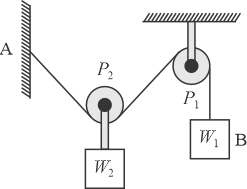
Q28. In the given Figure, both pulleys are Ideal. If W$_{1}$ = W$_{2}$ = 100 N, what is the angle P$_{2}$ P$_{1}$ B if the whole system is at rest?
📝 Daily Practice Problem (DPP)🟡 Medium🧠 Applying📌 Mass Pulley Systems
(A)30°
(B)60°
(C)90°
(D)120°
👉 View Correct Answer & Step-by-Step Solution (Option B)
Correct Option: (B)
60°
$L e t t h e t e n s i o n i n t h e s t r i n g A P_{2} a n d P_{2} P_{1} b e T . \\ C o n s i d e r i n g t h e f o r c e o n p u l l e y P_{1} , w e g e t \\ T = W_{1} \\ F u r t h e r , l e t A P_{2} P_{1} = 2 \\ R e s o l v i n g t e n s i o n s i n h o r i z o n t a l a n d v e r t i c a l d i r e c t i o n s \\ a n d c o n s i d e r i n g t h e f o r c e s o n p u l l e y P_{2} , w e g e t \\ 2 T c o s = W_{2} \\ O r 2 W_{1} c o s = W_{2} o r \&\text{nbsp}; c o s = \frac{1}{2} \\ o r = \left(60\right)^{} \\ P_{2} P_{1} B = \left(60\right)^{}$
Q29. A man pulls himself up the 30° incline by the method shown in Figure. If the combined mass of the man and cart is 50 kg, determine the acceleration of the cart if the man exerts a pull of 250 N on the rope. Neglect all friction and the mass of the rope, pulleys and wheels.
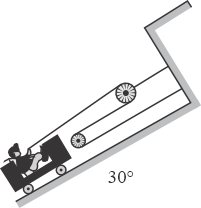
📝 Daily Practice Problem (DPP)🟢 Easy🧠 Applying📌 Mass Pulley Systems
(A)4.5 m/s$^{2}$
(B)2.5 m/s$^{2}$
(C)3.5 m/s$^{2}$
(D)10 m/s$^{2}$
👉 View Correct Answer & Step-by-Step Solution (Option D)
Correct Option: (D)
10 m/s$^{2}$
$\frac{3 T - m g s i n \theta}{m} = \frac{3 \times 250 - 50 \times 10 \times s i n 3 0^{^{\circ}}}{50} = 10 \text{ } m / s^{2}$
Q30. Two balls _A_ and _B_ weighing 7 _N_ and 9 _N_ are connected by a light cord. The system is suspended from a fixed support by connecting the ball _A_ with another light cord. the ball _B_ is pulled aside by a horizontal force 12 _N_ and equilibrium is established. angles α and β respectively are
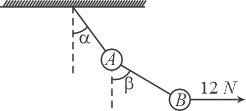
📝 Daily Practice Problem (DPP)🔴 Advanced🧠 Applying📌 Mass Pulley Systems
(A)$30^{\circ}\;$and
(B)$60^{\circ}\;$and
(C)$37^{\circ}\;$and
(D)$30^{\circ}\;$and
👉 View Correct Answer & Step-by-Step Solution (Option C)
Correct Option: (C)
$37^{\circ}\;$and$\;53^{\circ}$
For ball _A_:

_T_$_{1}$ cos α = _T_$_{2}$ cos β + m$_{1}$_g_ … (i)
_T_$_{1}$ sin α = _T_$_{2}$ sin β … (ii)
For ball _B_: _T_$_{2}$ cos β = _m$_{2}$ g_
_T_$_{2}$ cos β = 9 … (iii)
_T_$_{2}$ sin β = 12 … (iv)

Now, from equation (i)
_T_$_{1}$ cos α = (9) + 7
_T_$_{1}$ cos α = 16 … (v)
_T_$_{1}$ sin α = 12 … (vi)
(vi)/(v)

$tan \alpha = \frac{12}{16}$
β = 53°
Q31. A system to 10 balls each of mass 2 _kg_ are connected via massless and unstretchable string. The system is allowed to slip over the edge of a smooth table as shown in figure. Tension in the string between the 7$^{th}$ and 8$^{th}$ ball is_____________ N when 6$^{th}$ ball just leaves the table.
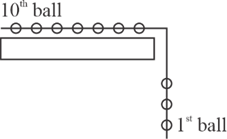
📝 Daily Practice Problem (DPP)🟡 Medium🧠 Applying📌 Mass Pulley Systems
👉 View Correct Answer & Step-by-Step Solution
Correct Answer: 36

$a = \frac{6 m g}{10 m} = \frac{6 g}{10} = \frac{3 g}{5}$
= 36 _N_
Q32. The system shown in figure is released from rest. the force (_N_) exerted by the strings on the pulley (_P_$_{2}$)is
$\frac{n}{100},$
value of _n_ is _________. Assuming pulleys and strings are massless. (_g_ = 10 _m_/_s_$^{2}$)
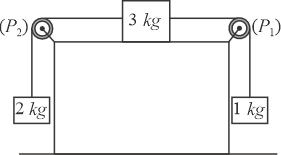
📝 Daily Practice Problem (DPP)🟡 Medium🧠 Applying📌 Mass Pulley Systems
👉 View Correct Answer & Step-by-Step Solution
Correct Answer: 2357
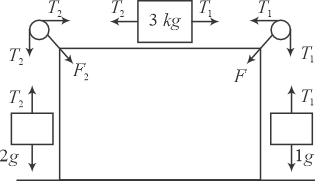
_FBD_
Note: As the motion of the block is on smooth horizontal surface, so no need to mark the forces along vertical direction
in drawing the FBD.
By Newton’s second law, we have
_T_<$_{1}$ – 1_g_ = 1_a_ … (i)
_T_<$_{2}$ – _T_<$_{1}$ = 3_a …_ (ii)
and 2_g_ – _T_<$_{2}$ = 2_a_ … (iii)
Solving above equations, we get
$a = \frac{g}{6} \&\text{nbsp}; m s^{2} ,$
$T_{1} = \frac{7 g}{6} N ,$
and $T_{2} = \frac{5 g}{3} N$
Force on pulley $P_{1} : F_{1} = \sqrt{T_{1}^{2} + T_{1}^{2}}$
$= \sqrt{2} T_{1}$
Force on pulley $P_{2} : F_{2} = \sqrt{T_{2}^{2} + T_{2}^{2}}$
$= \sqrt{2} T_{2}$
_F_<$_{2}$ = 23.57 Newton.
**_Alternate Method: Applying Booster 2 from Workbook_**
$= \frac{\left(2 - 1\right) g}{\left(1 + 3 + 2\right)} = \frac{g}{6} m / s^{2}$
$T_{1} = m_{u p} \left(g + a\right) = 1 \left(g + \frac{g}{6}\right) = \frac{7 g}{6} N .$
$T_{2} = m_{d o w n} \left(g - a\right) = 2 \left(g - \frac{g}{6}\right) = \frac{5 g}{3} N$
$a = \frac{u n b a l a n c e d \text{ } l o a d}{t o t a l \text{ } m a s s}$
Q33. In the given figure, find mass of the block _A_, if it remains at rest, when the system is released from rest. pulleys and strings are massless. [_g_ = 10 _m_/_s_$^{2}$]
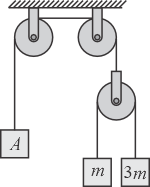
📝 Daily Practice Problem (DPP)🟡 Medium🧠 Applying📌 Mass Pulley Systems
(A)_m_
(B)2_m_
(C)2.5_m_
(D)3_m_
👉 View Correct Answer & Step-by-Step Solution (Option D)
Correct Option: (D)
3_m_
Tension in the string connecting m and 3m
$T = \frac{2 m \times 3 m g}{m + 3 m} = \frac{6 m g}{4} \\$
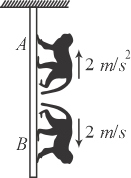
Q34. Two monkeys of masses 10 _kg_ and 8 _kg_ are moving along a vertical light rope, the former climbing up with an acceleration of 2 _m_/_s_$^{2}$, while the latter coming down with a uniform velocity of 2 _m_/_s_. Find tension in the rope at the fixed support.
📝 Daily Practice Problem (DPP)🟡 Medium🧠 Applying📌 Mass Pulley Systems
(A)180 _N_
(B)200 _N_
(C)80 _N_
(D)216 _N_
👉 View Correct Answer & Step-by-Step Solution (Option B)
Correct Option: (B)
200 _N_
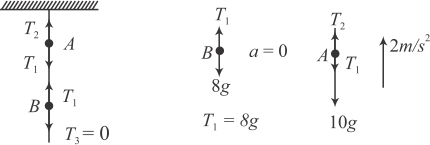
_T_$_{2}$ − _T_$_{1}$ − 10_g_ = 10 × 2
_T_$_{2}$ = 8_g_ + 10_g_ + 20 = 200 _N_
Q35. two blocks of masses _m_$_{1}$ and _m_$_{2}$ are connected by inextensible massless strings as shown in the figure. Neglecting the masses of pulleys and assuming friction at any point of the system to be absent, the ratio of
$\frac{m_1}{m_2}$ for equilibrium of the system is
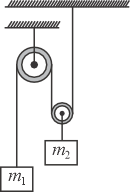
📝 Daily Practice Problem (DPP)🟡 Medium🧠 Applying📌 Mass Pulley Systems
(A)2 : 1
(B)1 : 2
(C)4 : 1
(D)1 : 4
👉 View Correct Answer & Step-by-Step Solution (Option B)
Correct Option: (B)
1 : 2

_T_ = _m_$_{1}$_g_
⇒ 2_T_ = _m_$_{2}$_g_
2_m_$_{1}$_g_ = _m_$_{2}$_g_
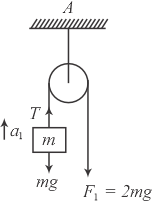
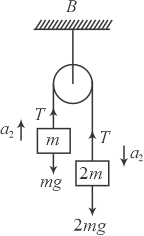
Q36. The pulley arrangements shown in figure are identical the mass of the rope being negligible. In case I, the mass m is lifted by attaching a mass 2_m_ to the other end of the rope. In case II, the mass m is lifted by pulling the other end of the rope with constant downward force F = 2_mg_, where g is acceleration due to gravity. the acceleration of mass in case I is
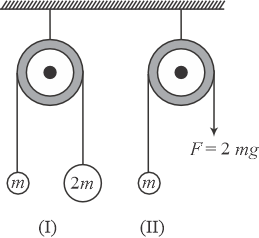
📝 Daily Practice Problem (DPP)🟡 Medium🧠 Analysing📌 Mass Pulley Systems
(A)zero
(B)more than that in case II
(C)less than that in case II
(D)equal to that in case II
👉 View Correct Answer & Step-by-Step Solution (Option C)
Correct Option: (C)
less than that in case II
Q37. A trolley is being self-pulled up an incline plane by a man sitting on it. He applies a force of 250 _N_. If the combined mass of the man and the trolley is 100 _kg_, the acceleration of the trolley will be
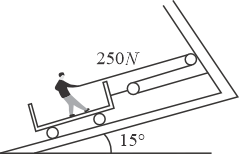
📝 Daily Practice Problem (DPP)🟡 Medium🧠 Analysing📌 Mass Pulley Systems
(A)2.48 _m_/_s_$^{2}$
(B)6.94 _m_/_s_$^{2}$
(C)9.46 _m_/_s_$^{2}$
(D)4.96 _m_/_s_$^{2}$
👉 View Correct Answer & Step-by-Step Solution (Option D)
Correct Option: (D)
4.96 _m_/_s_$^{2}$
**Step-1: Given data**
Force applied on the trolley, _F_ = 250 _N_
The combined mass of trolley and man, _M_ = 100 _kg_
The inclination of the plane, θ = 15°
**Step-2: Formula used**

_F$_{net}$_ = _ma_
where _F$_{net}$_ is net force, _m_ is mass, and _a_ is acceleration.
_W_ = _mg_ sinθ
Where _W_ is weight, _m_ is mass, _g_ is the acceleration due to gravity, and θ the angle of inclination.
**Step 3: Calculation**

The net force applied by tension force on the trolley system
_F$_{net}$_$_{}$ = 3_F_
_F$_{net}$_ = 3 × 250 _N_
_F$_{net}$_ = 750 _N_
Now total weight along the inclined plane downwards
_W_ = _mg_ sinθ
_W_ = 100 × 9.8 sin 15°
_W_ = 980 × 0.26
_W_ = 253.65 _N_
Now the net upward force along the inclined.
_F$_{net}$_ = 3_F_ – _W_
_F$_{net}$_ = 750_N_ – 253.65 _N_
_F$_{net}$_ = 496.35_N_
By Newton's second law,
_F$_{net}$_ = _ma_
496.35 _N_ = 100._a_
_$a = \frac{496.35}{100} = 4.96 \&\text{nbsp}; m / s^{2}$
_
Q38. The block of mass ‘_m_’ equal to 100 _kg_ is being pulled by a horizontal force _F_ = 2 mg applied to a string as shown in figure (Take _g_ = 10 _m_/_s_$^{2}$). The pulley is massless and is fixed at the edge of an immovable table. What is the value of force exerted by the supporting cable (rod) on the pulley (in newton).
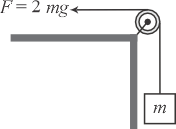
📝 Daily Practice Problem (DPP)🟡 Medium🧠 Applying📌 Mass Pulley Systems
(A)3 _mg_
(B)4 _mg_
(C)$2 \sqrt{2} m g$
(D)2 _mg_
👉 View Correct Answer & Step-by-Step Solution (Option C)
Correct Option: (C)
$2 \sqrt{2} m g$
The _F_._B_._D_ of pulley is as shown
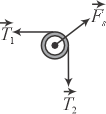
Let $\left(\overset{⃗}{T}\right)_{1} , \left(\overset{⃗}{T}\right)_{2} \&\text{nbsp};\text{and}\&\text{nbsp}; \left(\overset{⃗}{F}\right)_{S}$ be the force exerted by the horizontal string, vertical string and the support on the massless pulley respectively. Then
$\left(\overset{⃗}{T}\right)_{1} + \left(\overset{⃗}{T}\right)_{2} + \left(\overset{⃗}{F}\right)_{S} = 0$
$\&\text{nbsp};\text{or}\&\text{nbsp}; \mid \left(\overset{⃗}{F}\right)_{S} \mid = \mid \left(\overset{⃗}{T}\right)_{1} + \left(\overset{⃗}{T}\right)_{2} \mid = 2 \sqrt{2} m g$
$\&\text{nbsp};(\text{Tension}\&\text{nbsp};\text{in}\&\text{nbsp};\text{each}\&\text{nbsp};\text{string}\&\text{nbsp};\text{is}\&\text{nbsp}; \mid \left(\overset{⃗}{T}\right)_{1} \mid = \mid \left(\overset{⃗}{T}\right)_{2} \mid = 2 m g \&\text{nbsp};)\&\text{nbsp};$
Q39. Find the correct match between two columns. Assume all pulleys and strings are smooth and ideal as shown in the figure below.
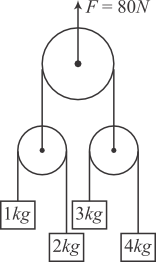
Column I | Column II |
(P) | 1 kg block | (1) | Will remain stationary |
(Q) | 2 kg block | (2) | Will move down |
(R) | 3 kg block | (3) | Will move up |
(S) | 4 kg block | (4) | Has acceleration 4 m/s2 |
📝 Daily Practice Problem (DPP)🟡 Medium🧠 Applying📌 Mass Pulley Systems
(A)P-1, Q-1, R-1, S-3
(B)P-3, Q-1, R-2, S-2
(C)P-2, Q-4, R-3, S-1
(D)P-1, Q-4, R-2, S-2
👉 View Correct Answer & Step-by-Step Solution (Option B)
Correct Option: (B)
P-3, Q-1, R-2, S-2
Since, the pulleys are smooth, net force on each pulley should be zero. With this concept, tensions on all strings are shown below,
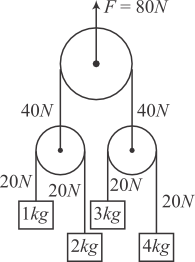
Now we can draw free body diagrams of all the four blocks.
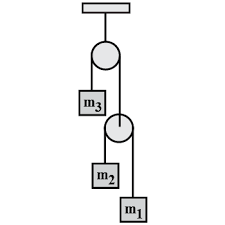
Q40. A juggler tries to balance three balls of masses
$\ m_1{,}\ m_2\$ and with the help of a string-pulley system as shown. All three balls are held at rest and then released. As we can see in the figure to keep third ball of mass at rest,the condition is
📝 Daily Practice Problem (DPP)🔴 Advanced🧠 Analysing📌 Mass Pulley Systems
(A)$\frac1{m_3} =\frac{1}{m_{1}}+\frac{1}{m_{2}}$
(B)$m_1+m_2=m_3$
(C)$\frac{4}{m_{3}}=\frac{1}{m_{1}}+\frac{1}{m_{2}}$
(D)$\frac{7}{m_{3}}=\frac{2}{m_{1}}+\frac{9}{m_{2}}$
👉 View Correct Answer & Step-by-Step Solution (Option C)
Correct Option: (C)
$\frac{4}{m_{3}}=\frac{1}{m_{1}}+\frac{1}{m_{2}}$
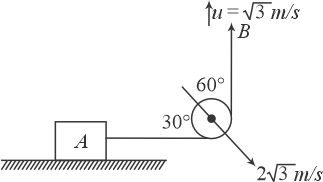
Q41. A system is shown in figure. End _B_ of string is moving upwards with √3 _m_/_s_. Pulley is moving with speed 2√3 _m_/s in direction shown in the figure. Then velocity of the block _A_ will be:
📝 Daily Practice Problem (DPP)🟡 Medium🧠 Analysing📌 Mass Pulley Systems
(A)√3 m/s
(B)3 _m_/_s_
(C)3 + 2√3 _m_/_s_
(D)3 + √3 _m_/_s_
👉 View Correct Answer & Step-by-Step Solution (Option C)
Correct Option: (C)
3 + 2√3 _m_/_s_

$V = \sqrt{3} + 2 \sqrt{3} \times \frac{1}{2} + 2 \sqrt{3} \times \frac{\sqrt{3}}{2} \\$
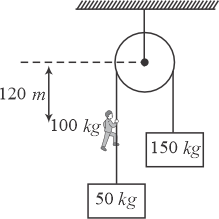
Q42. In Atwood machine two blocks of mass 50 _kg_ and 150 _kg_ are connected over a fixed smooth pulley. A person of mass 100 _kg_ starts climbing the string, 120 _m_ below the pulley, with constant acceleration 5 _m_/_s_$^{2}$ with respect to string at _t_ = 0. The time taken by the person to reach the pulley is
📝 Daily Practice Problem (DPP)🟡 Medium🧠 Applying📌 Mass Pulley Systems
(A)12 _s_
(B)8.5 _s_
(C)14 _s_
(D)18 _s_
👉 View Correct Answer & Step-by-Step Solution (Option B)
Correct Option: (B)
8.5 _s_
Let the acceleration of string = _a_

For 50 _kg_
500 – _T_$_{1}$ = 50_a_
_T_$_{1}$ = 500 – 50_a_ …(i)

For person
_T_$_{2}$ – 1000 – T$_{1}$ = 100(5 – _a_) …(ii)

For 150 _kg_
_T_$_{2}$ – 1500 = 150_a_
_T_$_{2}$ = 150_a_ + 1500 …(ii)
Putting (iii) and (i) into (ii)
150_a_ + 1500 – 1000 – 500 + 50_a_ = 500 – 100_a_
$\Rightarrow$
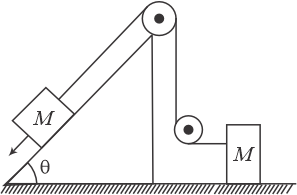
Q43. Two blocks, each having a mass M, rest on a frictionless surface as shown in the figure. If the pulleys are light and
frictionless and mass M on the incline is allowed to move down, the tension in the string will be
📝 Daily Practice Problem (DPP)🟡 Medium🧠 Applying📌 Mass Pulley Systems
(A)$\frac{2}{3} M g \sin \theta$
(B)$\frac{3}{2} M g \sin \theta$
(C)$\frac{M g \sin \theta}{2}$
(D)$2 M g \sin \theta$
👉 View Correct Answer & Step-by-Step Solution (Option C)
Correct Option: (C)
$\frac{M g \sin \theta}{2}$
1) draw the free body diagram of the blocks.
2) The acceleration of the block lying on the inclined plane will be in a downward direction.
3) block kept on the flat surface having acceleration in the leftward direction. now writing the equation for both after resolving the forces.

_Mg_ sin θ – _T_ = _Ma ..._(1)
_T_ = _Ma_
on putting in equation (1) we get
$T = \frac{M g sin \theta}{2}$
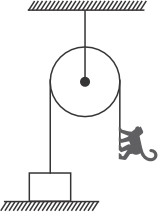
Q44. A monkey weighing 10 _kg_ is climbing up a light rope and frictionless pulley attached to 15 _kg_ mass at other end as in figure. In order to raise the 15 _kg_ mass off the ground the monkey must climb-up
📝 Daily Practice Problem (DPP)🟡 Medium🧠 Analysing📌 Mass Pulley Systems
(A)with constant acceleration
(B)with an acceleration greater than $\frac {g}{2}.$
(C)with an acceleration greater than $\frac {g}{4}.$
(D)It is not possible because weight of monkey is lesser than the block.
👉 View Correct Answer & Step-by-Step Solution (Option B)
Correct Option: (B)
with an acceleration greater than $\frac {g}{2}.$
_T_ > 15 _g_ in order to Just lift the block.

_T_ - 10 _g_ =10 _a_
_$\Rightarrow \text{ }$
_
Q45. Two blocks _A_ and _B_ of same mass are connected through a string and arranged as shown in figure. When the system is released from rest and there is no friction, then
📝 Daily Practice Problem (DPP)🟡 Medium🧠 Applying📌 Mass Pulley Systems
(A)acceleration of _A_ is $\frac{g}{2}$
(B)acceleration of _A_ is $\frac{g}{3}$
(C)tension in the string is zero
(D)tension in the string is $\frac{mg}{4}$
👉 View Correct Answer & Step-by-Step Solution (Option D)
Correct Option: (D)
tension in the string is $\frac{mg}{4}$
_FBD_ of _B_;

_mg_ – _T_ = _ma_ .....(i)
_FBD_ of _A_;

_mg_ sin θ + _T_ = _ma_ ......(ii)
By adding (i) and (ii)
_mg_ + _mg_ sin θ = 2 _ma_
_mg_ + $\frac{m g}{2}$
Q46. A particle of small mass _m_ is joined to a very heavy body by a light string passing over a light pulley. Both bodies are free to move. The total downward force in the pulley is
📝 Daily Practice Problem (DPP)🟡 Medium🧠 Applying📌 Mass Pulley Systems
(A)_mg_
(B)2_mg_
(C)4_mg_
(D)an not be determined
👉 View Correct Answer & Step-by-Step Solution (Option C)
Correct Option: (C)
4_mg_
The heavy body will fall due to acceleration due to gravity. The acceleration of the lighter body will be g in upward direction. Taking the equilibrium of the small body

Let _M_ is very heavy mass: _M_ >> _m_
We know: $T = \left(\frac{2 m_{1} m_{2}}{m_{1} + m_{2}}\right) g$
So force on pulley: 2_T_ = 4_mg_
Q47. Two masses are hanging vertically over frictionless pulley. The acceleration of the two masses is
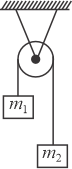
📝 Daily Practice Problem (DPP)🟡 Medium🧠 Applying📌 Mass Pulley Systems
(A)$\frac{m_1}{m_2} g$
(B)$\frac{m_2}{m_1} g$
(C)$\left(\frac{m_2-m_1}{m_1+m_2}\right) g$
(D)$\left(\frac{m_1+m_2}{m_2-m_1}\right) g$
👉 View Correct Answer & Step-by-Step Solution (Option C)
Correct Option: (C)
$\left(\frac{m_2-m_1}{m_1+m_2}\right) g$


_m_$_{2}$_g_ – _T_ = _m_$_{2}$_a_ …(i)
_T_ − _m_$_{1}$_g_ = _m_$_{1}$_a_ ...(ii)
From (i) and (ii)
$m_{2} g - m_{2} a - m_{1} g = m_{1} a$
Q48. A weight can be hung in any of the following four ways by string of same type. In which case is the string most likely to break?
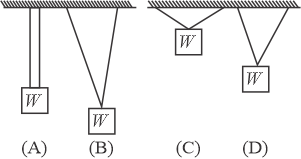
📝 Daily Practice Problem (DPP)🟡 Medium🧠 Analysing📌 Mass Pulley Systems
👉 View Correct Answer & Step-by-Step Solution (Option C)
Correct Option: (C)
_C_
Consider the string makes an angle θ with the horizontal,
Taking _FBD_ of the block, we get
_mg_ = 2_Tsin_θ
$\begin{matrix}\therefore \&\text{nbsp}; T = \frac{m g}{2 sin \theta}\end{matrix}$
Now, as the denominator decreases Tension becomes more and the string breaks.
It means θ should be minimum in case of maximum Tension and to break the string.
Thus, _C_ is the case
Q49. Three block are connected as shown, on a horizontal frictionless table and pulled to the right with a force _T_$_{3}$ = 60 _N_. If _m_$_{1}$ = 10 _kg_, _m_$_{2}$ = 20 _kg_ and _m_$_{3}$ = 30 _kg_, the tension _T_$_{2}$ is
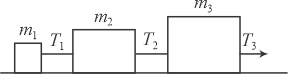
📝 Daily Practice Problem (DPP)🟡 Medium🧠 Applying📌 Mass Pulley Systems
(A)10 _N_
(B)20 _N_
(C)30 _N_
(D)60 _N_
👉 View Correct Answer & Step-by-Step Solution (Option C)
Correct Option: (C)
30 _N_
Common acceleration a = $\frac{60}{1 + 20 + 30}$
Q50. In the figure blocks _A_, _B_ and _C_ have acceleration _a_$_{1}$, _a_$_{2}$ and _a_$_{3}$ respectively. _F_$_{1}$ and _F_$_{2}$ are external forces of magnitude 2 _mg_ and _mg_ respectively. Find the value of _a_$_{1}$, _a_$_{2}$ and _a_$_{3}$.
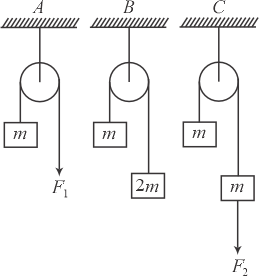
📝 Daily Practice Problem (DPP)🟡 Medium🧠 Applying📌 Mass Pulley Systems
(A)$a_1=g, a_2=\frac {g}{3}, a_3=\frac {g}{2}$
(B)$a_1=\frac {g}{3}g, a_2= {g}, a_3=\frac {2g}{3}$
(C)$a_1=g, a_2=\frac {g}{2}, a_3=\frac {g}{3}$
(D)$a_1=\frac {2g}{3}g, a_2=\frac {g}{3}, a_3=g$
👉 View Correct Answer & Step-by-Step Solution (Option A)
Correct Option: (A)
$a_1=g, a_2=\frac {g}{3}, a_3=\frac {g}{2}$
of given diagrams.
|
|
|
T = F1 T – mg = ma1 2mg – mg = ma1 a1 = g ↑ | T – mg = ma2 2mg – T = 2ma2 Adding both: mg = 3ma2 a2 = g/3 ↑ | T – mg = ma3 2mg – T = ma3 Adding both: mg = 2ma3 a3 = g/2 |
Q51. Find the acceleration (_a_) of each block, consider the pulley and string is ideal.
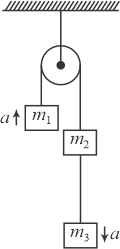
[JEE Main 2022]
🔥 JEE Main 2022🟡 Medium🧠 Applying📌 Mass Pulley Systems
(A)$a=\frac{m_3 g}{m_1+m_2+m_3}$
(B)$a=\frac{\left(m_3+m_2-m_1\right) g}{m_1+m_2+m_3}$
(C)$a=\frac{m_3 g-m_1 g}{m_1+m_2+m_3}$
(D)$a=\frac{m_2 g-m_1 g}{m_1+m_2+m_3}$
👉 View Correct Answer & Step-by-Step Solution (Option B)
Correct Option: (B)
$a=\frac{\left(m_3+m_2-m_1\right) g}{m_1+m_2+m_3}$
Acceleration of each block will remain same.
So, net force in downward direct: (_m_<$_{1}$ + _m_<$_{2}$ + _m_<$_{3}$)
$a = \frac{\left(m_{3} + m_{2} - m_{1}\right) g}{m_{1} + m_{2} + m_{3}}$
Q52. Calculate the acceleration (_a_) of blocks.
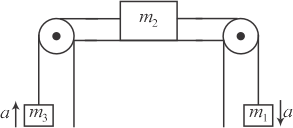
📝 Daily Practice Problem (DPP)🟡 Medium🧠 Applying📌 Mass Pulley Systems
(A)$\quad a=\frac{m_1 g}{m_1+m_2+m_3}$
(B)$\quad a=\frac{m_2 g-m_1 g}{m_1+m_2+m_3}$
(C)$a=\frac{m_1 g-m_3 g}{m_1+m_2+m_3}$
(D)$a=\frac{\left(m_1 g-m_3 g\right)-m_2 g}{m_1+m_2+m_3}$
👉 View Correct Answer & Step-by-Step Solution (Option C)
Correct Option: (C)
$a=\frac{m_1 g-m_3 g}{m_1+m_2+m_3}$
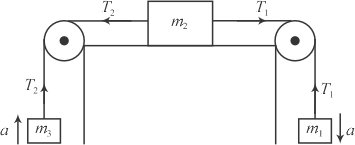
Net force to be pulled in downward direction: _m_<$_{1}$_g_ – _m_<$_{3}$_g_
Total mass to be pulled = _m_<$_{1}$ + _m_<$_{2}$ + _m_<$_{3}$
$a = \frac{m_{1} g - m_{3} g}{m_{1} + m_{2} + m_{3}}$
Q53. A block of mass 40 _kg_ slides over a surface, when a mass of 4 _kg_ is suspended through an inextensible massless string passing over frictionless pulley as shown below. The acceleration of block is. [Given _g_ = 10 _ms_$^{–2}$]
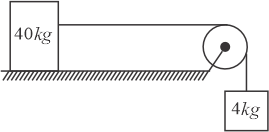
📝 Daily Practice Problem (DPP)🟡 Medium🧠 Applying📌 Mass Pulley Systems
(A)1 _ms_$^{–2}$
(B)$\frac {1}{5} m s^{-2}$
(C)$\frac {4}{5} m s^{-2}$
(D)$\frac {10}{11} m s^{-2}$
👉 View Correct Answer & Step-by-Step Solution (Option D)
Correct Option: (D)
$\frac {10}{11} m s^{-2}$
$a = \frac{\&\text{nbsp};\text{Net}\&\text{nbsp};\text{pulling}\&\text{nbsp};\text{force}\&\text{nbsp};}{\&\text{nbsp};\text{Total}\&\text{nbsp};\text{mass}\&\text{nbsp};} = \frac{4 \times 10}{4 + 40}$
$a = \frac{10}{11} \&\text{nbsp}; m / s^{2}$
Q54. In the system shown below calculate _T_$_{1}$, _T_$_{2}$ and _a_?
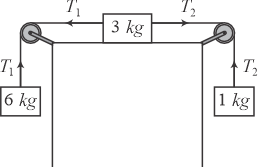
📝 Daily Practice Problem (DPP)🔴 Advanced🧠 Applying📌 Mass Pulley Systems
(A)_T_$_{1}$ =30 _N_, _T_$_{2}$ = 15 _N_, _a_ = 5 _m_/_s_$^{2}$
(B)_T_$_{1}$ = 10 _N_, _T_$_{2}$ = 5 _N_, _a_ = 2 _m_/_s_$^{2}$
(C)_T_$_{1}$ = 5 _N_, _T_$_{2}$ = 10 _N_, _a_ = 2 _m_/_s_$^{2}$
(D)_T_$_{1}$ = 6 _N_, _T_$_{2}$ = 5 _N_, _a_ = 1 _m_/_s_$^{2}$
👉 View Correct Answer & Step-by-Step Solution (Option A)
Correct Option: (A)
_T_$_{1}$ =30 _N_, _T_$_{2}$ = 15 _N_, _a_ = 5 _m_/_s_$^{2}$
$6 g - T_{1} = 6 a$
Q55. Two masses _M_$_{1}$ and _M_$_{2}$ are tied together at the two ends of a light inextensible string that passes over a frictionless pulley. When the mass _M_$_{2}$ is twice that of _M_$_{1}$. the acceleration of the system is _a_$_{1}$. When the mass _M_$_{2}$ is thrice that of _M_$_{1}$. The acceleration of The system is _a_$_{2}$. The ratio
$\frac{{{a_1}}}{{{a_2}}}$ will be:
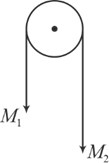
📝 Daily Practice Problem (DPP)🟢 Easy🧠 Understanding📌 Mass Pulley Systems
(A)$\frac{1}{3}$
(B)$\frac{2}{3}$
(C)$\frac{3}{2}$
(D)$\frac{1}{2}$
👉 View Correct Answer & Step-by-Step Solution (Option B)
Correct Option: (B)
$\frac{2}{3}$
$a = \frac{m_{2} g - m_{1} g}{m_{1} + m_{2}}$
Q56. Three equal weights _A, B, C_ of mass 2 _kg_ each are hanging on a string passing over a fixed frictionless pulley as shown in the fig. The tension in the string connecting weights _B_ and _C_ is-
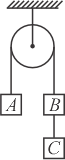
📝 Daily Practice Problem (DPP)🟡 Medium🧠 Applying📌 Mass Pulley Systems
(A)zero
(B)13 Newton
(C)3.3 Newton
(D)19.6 Newton
👉 View Correct Answer & Step-by-Step Solution (Option B)
Correct Option: (B)
13 Newton

The free body diagram of the system is shown.
For block _A_: _T_ – _mg_ = _ma_
_T_ – 2_g_ = 2_a_
We get _T_ = 2_a_ + 2_g_
For block _B_ + _C_ system : _mg_ + _mg_ – _T_ = (_m_ + _m_)_a_
2_g_ + 2_g_ – _T_ = (2 + 2)_a_
⇒ 4_g_ – _T_ = 4_a_
Or 4_g_ – 2_a_ – 2_g_ = 4_a_
Or 2_g_ = 6_a_
This gives a = $\frac{g}{3}$
Q57. A heavy cart is pulled by a constant force _F_ along a horizontal track with the help of a rope that passes over a fixed pulley, as shown in the figure. Assume the tension in the rope and the frictional forces on the cart remain constant and consider motion of the cart until it reaches vertically below the pulley. As the cart moves to the right, its acceleration
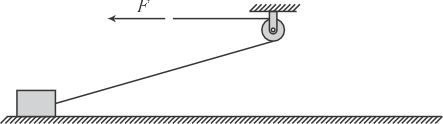
📝 Daily Practice Problem (DPP)🟡 Medium🧠 Analysing📌 Mass Pulley Systems
(A)ecreases.
(B)increases.
(C)remains constant.
(D)is zero
👉 View Correct Answer & Step-by-Step Solution (Option A)
Correct Option: (A)
decreases.

$F cos \theta - f_{r} = m a$ a will decrease.
Q58. A small electrically charged sphere is suspended vertically from a thread. An oppositely charged rod is brought close to the sphere such that the sphere is in equilibrium displaced from the vertical by an angle of
$\;30^{\circ}$. Which one of the following best represents the free body diagram for the sphere?
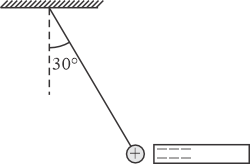
📝 Daily Practice Problem (DPP)🟡 Medium🧠 Applying📌 Mass Pulley Systems
👉 View Correct Answer & Step-by-Step Solution (Option D)
Correct Option: (D)
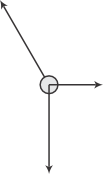

$tan 3 0^{\circ} = \frac{F_{E}}{m g}$
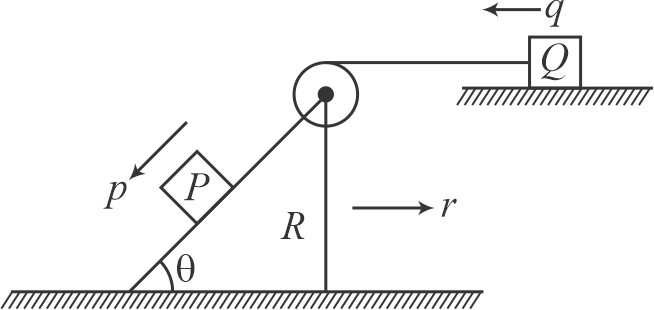
Q59. The accelerations of bodies _P,_ _Q,_ and _R_ are given in the diagram, along with their directions. The values _q_ and _r_ are relative to the ground. Here, _p_ is the acceleration of block _P_ relative to wedge _R_. Find The acceleration of block _P_ relative to the ground up to 2 decimal places.
(Use _q_ = _r_ = 1
$m/s^2$__, θ = 60°)
📝 Daily Practice Problem (DPP)🟡 Medium🧠 Applying📌 Mass Pulley Systems
👉 View Correct Answer & Step-by-Step Solution (Option A)
Correct Option: (A)
1.73
using constraint relation _p_ =_q_ + _r_
Net acceleration of P $= \sqrt{p^{2} + r^{2} + 2 p r c o s \left(\pi - \theta\right)}$
Q60. A vehicle of mass
$m_1=2kg$ is being pulled over a smooth surface using a block of mass . Initially vehicle is moving towards left direction with speed 9 m/s then consider the following statement.
(1) The acceleration of the cart is 6 _m/s$^{2}$_ towards right.
(2) The cart comes to momentary rest after 1.5 _s_.
(3) The distance travelled by the cart in the first 3 _s_ is 13.5 _m_.
(4) The velocity of the cart after 3 s will be same as initial velocity.
Which of following option represent all the correct statement given above
📝 Daily Practice Problem (DPP)🟡 Medium🧠 Applying📌 Mass Pulley Systems
(A)1, 2, 3
(B)1, 3, 4
(C)2, 3, 4
(D)1, 2, 4
👉 View Correct Answer & Step-by-Step Solution (Option A)
Correct Option: (A)
1, 2, 3
Since friction is absent therefore
$F_{n e t \&\text{nbsp};} = 3 g = 5 a \Rightarrow a = \frac{3 g}{5} \&\text{nbsp}; \frac{m}{s^{2}} = 6 \&\text{nbsp}; \frac{m}{s^{2}}$
_S_ = 6.75 _m_
Vehicle will be at rest after 1.5 second.
after that it will move towards right.
Total distance in 3 second will be = 2 × 6.75 = 13.5 _m_
After 3_s_, it speed will be same as that of initial (9_m_/_s_) but direction will be reversed.
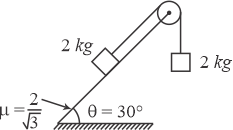
Q61. The frictional force (in _N_) acting between block and the incline is [Take
$~\left.g=10 {~m} /{s}^2\right]$.
📝 Daily Practice Problem (DPP)🟡 Medium🧠 Applying📌 Mass Pulley Systems
👉 View Correct Answer & Step-by-Step Solution
Correct Answer: 10

$f_{s , m a x} = u N$
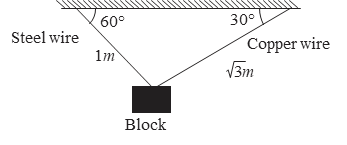
Q62. A block of weight 100 _N_ is suspended by copper and steel wires of same cross sectional area 0.5 _cm_$^{2}$ and, length
$\sqrt 3 m$ and 1 _m_, respectively. Their other ends are fixed on a ceiling as shown in figure. The angles subtended by copper and steel wires with ceiling are 30° and 60°, respectively. If elongation in copper wire is (Δ_l$_{C}$_) and elongation in steel wire is (Δ_l$_{S}$_), then the ratio is _____.
[Young's modulus for copper and steel are 1 × 10$^{11}$_N_/_m_$^{2}$ and 2 × 10$^{11}$_N_/_m_$^{2}$ respectively]
**[JEE Adv. 2019]**
🔥 JEE Adv. 2019🟡 Medium🧠 Applying📌 Mass Pulley Systems
👉 View Correct Answer & Step-by-Step Solution (Option A)
Correct Option: (A)
2.00

$T_{S} sin 3 0^{\circ} = T_{C} sin 6 0^{\circ}$
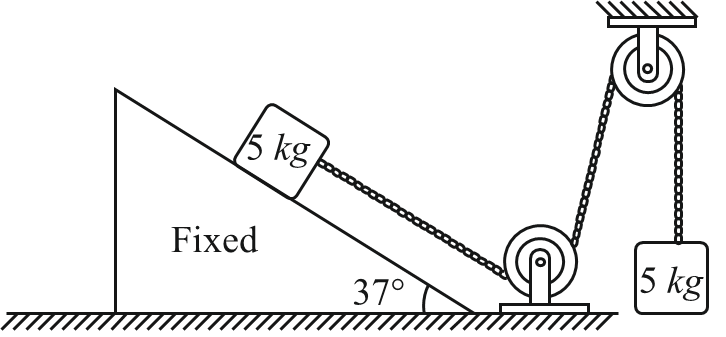
Q63. Two blocks _A_ and _B_ of same mass 5 _kg_ are connected as shown in figure. If system is released from rest,
(1) tension in string is
$8N$
(2) tension in string is
$10\ N$
(3) acceleration of _A_ is
$5\ m/s^2$
(4) acceleration of _A_ is
$8\ m/s^2$
Which of the following option represent all the correct option given above?
📝 Daily Practice Problem (DPP)🟡 Medium🧠 Applying📌 Mass Pulley Systems
(A)1, 3
(B)2, 4
(C)1, 4
(D)2, 3
👉 View Correct Answer & Step-by-Step Solution (Option B)
Correct Option: (B)
2, 4
Let a be acceleration of system and _T_ be tension in, the string

_F_._BD_ of block on incline plane
_Mg_ sin 37° + _T_ = _ma_
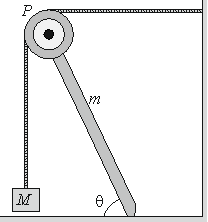
Q64. A rod of mass is placed on floor at incline angle θ = 37° with the horizontal. Its upper end is attached with a horizontal rope using a pulley and other part of the rope is attached with a block of mass M. If the coefficient of static friction between rod and floor is
${\mu _{s\;\;}} = \frac{4}{5},$ then choose the correct answer(s) from the following options.
📝 Daily Practice Problem (DPP)🔴 Advanced🧠 Applying📌 Mass Pulley Systems
(A)Value of mass M is 1 kg.
(B)Value of mass M is 2 kg.
(C)Ratio of reaction force by floor and force acting on pulley is $\sqrt {\frac{{41}}{{17}}} .$
(D)Ratio of reaction force by floor and force acting on pulley is $\frac{5}{3}.$
👉 View Correct Answer & Step-by-Step Solution (Option A)
Correct Option: (A)
Value of mass M is 1 kg.
Correct Answer is:
Ratio of reaction force by floor and force acting on pulley is $\sqrt {\frac{{41}}{{17}}} .$
We can use $\Sigma F_{x} = \Sigma F_{y} = 0$
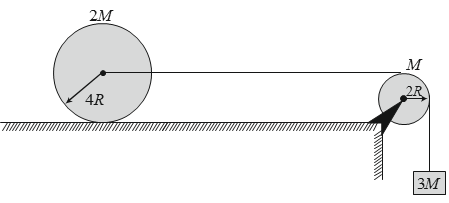
Q65. A string is attached at the centre of disc of mass 2M and radius 4R which is placed over the top of a sufficiently rough surface. Other end of the string is passing over a pully of mass M and radius 2R (can be assumed as disc) and attached to a block of mass 3M which is hanging freely as shown in figure. If there is no slipping anywhere then find acceleration of the block of mass 3M?
📝 Daily Practice Problem (DPP)🟡 Medium🧠 Applying📌 Mass Pulley Systems
(A)$\frac{{3g}}{7}$
(B)$\frac{5 g}{13}$
(C)$\frac{6 g}{13}$
(D)$\frac{4 g}{13}$
👉 View Correct Answer & Step-by-Step Solution (Option C)
Correct Option: (C)
$\frac{6 g}{13}$

$\begin{matrix}T_{1} - f = 2 M a \textrm{ } \textrm{ } \textrm{ } \textrm{ } \textrm{ } \textrm{ } \textrm{ } \textrm{ } \textrm{ } \textrm{ } \textrm{ } \textrm{ } \textrm{ } \textrm{ } \textrm{ } . . . . . . \left(i\right) \\ f \left(4 R\right) = \frac{2 M \left(4 R\right)^{2}}{2} \alpha_{1} \\ f = 4 M \alpha_{1} R \textrm{ } \textrm{ } \textrm{ } \textrm{ } \textrm{ } \textrm{ } \textrm{ } \textrm{ } \textrm{ } \textrm{ } \textrm{ } \textrm{ } \textrm{ } . . . . . \left(i i\right) \\ \\ F o r \textrm{ } P u l l e y \\ \left(T_{2} - T_{1}\right) \left(2 R\right) = \frac{M \left(2 R\right)^{2}}{2} \alpha_{2} \\ \Rightarrow T_{2} - T_{1} = M \alpha_{2} R \textrm{ } \textrm{ } \textrm{ } \textrm{ } \textrm{ } \textrm{ } \textrm{ } \textrm{ } \textrm{ } \textrm{ } \textrm{ } \textrm{ } \textrm{ } . . . . . . . \left(i i i\right) \\ \\ F o r \textrm{ } b l o c k \\ 3 M g - T_{2} = 3 M a \textrm{ } \textrm{ } \textrm{ } \textrm{ } \textrm{ } \textrm{ } \textrm{ } \textrm{ } \textrm{ } \textrm{ } \textrm{ } \textrm{ } . . . . . \left(i v\right) \\ \\ F o r \textrm{ } n o \textrm{ } s l i p p i n g , \textrm{ } w e \textrm{ } u s e . \\ a = 4 R \alpha_{1} = 2 R \alpha_{2} \textrm{ } \textrm{ } \textrm{ } \textrm{ } \textrm{ } \textrm{ } \textrm{ } \textrm{ } \textrm{ } . . . . . . . . . \left(v\right) \\ \\ A d d i n g \textrm{ } e q u a t i o n - \left(i\right) , \textrm{ } \left(i i\right) , \textrm{ } \left(i i i\right) \textrm{ } \& \textrm{ } \left(i v\right) ; \textrm{ } w e \textrm{ } h a v e \\ \\ 3 M g = 2 M a + 4 M \alpha_{1} R + M \alpha_{2} R + 3 M a \\ \Rightarrow 3 M g = 2 M a + M a + \frac{M a}{2} + 3 M a \\ \Rightarrow 3 M g = \frac{13}{2} M a \\ \Rightarrow a = \frac{6 g}{13}\end{matrix}$
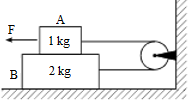
Q66. Two blocks A (1 kg) and B (2 kg) are connected by a string passing over a smooth pulley as shown in the figure. B rests on rough horizontal surface and A rest on B. The coefficient of friction between A and B is the same as that between B and the horizontal surface. The minimum horizontal force F required to move A to the left is 25 N. The coefficient of friction is : (g = 10 m/s$^{2}$)
📝 Daily Practice Problem (DPP)🟡 Medium🧠 Applying📌 Mass Pulley Systems
(A)0.67
(B)0.5
(C)0.4
(D)0.25
👉 View Correct Answer & Step-by-Step Solution (Option B)
Correct Option: (B)
0.5
Let coefficient of friction is μ
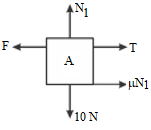
N$_{1}$ = 10
T + 10m = 25 ….(1)
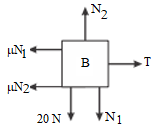
N$_{2}$ = 20 + N$_{1}$ = 30
T = μ(10) + μ(30)
T = 40μ ….(2)
Form (1) and (2), we get
50μ = 25
μ = 0.5
Q67. Two bodies of masses _m_$_{1}$ = 5_kg_ and _m_$_{2}$ = 3_kg_ are connected by a light string going over a smooth light pulley on a smooth inclined plane as shown in the figure. The system is at rest. The force exerted by the inclined plane on the body of mass _m_$_{1}$ will be: [Take _g_ = 10_ms_$^{–2}$]
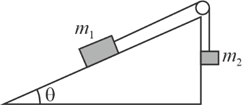
📝 Daily Practice Problem (DPP)🟡 Medium🧠 Remembering📌 Mass Pulley Systems
(A)30 _N_
(B)40 _N_
(C)50 _N_
(D)60 _N_
👉 View Correct Answer & Step-by-Step Solution (Option B)
Correct Option: (B)
40 _N_
For equilibrium _m_$_{2}$_g_ = _m_$_{1}$_g_ sinθ
$sin \theta = \frac{m_{2}}{m_{1}} = \frac{3}{5}$
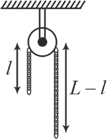
Q68. A uniform metal chain of mass _m_ and length _L_ passes over a massless and frictionless pulley. It is released from rest with a part of its length _l_ is hanging on one side and rest of its length _L_ – _l_ is hanging on the other side of the pulley. At a certain point of time, when
$l = \frac{L}{x},$ the acceleration of the chain is The value of _x_ is _______.
📝 Daily Practice Problem (DPP)🟡 Medium🧠 Applying📌 Mass Pulley Systems
👉 View Correct Answer & Step-by-Step Solution (Option D)
Correct Option: (D)

$a = \frac{\left(m_{2} - m_{1}\right)}{\left(m_{2} + m_{1}\right)} g$
_x_ = 4
Q69. Two blocks of same mass 10 _kg_ are attached with help of pulley over wedge as shown in figure. If wedge is moving towards right direction with acceleration 4 _m_/_s_$^{2}$ then (_g_ =10 _m_/_s_$^{2}$).
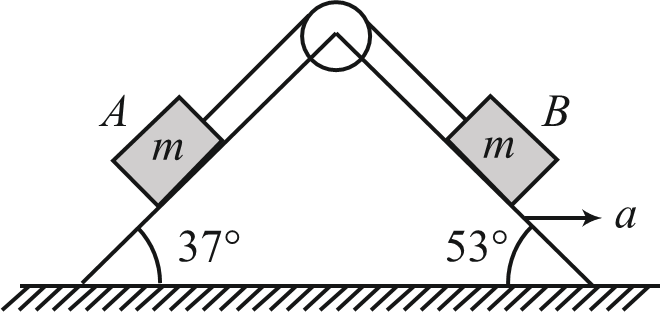
1. Normal reaction acting on block _B_ is 230 _N_
2. Normal reaction acting on block _A_ is 140 _N_
3. Normal reaction acting on block _A_ is 190 _N_
4. The maximum value of acceleration a for which normal reactions acting on the block _A_ and block _B_ are nonzero is
$\frac{4}{3}\;g$
Which of the following option represents all the correct statements given above?
📝 Daily Practice Problem (DPP)🟡 Medium🧠 Applying📌 Mass Pulley Systems
(A)1, 2, 3
(B)2, 3, 4
(C)1, 2, 3, 4
(D)1, 2, 4
👉 View Correct Answer & Step-by-Step Solution (Option D)
Correct Option: (D)
1, 2, 4

The _FBD_ of _A_ and _B_ are Applying Newtons second law to block _A_ and _B_ along normal to inclined surface
_NB_ – _mg_ cos 53° = _ma_ sin 53°
_mg_ cos 37° – _N$_{A}$_ = _ma_ sin 37°
Solving
Q70. The figure below shows two blocks and a wedge with their masses. What should be the value of mass _M_ (in _kg_) so that block of mass m will remain at rest on wedge of mass _M_. Assume all the surfaces are smooth and pulley and string are ideal. Take θ = 37°, _M_ = 3 _kg_,
$m=\frac{1}{3}\quad kg$
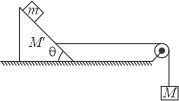
📝 Daily Practice Problem (DPP)🔴 Advanced🧠 Applying📌 Mass Pulley Systems
👉 View Correct Answer & Step-by-Step Solution
Correct Answer: 10

For the m to be at rest, net force on it along the inclined must be zero.
_ma_ cos_mg_ sin_a_ _g_ tan
For _m_ to be at rest, the acceleration of the (wedge + _M_) system _g_ tan
∴ _T_ = (_M_ + _m_)_g_ tanθ
For block _M_, _Mg_ – (_M_’ + _m_)_g_ tan θ = _Mg_ tan θ
$O n s o l v i n g , M = \frac{M + m}{c o t \theta - 1} = 10$
Q71. A hanging mass _M_ is connected to a four times bigger mass by using a string-pulley arrangement. as shown in the figure. The bigger mass is placed on a horizontal ice-slab and being pulled by 2 _Mg_ force. In this situation. tension in the string is
$\frac{x}{5}$ _Mg_ or _x =_ _________. Neglect mass of the string and friction of the block (bigger mass) with ice slab. (Given _g =_ acceleration due to gravity)
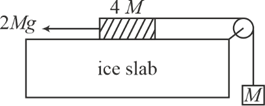
📝 Daily Practice Problem (DPP)🟡 Medium🧠 Applying📌 Mass Pulley Systems
👉 View Correct Answer & Step-by-Step Solution
Correct Answer: 6
Using $\left(\overset{\rightarrow}{F}\right)_{n e t} = \mu \overset{\rightarrow}{a}$
Q72. Two boxes are placed as shown in the figure below. The coefficient of friction between all the surfaces in contact is
$\frac{1}{{10}}$ . If the mass of _m_$_{1}$ is10 _kg_ and mass of box on the right is twice of left one. Then If tension in the cable is _N_ in limiting condition then find the value of .
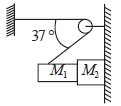
📝 Daily Practice Problem (DPP)🔴 Advanced🧠 Applying📌 Mass Pulley Systems
👉 View Correct Answer & Step-by-Step Solution (Option C)
Correct Option: (C)
As per the _FBD_ of _M_$_{1}$ below,

$T cos 3 7^{0} = N_{1}$
Q73. Find the acceleration of block A immediately after the string is cut.
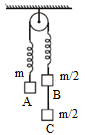
📝 Daily Practice Problem (DPP)🔴 Advanced🧠 Comprehension Skills📌 Mass Pulley Systems
👉 View Correct Answer & Step-by-Step Solution
Correct Answer: 0
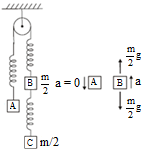
$\begin{matrix}W h e n t h e s t r i n g i s c u t t h e B w i l l r e b o u n c e b a c k w i t h a f o r c e \frac{m}{2} g \\ F r o m F . B . D o f B \\ \left(\frac{m}{2} g \frac{m}{2} g\right) \frac{m}{2} a \\ a = 0 \\ H e n c e a c c e l e r a t i o n o f a = 0 \\ H o w e v e r b l o c k ^{'} C^{'} f a l l s f r e e l y f a l l i n g \left(a = g\right) .\end{matrix}$
Q74. Two masses m1 = 5 kg and m2 = 4.8 kg tied to a string are hanging over a light frictionless pulley. What is the acceleration of the masses when they are free to move? (g = 9.8 m/s$^{2}$)
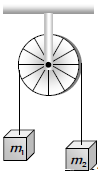
📝 Daily Practice Problem (DPP)🟡 Medium🧠 Analysing📌 Mass Pulley Systems
(A)0.2 m/s$^{2}$
(B)9.8 m/s$^{2}$
(C)5 m/s$^{2}$
(D)4.8 m/s$^{2}$
👉 View Correct Answer & Step-by-Step Solution (Option A)
Correct Option: (A)
0.2 m/s$^{2}$
$a = \left[\frac{m_{1} m_{2}}{m_{1} + m_{2}}\right] g = \left[\frac{5 4 .8}{5 + 4 .8}\right] 9 .8 = 0 .2 m / s^{2}$
Q75. Figure shows a man of mass 80 kg standing on a light weighing machine kept in a box of mass 30 kg. The box is hanging from a pulley fixed to the ceiling through a light rope, the other end of which is held by the man himself. If the man manages to keep the box at rest, what is the weight (in kg) shown by the machine ? (g =10 m/s$^{2}$)
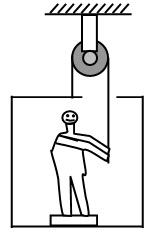
📝 Daily Practice Problem (DPP)🟡 Medium🧠 Applying📌 Mass Pulley Systems
👉 View Correct Answer & Step-by-Step Solution
Correct Answer: 55
Given:
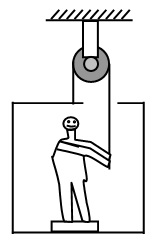
Mass of man = 80 kg
Mass of box m = 30 kg
When box & man at rest as shown in fig. then in equilibrium
2T = (M + m) g
2T = 1100
Weight shown by machine is equal to $\frac{T}{g} = 55 kg$
Q76. Calculate the tension in the string shown in figure. The pulley and the string are light and all the surfaces are frictionless. Take _g_ = 10 m/s$^{2}$.
📝 Daily Practice Problem (DPP)🟡 Medium🧠 Applying📌 Mass Pulley Systems
👉 View Correct Answer & Step-by-Step Solution
Q77. In the previous problem, suppose _m_$_{2}$ = 2.0 kg and _m_$_{3}$ = 3.0 _kg_. What should be the mass _m_ so that it remains at rest ?
📝 Daily Practice Problem (DPP)🟡 Medium🧠 Applying📌 Mass Pulley Systems
👉 View Correct Answer & Step-by-Step Solution
When the tension in the string _m_$_{1}$ equals _mg_, the mass of the block _m_$_{1}$ is resting.
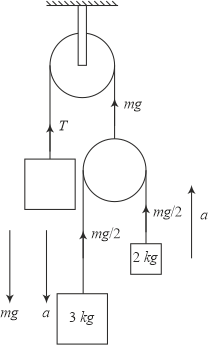
$T = m g$
$\begin{aligned}3 g - \frac{m g}{2} = 3 a \left(i\right) \\ \frac{m g}{2} - 2 g = 2 a \left(i i\right)\end{aligned}$
From equations (i) & (ii)
$\begin{matrix}g = 5 a \\ a = \frac{g}{5} m / s^{2}\end{matrix}$
Put the acceleration value into the equation (i)
$\begin{matrix}3 g - \frac{m g}{2} = \frac{3 g}{5} \\ \frac{m g}{2} = 3 g - \frac{3 g}{5} = \frac{12}{5} g \\ \frac{m g}{2} = \frac{12}{5} g\end{matrix}$
$ m = 4.8 k g$
Q78. Calculate the tension in the string shown in figure. The pulley and the string are light and all the surfaces are frictionless. Take _g_ = 10 m/s$^{2}$.
📝 Daily Practice Problem (DPP)🟡 Medium🧠 Applying📌 Mass Pulley Systems
👉 View Correct Answer & Step-by-Step Solution
Two block of mass 1 kg are connected the help of string and pulley as shown in div
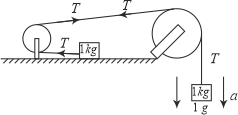
By balancing the forces on both the blocks
$\begin{matrix}g - T = a - \left(i\right) \\ T = a - \left(i i\right)\end{matrix}$
from eq (i) and eq (ii)
$\begin{matrix}g = 2 a \\ a = \frac{g}{2}\end{matrix}$
Put the value of a in equation (ii)
$\begin{matrix}T = \frac{g}{2} = 4.9 N \\ T = 5 N\end{matrix}$
Q79. Find the acceleration of block A immediately after the string is cut.
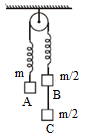
📝 Daily Practice Problem (DPP)🔴 Advanced🧠 Comprehension Skills📌 Mass Pulley Systems
👉 View Correct Answer & Step-by-Step Solution
Correct Answer: 0
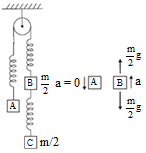
$\begin{matrix}W h e n t h e s t r i n g i s c u t t h e B w i l l r e b o u n c e b a c k w i t h a f o r c e \frac{m}{2} g \\ F r o m F . B . D o f B \\ \left(\frac{m}{2} g \frac{m}{2} g\right) \frac{m}{2} a \\ a = 0 \\ H e n c e a c c e l e r a t i o n o f a = 0 \\ H o w e v e r b l o c k ^{'} C^{'} f a l l s f r e e l y f a l l i n g \left(a = g\right) .\end{matrix}$
Q80. The block of mass ‘m’ equal to 100 kg is being pulled by a horizontal force F = 2 mg applied to a string as shown in figure (Take g = 10 m/s$^{2}$). The pulley is massless and is fixed at the edge of an immovable table. What is the value of force exerted by the supporting cable (rod) on the pulley (in Newton).
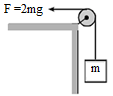
📝 Daily Practice Problem (DPP)🟡 Medium🧠 Applying📌 Mass Pulley Systems
(A)3 mg
(B)4 mg
(C)2√2 mg
(D)2 mg
👉 View Correct Answer & Step-by-Step Solution (Option C)
Correct Option: (C)
2√2 mg
The F.B.D of pulley is as shown

$\begin{matrix}L e t \left(\overset{}{T}\right)_{1} , \left(\overset{}{T}\right)_{2} a n d \left(\overset{}{F}\right)_{S} b e t h e f o r c e e x e r t e d b y t h e h o r i z o n t a l s t r i n g , \\ v e r t i c a l s t r i n g a n d t h e s u p p o r t o n t h e m a s s l e s s p u l l e y r e s p e c t i v e l y . \\ t h e n \\ \left(\overset{}{T}\right)_{1} + \left(\overset{}{T}\right)_{2} + \left(\overset{}{F}\right)_{S} = 0 \\ o r \left|\right. \left(\overset{}{F}\right)_{S} \left|\right. = \left|\right. \left(\overset{}{T}\right)_{1} + \left|\right. \left(\overset{}{T}\right)_{2} \left|\right. = 2 \sqrt{2} m g \\ \left(T e n s i o n i n e a c h s t r i n g i s \left|\right. \left(\overset{}{T}\right)_{1} \left|\right. = \left|\right. \left(\overset{}{T}\right)_{2} \left|\right. = 2 m g\right)\end{matrix}$
Q81. Two block of mass $M_{1}%%MATHJAX_DISP_0%%M 2$are attached with the help of string and pully as shown in figure
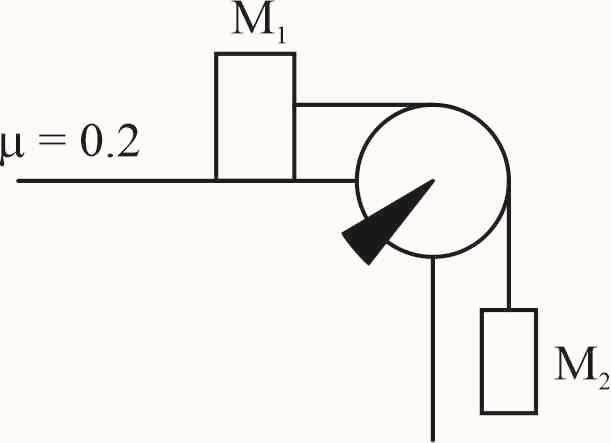
Find out the value of $M_{2}%%MATHJAX_DISP_1%%M 1$ moves with an accelerator of $2 m / s 2 \left(M 1 = 2 kg\right)%%MATHJAX_DISP_2%%g l 5$
(B)$\sqrt{g \mathcal{l}}%%MATHJAX_DISP_3%%5 g l$
(D)None of these
👉 View Correct Answer & Step-by-Step Solution (Option A)
Correct Option: (A)
$\sqrt{\frac{g \mathcal{l}}{5}}$
For body _B_ : _mg_ – _T_ = _m_(2_a_)
For body $A : \textrm{ } 2 T \textrm{ } - \textrm{ } mg \textrm{ } = ma \Rightarrow a = \frac{g}{5}$
$a_{B} = 2 a_{A}$ and $a_{A} = a$
$\therefore$Velocity of _B_ after travelling distance _l_
_$= \sqrt{2 as} = \sqrt{\frac{4 g \mathcal{l}}{5}}$_

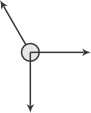
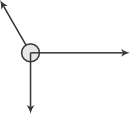
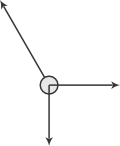
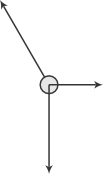
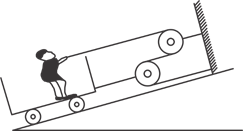
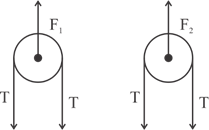 }$
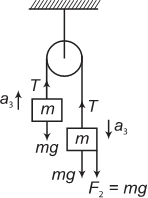
$_{$a_{1} = \frac{4 m g - 2 m g}{6 m} = \frac{2 m g}{6 m} = \frac{g}{3}$}$
$_{$\therefore \textrm{ } T_{1} = \frac{8 m g}{3} \textrm{ } \therefore \textrm{ } F_{1} = \frac{16 m g}{3}$}$
Case (ii): $F_{2} = 2 T_{2}$
$a_{2} = \frac{4 m g - 2 m g}{6 m} = \frac{g}{3}$
$\therefore \textrm{ } 4 m g - T_{2} = 4 m \textrm{ }\textrm{ } \frac{g}{3}$
$T_{2} = \frac{8 m g}{3} \textrm{ }\textrm{ }\textrm{ }\textrm{ } \therefore \textrm{ } F_{2} = 2 T_{2} = \frac{16 m g}{3}$
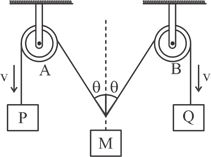
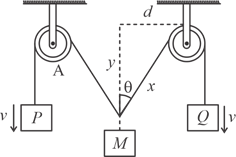 Here $x^{2} = y^{2} + d^{2}$
$2 x \frac{d x}{d t} = 2 y \frac{d y}{d t} \Rightarrow \frac{d y}{d t} = \left(\frac{x}{y}\right) \left(\frac{d x}{d t}\right) = \left(\frac{x}{y}\right) \left(v\right) = \frac{v}{cos \theta}$
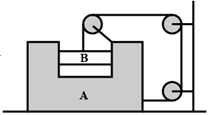
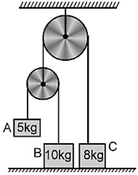
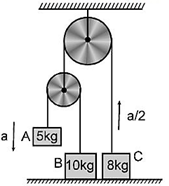 2g = 14a
a = g/7
∴ a/2 = g/14 = 9.8/14 = 7/10 = 0.7 m/s$^{2}$
x/10 = 7/10
∴ ( x + 3)$^{2}$ = 10$^{2}$ = 100