Are you aiming for a top percentile in JEE Main 2027 Physics? The Maxwell Speed Distribution is a fundamental concept within the Kinetic Theory of Gases, consistently appearing in past year papers. Mastering this chapter is non-negotiable for securing those crucial marks, as it forms the bedrock for understanding gas behavior and thermodynamics. This topic often tests your ability to apply formulas and interpret graphical representations, making it a high-yield area for competitive exams.
This comprehensive PYQ PDF for Maxwell Speed Distribution is your ultimate tool to conquer this chapter for JEE 2027. It provides meticulously solved previous year questions, exposing you to the exact problem patterns and conceptual traps set by examiners. By practicing these step-by-step solutions, you'll not only solidify your understanding but also develop the speed and accuracy required to ace the JEE Main Physics section.
🤖
AI Direct Answer & Quick Concept Summary
The Maxwell-Boltzmann speed distribution describes the range of speeds for particles in an ideal gas at a specific temperature, showing that not all particles move at the same speed. It's crucial for understanding kinetic theory, relating temperature to molecular motion, and calculating various average speeds like RMS, average, and most probable speeds. Problems typically involve applying these speed formulas and understanding their relationships for JEE Main 2027.
⚡ High-Yield Exam Rules & Formulas:
- Most Probable Speed: $v_{mp} = \sqrt{\frac{2RT}{M}}$
- Average Speed: $v_{avg} = \sqrt{\frac{8RT}{\pi M}}$
- Root Mean Square (RMS) Speed: $v_{rms} = \sqrt{\frac{3RT}{M}}$
- Relationship: $v_{mp} : v_{avg} : v_{rms} = \sqrt{2} : \sqrt{\frac{8}{\pi}} : \sqrt{3} \approx 1 : 1.128 : 1.224$
🎯 DPP & Worksheet Scope: This DPP focuses on numerical problems involving the calculation and comparison of RMS, average, and most probable speeds, their dependence on temperature and molecular mass, and conceptual questions related to the kinetic theory of gases.
Maxwell Speed Distribution
Q1. Sound travel in a mixture of two moles of helium and _n_ moles of hydrogen. If rms speed of gas molecules in the mixture is
$\sqrt 2$ times the speed of sound, then the value of _n_ will be
📝 Daily Practice Problem (DPP)🟡 Medium🧠 Applying📌 Maxwell Speed Distribution
👉 View Correct Answer & Step-by-Step Solution (Option B)
Correct Option: (B)
$v_{s} = \sqrt{\frac{\gamma R T}{M}}$
$v_{r m s} = \sqrt{\frac{3 R T}{M}}$
$\frac{v_{s}}{v_{r m s}} = \sqrt{\frac{\gamma}{3}} = \frac{1}{\sqrt{2}} \Rightarrow \frac{\gamma}{3} = \frac{1}{2} \Rightarrow \gamma = \frac{3}{2}$
$\gamma = 1 + \frac{2}{f_{m i x}}$
$f_{m i x} = \frac{2 \times 3 + n \times 5}{n + 2} = \frac{6 + n \times 5}{\left(n + 2\right)}$
$\gamma = 1 + \frac{2 \left(n + 2\right)}{6 + n \times 5} = \frac{6 + 5 n + 2 n + 4}{6 + 5 n}$
$\gamma = \frac{7 n + 10}{6 + 5 n} = \frac{3}{2}$
14_n_ + 20 = 18 + 15_n_
_n_ = 2
Q2. Following statements are given
(1) The average kinetic energy of a gas molecule decreases when the temperature is reduced.
(2) The average kinetic energy of a gas molecule increases with increase in pressure at constant temperature.
(3) The average kinetic energy of a gas molecule decreases with increases in volume.
(4) Pressure of a gas increases with increase in temperature at constant volume.
(5) The volume of gas decreases with increase in temperature.
Choose the correct answer from the options given below:
📝 Daily Practice Problem (DPP)🟡 Medium🧠 Applying📌 Maxwell Speed Distribution
(A)(1) and (4) only
(B)(1), (2) and (4) only
(C)(2) and (4) only
(D)(1), (2) and (5) only
👉 View Correct Answer & Step-by-Step Solution (Option A)
Correct Option: (A)
(1) and (4) only
$K E_{\text{avg}\&\text{nbsp};} = \frac{3}{2} k_{B} T$
$P \propto T \left(V = \&\text{nbsp};\text{constant}\&\text{nbsp};\right)$
Q3. A mixture of 2 moles of helium gas (atomic mass = 4 _u_), and 1 mole of argon gas (atomic mass = 40_u_) is kept at 300 _K_ in a container. The ratio of their rms speeds
$\left[\frac{{V}_{rms}(\text{helium)}}{{V}_{rms}\left(\text{argon}\right)}\right]$ , is close to :
📝 Daily Practice Problem (DPP)🟡 Medium🧠 Understanding📌 Maxwell Speed Distribution
(A)0.32
(B)0.45
(C)2.24
(D)3.16
👉 View Correct Answer & Step-by-Step Solution (Option D)
Correct Option: (D)
3.16
RMS speed of a particle $V_{r m s} = \sqrt{\frac{3 R T}{M}}$ for some temperature
$V_{r m s} \times \sqrt{\frac{1}{M}}$
$\frac{V_{r m s \left(M e\right)}}{V_{r m s \left(A r\right)}} = \sqrt{\frac{40}{4}} = \sqrt{10} = 3.16$
Q4. What will be the effect on the root mean square velocity of oxygen molecules if the temperature is doubled and oxygen molecule dissociates into atomic oxygen?
📝 Daily Practice Problem (DPP)🟡 Medium🧠 Applying📌 Maxwell Speed Distribution
(A)The velocity of atomic oxygen remains same
(B)The velocity of atomic oxygen doubles
(C)The velocity of atomic oxygen becomes half
(D)The velocity of atomic oxygen becomes four times
👉 View Correct Answer & Step-by-Step Solution (Option B)
Correct Option: (B)
The velocity of atomic oxygen doubles
$V_{r m s} = \sqrt{\frac{3 R T}{M}}$
_T→_ 2_T_
$M \rightarrow \frac{M}{2}$
$V_{r m s} \propto \sqrt{\frac{T}{M}}$
$\Rightarrow \left(V_{r m s}\right)_{a t o m i c} = \left(V_{r m s}\right)_{m o l e c u l a r} \times \sqrt{\frac{2}{1 / 2}} = 2 \left(V_{r m s}\right)_{m o l e c u l a r}$
Q5. The value closest to the thermal velocity of a Helium atom at room temperature (300 _K_) in _ms_$^{−1}$ is : [ _k$_{B}$_ = 1.4 × 10$^{−23}$ _J_/_K_; _m$_{He}$_ = 7 × 10$^{−27}$ _kg_]
📝 Daily Practice Problem (DPP)🟢 Easy🧠 Applying📌 Maxwell Speed Distribution
(A)1.3 × 10$^{4}$
(B)1.3 × 10$^{3}$
(C)1.3 × 10$^{5}$
(D)1.3 × 10$^{2}$
(B)$\sqrt{\frac{8}{3}}$
(C)$\sqrt{\frac{3\mathrm{\pi }}{8}}$
(D)$\sqrt{\frac{8\mathrm{\pi }}{3}}$
👉 View Correct Answer & Step-by-Step Solution (Option B)
Correct Option: (B)
1.3 × 10$^{3}$
The root mean velocity of the gas molecules is
$\sqrt{\frac{3}{3}}$
(b.) $\sqrt{\frac{8}{3}}$
(c.) $\sqrt{\frac{3\mathrm{\pi }}{8}}$
(d.) $\sqrt{\frac{8\mathrm{\pi }}{3}}$
Ans: c
Exp: Correct Answer is: $\sqrt{\frac{3\mathrm{\pi }}{8}}$
$v_{rms} = \sqrt{\frac{3 RT}{M}}$
$v_{avg} = \sqrt{\frac{8}{\pi} \frac{RT}{M}}$
$\frac{v_{rms}}{v_{avg}} = \sqrt{\frac{3 \pi}{8}}$
Q9. The temperature, at which the root mean square, the velocity of hydrogen molecules equals their escape velocity from the earth, is closest to : [Boltzmann constant $k_{B} = 1 . 38 \times 10^{- 23} J / K${\displaystyle \mathrm{C}\phantom{\rule{\;}{0ex}}\phantom{\rule{\;}{0ex}}m{{s}^{-}}^{1}}$
(B)${\displaystyle \frac{1}{\mathrm{C}}\phantom{\rule{\;}{0ex}}\phantom{\rule{\;}{0ex}}m{{s}^{-}}^{1}}$
(C)${\displaystyle 4\mathrm{C}\phantom{\rule{\;}{0ex}}\phantom{\rule{\;}{0ex}}m{{s}^{-}}^{1}}$
(D)${\displaystyle \frac{\mathrm{C}}{4}\phantom{\rule{\;}{0ex}}\phantom{\rule{\;}{0ex}}m{{s}^{-}}^{1}}$
👉 View Correct Answer & Step-by-Step Solution (Option C)
Correct Option: (C)
${\displaystyle 4\mathrm{C}\phantom{\rule{\;}{0ex}}\phantom{\rule{\;}{0ex}}m{{s}^{-}}^{1}}$
$\begin{matrix}\begin{matrix}v_{r m s} \frac{1}{\sqrt{M}} \frac{v_{O_{2}}}{v_{H_{2}}} = \sqrt{\frac{M_{H_{2}}}{M_{O_{2}}}} \frac{C}{v_{H_{2}}} = \sqrt{\frac{2}{32}} = \frac{1}{4}\end{matrix} \\ \begin{matrix} v_{H_{2}} = 4 C m / s\end{matrix}\end{matrix}$
Q17. At what temperature the molecule of nitrogen will have same rms velocity as the molecule of oxygen at 127 _℃_ ?
📝 Daily Practice Problem (DPP)🟡 Medium🧠 Applying📌 Maxwell Speed Distribution
(A)457 _$^{°}$C_
(B)273 $^{_°_}$_C_
(C)350_$^{°}$C_
(D)77 $^{_°_}$_C_
👉 View Correct Answer & Step-by-Step Solution (Option D)
Correct Option: (D)
77 $^{_°_}$_C_
$\begin{matrix}R M S v e l o c i t y o f g a s i s v_{r m s} = 1 .73 \left(\frac{R T}{M}\right)^{\frac{1}{2}} \\ M = M o l e c u l a r m a s s \\ F o r o x y g e n , M = 16 2 \\ T = 127 ^{} C = 127 + 273 = 400 K \\ F o r n i t r o g e n , M = 17 2 , T \\ 1 .73 \left(\frac{R T}{M}\right)_{O_{2}}^{\frac{1}{2}} = 1 .73 \left(\frac{R T}{M}\right)_{N_{2}}^{\frac{1}{2}} \\ \left(\frac{T}{M}\right)_{O_{2}}^{\frac{1}{2}} = \left(\frac{T}{M}\right)_{N_{2}}^{\frac{1}{2}} \\ \sqrt{T_{N_{2}}} = \sqrt{\frac{M_{N_{2}}}{M_{O_{2}}} T_{O_{2}}} \\ = \sqrt{\frac{28}{32} 400} \\ = \sqrt{\frac{7}{8} 400} \\ T_{N_{2}} = \frac{7}{8} 400 = 350 K \\ T_{N_{2}} = 350 K 273 K = 77 ^{} C\end{matrix}$
Q18. The temperature at which the r.m.s. speed of hydrogen molecules is equal to escape velocity on earth surface, will be
📝 Daily Practice Problem (DPP)🟡 Medium🧠 Evaluating📌 Maxwell Speed Distribution
(A)1060 _K_
(B)5030 _K_
(C)8270 _K_
(D)10063 _K_
👉 View Correct Answer & Step-by-Step Solution (Option D)
Correct Option: (D)
10063 _K_
$\begin{matrix}\begin{matrix}E s c a p e v e l o c i t y f r o m t h e e a r t h s s u r f a c e i s 11.2 k m / sec\end{matrix} \\ \begin{matrix}\begin{matrix}s o , v_{r m s} = v_{e s c a p e} = \sqrt{\frac{3 R T}{M}}\end{matrix}\end{matrix} \\ \begin{matrix}\begin{matrix} T = \frac{\left(v_{e s c a p e}\right)^{2} M}{3 R}\end{matrix}\end{matrix} \\ \begin{matrix}\begin{matrix}= \frac{\left(11.2 10^{3}\right)^{2} \left(2 10^{ 3}\right)}{3 8.31} = 10063 K\end{matrix}\end{matrix}\end{matrix}$
Q19. The rms velocity of gas molecules is 300 _ms_$^{-1}$. The rms velocity of molecules of gas with twice the molecular weight and half the absolute temperature is
📝 Daily Practice Problem (DPP)🟢 Easy🧠 Applying📌 Maxwell Speed Distribution
(A)300 _ms_$^{-1}$
(B)600 _ms_$^{-1}$
(C)75 _ms_$^{-1}$
(D)150 _ms_$^{-1}$
👉 View Correct Answer & Step-by-Step Solution (Option D)
Correct Option: (D)
150 _ms_$^{-1}$
Root mean square velocity,
$c = \sqrt{\frac{3 p V}{M}} = \sqrt{\frac{3 R T}{M}}$
$c_{1} = \sqrt{\frac{3 R \left(T / 2\right)}{2 M}} = \frac{1}{2} \sqrt{\frac{3 R T}{M}}$
Q20. The ratio of the vapour densities of two gases at a given temperature is 9:8. The ratio of the rms velocities of their molecules is
📝 Daily Practice Problem (DPP)🟢 Easy🧠 Applying📌 Maxwell Speed Distribution
(A)${\displaystyle 3:2\sqrt{2}}$
(B)${\displaystyle 2\sqrt{2}:3}$
(C)${\displaystyle 9:8}$
(D)${\displaystyle 8:9}$
👉 View Correct Answer & Step-by-Step Solution (Option B)
Correct Option: (B)
${\displaystyle 2\sqrt{2}:3}$
$\begin{matrix}R o o t m e a n s q u a r e s p e e d \\ v_{r m s} \frac{1}{\sqrt{}} \\ \frac{v_{r m s}_{1}}{v_{r m s}_{2}} = \sqrt{\frac{_{2}}{_{1}}} \\ G i v e n \frac{_{1}}{_{2}} = \frac{9}{8} \\ \frac{v_{r m s}_{1}}{v_{r m s}_{2}} = \sqrt{\frac{8}{9}} = \frac{2 \sqrt{2}}{3}\end{matrix}$
Q21. At temperature T the r.m.s. speed of helium molecules is the same as r.m.s speed of hydrogen molecules at normal temperature and pressure. The value of T is
📝 Daily Practice Problem (DPP)🟢 Easy🧠 Applying📌 Maxwell Speed Distribution
(A)273°C
(B)546°C
(C)0°C
(D)136.5°C
👉 View Correct Answer & Step-by-Step Solution (Option A)
Correct Option: (A)
273°C
$\begin{matrix}V_{r m s} = \sqrt{\frac{3 R T}{M}} \Rightarrow T \propto M \Rightarrow \frac{T_{H e}}{T_{H}} = \frac{M_{H e}}{M_{H}} \\ \Rightarrow \frac{\left(273 + 0\right)}{T_{H e}} = \frac{2}{4} \Rightarrow T_{H e} = 546 K = 273^{\circ} C\end{matrix}$
Q22. The kinetic energy, due to translation motion, of most of the molecules of an ideal gas at absolute temperature T is
📝 Daily Practice Problem (DPP)🟢 Easy🧠 Applying📌 Maxwell Speed Distribution
(A)$k T$v_{\mathrm{rms}}$ the most probable speed and the average speed obeys the relationship {{PYQ: N/A}} {Meta: TOPIC: Maxwell Speed Distribution; Difficulty: Easy; Blooms Taxonomy: Understanding}
(A)_v$_{av}$_ > _v$_{rms}$_ > _v$_{mp}$_
(B)_v$_{rms}$_ > _v$_{av}$_ > _v$_{mp}$_
(C)_v$_{mp}$_ > _v$_{av}$_ > _v$_{rms}$_
(D)_v$_{mp}$_ > _v$_{rms}$_ > _v$_{av}$_
👉 View Correct Answer & Step-by-Step Solution (Option B)
Correct Option: (B)
_v$_{rms}$_ > _v$_{av}$_ > _v$_{mp}$_
$v_{r m s} = \sqrt{\frac{3 k T}{\text{ } m}} , v_{a v} = \sqrt{\frac{8 k T}{\text{ } m \pi}} a n d v_{m p} = \sqrt{\frac{2 k T}{\text{ } m}}$
_⇒ v<$_{rms}$_ : _v<$_{av}$_ : _v<$_{mp}$_ = 1 : 0.92 : 0.816
_∴ v<$_{rms}$_ > _v<$_{av}$_< > _v<$_{mp}$_
Q27. The gas having average speed four times as that of (molecular mass 64) is
📝 Daily Practice Problem (DPP)🟡 Medium🧠 Applying📌 Maxwell Speed Distribution
(A)He (molecular mass 4)
(B)O$_{2}$ (molecular mass 32)
(C)H$_{2}$ (molecular mass 2)
(D)H$_{4}$ (molecular mass 16)
👉 View Correct Answer & Step-by-Step Solution (Option A)
Correct Option: (A)
He (molecular mass 4)
$\begin{matrix}A v e r a g e s p e e d \left(v_{a v}\right) o f g a s m o l e c u l e s i s i n v e r s e l y p r o p o r t i o n a l t o t h e \\ s q u a r e r o o t o f t h e a b s o l u t e t e m p e r a t u r e \left(T\right) o f t h e g a s \\ v_{a v} = \sqrt{\frac{8 R T}{ M}} \\ w h e r e R i s g a s c o n s t a n t a n d M t h e m o l e c u l a r w e i g h t \\ G i v e n v_{1} = v , M_{1} = 64 , v_{2} = 4 v \\ \frac{v_{1}}{v_{2}} = \sqrt{\frac{M_{2}}{M_{1}}} \\ \frac{v}{4 v} = \sqrt{\frac{M_{2}}{64}} \\ M_{2} = \frac{64}{16} = 4 \\ H e n c e , t h e g a s i s h e l i u m \left(m o l e c u l a r m a s s 4\right) .\end{matrix}$
Q28. The speeds of 5 molecules of a gas (in arbitrary units) are as follows: The root mean square speed for these molecules is
📝 Daily Practice Problem (DPP)🟢 Easy🧠 Evaluating📌 Maxwell Speed Distribution
(A)2.91
(B)3.52
(C)4.00
(D)4.24
👉 View Correct Answer & Step-by-Step Solution (Option D)
Q29. The r.ms. speed of the molecules of a gas at a pressure 10$^{5}$ _Pa_ and temperature 0°C is 0.5 _km-s_$^{-1}$. If the pressure is kept constant but the temperature is raised to 819 °_C_ the velocity will become
📝 Daily Practice Problem (DPP)🟢 Easy🧠 Applying📌 Maxwell Speed Distribution
(A)1.5 _km-s_$^{-1}$
(B)2 _km-s_$^{-1}$
(C)5 _km-s_$^{-1}$
(D)1 _km-s_$^{-1}$
👉 View Correct Answer & Step-by-Step Solution (Option D)
Correct Option: (D)
1 _km-s_$^{-1}$
$\begin{matrix}\frac{\left(v_{r m s}\right)_{1}}{\left(v_{r m s}\right)_{2}} = \sqrt{\frac{T_{1}}{T_{2}}} \\ \frac{500}{\left(v_{r m s}\right)_{2}} = \sqrt{\frac{0 + 273}{819 + 273}} = \sqrt{\frac{273}{1092}} \\ \left(v_{r m s}\right)_{2} = 500 \sqrt{\frac{1092}{273}} = 500 \sqrt{4} = 1000 m / s = 1 k m / s\end{matrix}$
Q30. If v is the rms velocity, then at constant pressure which of the following is true?
📝 Daily Practice Problem (DPP)🟢 Easy🧠 Applying📌 Maxwell Speed Distribution
(A)$v \propto \sqrt{\rho}$\frac{1}{32}$
(B)$\frac{2 \sqrt{2}}{1}$
(C)$\frac{1}{4}$
(D)$\frac{1}{2 \sqrt{2}}$
👉 View Correct Answer & Step-by-Step Solution (Option B)
Correct Option: (B)
$\frac{2 \sqrt{2}}{1}$
$V_{r m s} = \sqrt{\frac{3 R T}{M_{w}}}$
$\Rightarrow \frac{V_{O_{2}}}{V_{H e}} = \sqrt{\frac{M_{w , H e}}{M_{w , O_{2}}}}$
$= \sqrt{\frac{4}{32}} = \frac{1}{2 \sqrt{2}}$
$\frac{V_{H e}}{V_{O_{2}}} = \frac{2 \sqrt{2}}{1}$
Q43. Choose the correct statement
📝 Daily Practice Problem (DPP)🟢 Easy🧠 Remembering📌 Maxwell Speed Distribution
(A)bsolute zero degrees temperature is not the same as zero energy temperature.
(B)The root mean square velocities of two different gases at the same temperature and pressure are equal.
(C)t the same temperature, the roots mean square speed of molecules of different ideal gases is the same.
(D)Given a 1 cc hydrogen and 1 cc oxygen sample, both at NTP, the oxygen sample has a large number of molecules.
👉 View Correct Answer & Step-by-Step Solution (Option A)
Correct Option: (A)
Absolute zero degrees temperature is not the same as zero energy temperature.
At absolute temperature kinetic energy of gas molecules becomes zero but they have potential energy so we can say that absolute zero degree temperature is not zero energy temperature.
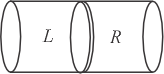
Q44. A vessel is partitioned in two equal halves by a fixed diathermic separator. Two different ideal gases are filled in left (_L_) and right (_R_) halves. The rms speed of the molecules in _L_ part is equal to the mean speed of molecules in the _R_ part. Then the ratio of the mass of a molecule in _L_ part to that of a molecule in _R_ part is
📝 Daily Practice Problem (DPP)🟡 Medium🧠 Analysing📌 Maxwell Speed Distribution
(A)$\sqrt{3 / 2}$
(B)$\sqrt{2 / 3}$
(C)$\sqrt{\pi / 4}$
(D)$3 \pi / 8$
👉 View Correct Answer & Step-by-Step Solution (Option D)
Correct Option: (D)
$3 \pi / 8$
$\left(V_{r m s}\right)_{L} = \left(V_{a r g}\right)_{R}$
$\sqrt{\frac{3 R T}{M_{1}}} = \sqrt{\frac{8 R T}{\pi M_{2}}}$
$\Rightarrow \frac{M_{1}}{M_{2}} = \frac{3 \pi}{8}$
Q45. _N_ (< 100) molecules of a gas have velocities 1, 2, 3 ........ _N_/_km_/_s_ respectively. Then
📝 Daily Practice Problem (DPP)🔴 Advanced🧠 Applying📌 Maxwell Speed Distribution
(A)rms speed and average speed of molecules is same.
(B)ratio of rms speed to average speed is $\frac{{\sqrt {(2N + 1)(N + 1)} }}{{6N}}$
(C)ratio of rms speed to average speed is $\frac{{\sqrt {(2\;N + 1)(N + 1)} }}{6}$
(D)ratio of rms speed to average speed of a molecules is $\frac{2}{{\sqrt 6 }} \times \sqrt {\frac{{(2N + 1)}}{{(N + 1)}}}$
👉 View Correct Answer & Step-by-Step Solution (Option D)
Correct Option: (D)
ratio of rms speed to average speed of a molecules is $\frac{2}{{\sqrt 6 }} \times \sqrt {\frac{{(2N + 1)}}{{(N + 1)}}}$
Q46. The velocity of 4 gas molecules are given by 1 _km/s_, 3 _km/s_, 5 _km/s_, and 7 _km/s_. Calculate the difference between average and r.m.s velocity?
📝 Daily Practice Problem (DPP)🟡 Medium🧠 Aptitude Skills📌 Maxwell Speed Distribution
(A)0.338 _km/s_
(B)0.438 _km/s_
(C)0.538 _km/s_
(D)0.683 _km/s_
👉 View Correct Answer & Step-by-Step Solution (Option C)
Correct Option: (C)
0.538 _km/s_
The average velocity $= \frac{1 + 3 + 5 + 7}{4} k m / s = 4 \textrm{ }\textrm{ } k m / s$
$v_{r m s} = \sqrt{\frac{v_{1}^{2} + v_{2}^{2} + v_{3}^{2} + \ldots + v_{n}^{2}}{\textrm{ }\textrm{ } N}}$
$= \sqrt{\frac{1 + \left(3\right)^{2} + \left(5\right)^{2} + \left(7\right)^{2}}{4}}$
$= \textrm{ }\textrm{ } \sqrt{21} = 4.583 \textrm{ }\textrm{ } k m / s$
Difference between average velocity and root mean square velocity
= 4.583 – 4
0.583 _km/s_
Q47. If mass of Helium is 4 times that of hydrogen, then mean velocity of Helium is
📝 Daily Practice Problem (DPP)🟢 Easy🧠 Applying📌 Maxwell Speed Distribution
(A)2 times of Hydrogen – mean velocity
(B)$\frac12$ times of Hydrogen – mean velocity
(C)4 times of Hydrogen – mean velocity
(D)Same as Hydrogen – mean velocity
👉 View Correct Answer & Step-by-Step Solution (Option B)
Correct Option: (B)
$\frac12$ times of Hydrogen – mean velocity
Average speed or mean speed of gas molecules
$\overset{ˉ}{v} = \sqrt{\frac{8 R T}{\pi M}} \&\text{nbsp};\text{or}\&\text{nbsp}; \overset{ˉ}{v} \propto \frac{1}{\sqrt{M}}$
$\&\text{nbsp};\text{or}\&\text{nbsp}; \frac{\left(\overset{ˉ}{v}\right)_{H}}{\left(\overset{ˉ}{v}\right)_{H e}} = \sqrt{\frac{M_{H z}}{M_{H}}}$
Here _M<$_{HE}$_ = 4 _M<$_{H}$_
$\therefore \frac{\left(\overset{ˉ}{v}\right)_{H}}{\left(\overset{ˉ}{v}\right)_{H e}} = \sqrt{\frac{4}{1}} = 2$
$\left(\overset{ˉ}{v}\right)_{H e} = \frac{1}{2} \left(\overset{ˉ}{v}\right)_{H}$
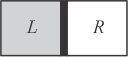
Q48. A vessel is partitioned in two equal halves by a fixed diathermic separator. Two different ideal gases are filled in left (_L_) and right (_R_) halves. The rms speed of the molecules in _L_ part is equal to the mean speed of molecules in the _R_ part. Then the ratio of the mass of a molecule in _L_ part to that of a molecule in _R_ part is
📝 Daily Practice Problem (DPP)🟡 Medium🧠 Applying📌 Maxwell Speed Distribution
(A)${\displaystyle \sqrt{\frac{3}{2}}}$
(B)${\displaystyle \sqrt{\frac{\pi }{4}}}$
(C)${\displaystyle \sqrt{\frac{2}{3}}}$
(D)${\displaystyle \frac{3\pi }{8}}$
👉 View Correct Answer & Step-by-Step Solution (Option D)
Correct Option: (D)
${\displaystyle \frac{3\pi }{8}}$
$v_{r m s} = \sqrt{\frac{3 K T}{m}}$
Root means square velocity of molecule in left part Mean of average speed of molecule in right part
according to problem $\sqrt{\frac{3 K T}{m_{L}}} = \sqrt{\frac{8}{\pi} \frac{K T}{m_{R}}}$
$\Rightarrow \frac{3}{m_{L}} = \frac{8}{\pi m_{R}} \Rightarrow \frac{m_{L}}{m_{R}} = \frac{3 \pi}{8}$
Q49. In the two vessels of the same volume, atomic hydrogen and helium at pressure 1 _atm_ and 2 _atm_ are filled. If the temperature of both the samples is the same, then the average speed of hydrogen atoms _v_$_{H}$ will be related to that of helium _v_$_{He}$ as
📝 Daily Practice Problem (DPP)🟡 Medium🧠 Applying📌 Maxwell Speed Distribution
(A)$v_{\mathrm{H}}=\sqrt{2 v_{\mathrm{He}}}$
(B)_v$_{H}$_ = _v$_{He}$_
(C)_v$_{H}$_ = 2_v_$_{He}$
(D)$v_{\mathrm{H}}=\frac{v_{\mathrm{He}}}{2}$
👉 View Correct Answer & Step-by-Step Solution (Option C)
Correct Option: (C)
_v$_{H}$_ = 2_v_$_{He}$
Average speed is given by:
$v_{\text{avg}\&\text{nbsp};} = \sqrt{\frac{8 R T}{\pi M}}$
$v_{H} = \sqrt{\frac{8 R T}{\pi \left(1\right)}}$
$v_{H e} = \sqrt{\frac{8 R T}{\pi \left(4\right)}} = \frac{1}{2} v_{H}$
i.e., _v_<$_{H}$ = 2_v<$_{He}$_
Q50. Let the two gases follow given relation :
$\frac{{{T_A}}}{{{M_A}}} = 4\frac{{{T_B}}}{{{M_B}}}:$ where _T_ is the temperature and _M_ is molecular mass. If _C$_{A}$_ and _C$_{B}$_ are the r.m.s speed, then the radio will be equal to
📝 Daily Practice Problem (DPP)🟢 Easy🧠 Applying📌 Maxwell Speed Distribution
👉 View Correct Answer & Step-by-Step Solution (Option A)
Correct Option: (A)
$\frac{T_{A}}{M_{A}} = 4 \frac{T_{B}}{M_{B}} \Rightarrow \sqrt{\frac{T_{A}}{M_{A}}} = 2 \sqrt{\frac{T_{B}}{M_{B}}}$
$\Rightarrow \sqrt{\frac{3 R T_{A}}{M_{A}}} = 2 \sqrt{\frac{3 R T_{B}}{M_{B}}} \Rightarrow C_{A} = 2 C_{B} \Rightarrow \frac{C_{A}}{C_{B}} = 2$
Q51. For a given gas at 1 _atm_ pressure, rms speed of the molecules is 200 _m/s_ at 127° _C_. At 2 _atm_ pressure 227°_C_, the rms speed of the molecules will be
📝 Daily Practice Problem (DPP)🟡 Medium🧠 Understanding📌 Maxwell Speed Distribution
(A)$100\sqrt{5}\text{\space}m/s$
(B)8 _m/s_
(C)100 _m/s_
(D)$80\sqrt{5}\text{\space}m/s$
👉 View Correct Answer & Step-by-Step Solution (Option A)
Correct Option: (A)
$100\sqrt{5}\text{\space}m/s$
Key idea for a gas molecule,
$v_{r m s} = \sqrt{\frac{3 R T}{M}}$
$\therefore v_{r m s} \propto \sqrt{T}$
Let unknown rms speed by _v_<$_{rms}$, 2
at _T_<$_{2}$ = 227_°C_ (or 500 _K_)
and at _T_<$_{1}$ = 127_°C_ (or 400 _K_)
_v_<$_{rsm}$,1 = 200 _m/s_
∴ Using the relation $v_{\text{rms}\&\text{nbsp};} \propto \sqrt{T} ,$ we can write
$\frac{v_{r m s , 2}}{v_{r m s , 1}} = \sqrt{\frac{T_{2}}{T_{1}}} \&\text{nbsp};\&\text{nbsp}; . . . \left(\right. i \left.\right)$
Substituting these given value in equation (i), we get
$v_{r m s , \text{ } 2} = \sqrt{\frac{500}{400}} \times 200 \text{ } m / s$
$= \frac{1}{2} \sqrt{5} \times 200 \textrm{ }\textrm{ } m / s = 100 \sqrt{5} \textrm{ }\textrm{ } m / s$
Q52. The molecules of a given mass of a gas have a rms velocity of 200 _m/s_ at 27 _℃_ and 1.0 × 10$^{5}$_N/m$^{2}$_ pressure. When the temperature is 127 _℃_ and pressure is 0.5 × 10$^{5}$_N/m$^{2}$_, the rms velocity in _m/s_ will be
📝 Daily Practice Problem (DPP)🟡 Medium🧠 Applying📌 Maxwell Speed Distribution
(A)${\displaystyle \frac{100\sqrt{2}}{3}}$
(B)${\displaystyle 100\sqrt{2}}$
(C)${\displaystyle \frac{400}{\sqrt{3}}}$
(D)${\displaystyle \frac{200}{\sqrt{3}}}$
👉 View Correct Answer & Step-by-Step Solution (Option C)
Correct Option: (C)
${\displaystyle \frac{400}{\sqrt{3}}}$
RMS velocity does not depend upon pressure, it depends upon temperature only,
$i . e . , v_{\text{rms}\&\text{nbsp};} \propto \sqrt{T} .$
$\Rightarrow \frac{v_{1}}{v_{2}} = \sqrt{\frac{T_{1}}{\left(\&\text{nbsp}; T\right)_{2}}}%%MATHJAX_DISP_0%%x 3 m / s$ when temp is 127$^{o}$C and 2 atm pressure.
find value of x.
📝 Daily Practice Problem (DPP)🟡 Medium🧠 Understanding📌 Maxwell Speed Distribution
👉 View Correct Answer & Step-by-Step Solution
Correct Answer: 400
RMS speed of gas is defined as
$V_{rms} = \sqrt{\frac{3 RT}{M_{0}}}$
$200 = \sqrt{\frac{3 R \times 300}{M_{0}}} . . . . . . \left(i\right)$
In second condition
$\frac{x}{\sqrt{3}} = \sqrt{\frac{3 R \times 400}{M_{0}}} . . . . \left(ii\right)$
From equation first and second
$\frac{200}{\frac{x}{\sqrt{3}}} = \sqrt{\frac{3 R \times 400}{M_{0}}}$
$\frac{200}{\frac{x}{\sqrt{3}}} = \sqrt{\frac{3}{4}}$
$\frac{200 \sqrt{3}}{x} = \frac{\sqrt{3}}{2}$
$X = 400 m / s$
Q89. A $15 g%%MATHJAX_DISP_1%%27 º C$. Amount of heat transferred to the gas, so that rms velocity of molecules is doubled, is about : $\left[Take R = 8 . 3 J / K moles\right]%%MATHJAX_DISP_2%%0 . 9 k J$
(B)$6 k J%%MATHJAX_DISP_3%%10 k J$
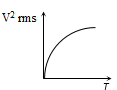
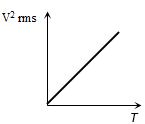
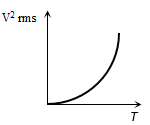
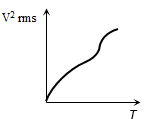
(D)$14 k J%%MATHJAX_DISP_4%%T h e c u r v e b e t w e e n a b s o l u t e t e m p e r a t u r e a n d v r m s 2 i s$
📝 Daily Practice Problem (DPP)🟢 Easy🧠 Applying📌 Maxwell Speed Distribution
👉 View Correct Answer & Step-by-Step Solution (Option B)
Correct Option: (B)
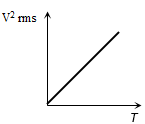
$v_{r m s} = \sqrt{\frac{3 R T}{M}} v_{r m s}^{2} T$
Q91. $\begin{matrix}\text{If the ratio of vapour density for hydrogen and oxygen is} \frac{1}{16} t h e n \\ \text{under constant pressure the ratio of their rms velocities will be}\end{matrix}%%MATHJAX_DISP_5%%4 1$
(B)$\frac{1}{4}%%MATHJAX_DISP_6%%1 16$
(D)$\frac{16}{1}%%MATHJAX_DISP_7%%v 2 T = c o n s t a n t$
(B)$\frac{v^{2}}{T} = c o n s t a n t%%MATHJAX_DISP_8%%v T 2 = c o n s t a n t$
(D)$v i s i n d e p e n d e n t o f T%%MATHJAX_DISP_9%%A mixture of 2 moles of helium gas atomic mass = 4 u , and 1 mole of argon gas atomic mass = 40 u is kept at 300 K in a container . The ratio of their rms speeds V ms helium V ms argon is close to .$
📝 Daily Practice Problem (DPP)🟢 Easy🧠 Evaluating📌 Maxwell Speed Distribution
(A)2.24
(B)0.45
(C)3.16
(D)0.32
👉 View Correct Answer & Step-by-Step Solution (Option C)
Correct Option: (C)
3.16
$\begin{matrix}\frac{\text{V}_{\text{ms}} \left(\text{helium}\right)}{\text{V}_{\text{ms}} \left(\text{argon}\right)} \textrm{ } = \textrm{ } \sqrt{\frac{\text{M}_{\text{ar}}}{\text{M}_{\text{he}}}} \\ \text{at} \textrm{ } \text{same} \textrm{ } \text{temperature} \textrm{ } \\ \frac{\text{V}_{\text{ms}} \left(\text{helium}\right)}{\text{V}_{\text{ms}} \left(\text{argon}\right)} \textrm{ } = \textrm{ } \sqrt{\frac{\text{40}}{\text{4}}} \textrm{ } = \textrm{ } \text{3} .\text{16}\end{matrix}$
Q94. The absolute temperature of a gas is determined by
📝 Daily Practice Problem (DPP)🟢 Easy🧠 Understanding📌 Maxwell Speed Distribution
(A)The average momentum of the molecules.
(B)The velocity of sound in the gas.
(C)The number of molecules in the gas.
(D)The mean square velocity of the molecules.
👉 View Correct Answer & Step-by-Step Solution (Option D)
Correct Option: (D)
The mean square velocity of the molecules.
$Sin c e v_{r m s} \sqrt{T} . A l s o m e a n s q u a r e v e l o c i t y \overset{}{v^{2}} = v_{r m s}^{2}$
Q95. In thermal equilibrium, the average velocity of gas molecules is
📝 Daily Practice Problem (DPP)🟢 Easy🧠 Remembering📌 Maxwell Speed Distribution
(A)$P r o p o r t i o n a l t o \sqrt{T}%%MATHJAX_DISP_10%%P r o p o r t i o n a l t o T 2$
(C)$P r o p o r t i o n a l t o T^{3}%%MATHJAX_DISP_11%%Z e r o$
👉 View Correct Answer & Step-by-Step Solution (Option D)
Correct Option: (D)
$Z e r o$
The average velocity of gas molecules is zero as velocity components in different directions will cancel each other.
⚡ CBT Online Mock Testing • Target 2027
Attempt Chapter Test in Online CBT Test Series
20-minute timer, negative marking, instant score card, and All-India Rank comparison.
⚡ Start CBT Test
✅ Key Takeaways & Exam Summary
- The three characteristic speeds are most probable ($v_{mp}$), average ($v_{avg}$), and root mean square ($v_{rms}$).
- The relationship between these speeds is always $v_{rms} > v_{avg} > v_{mp}$.
- All molecular speeds are directly proportional to the square root of the absolute temperature ($\sqrt{T}$) and inversely proportional to the square root of the molecular mass ($\sqrt{M}$).
- The average kinetic energy of a gas molecule is directly proportional to the absolute temperature, given by $KE_{avg} = \frac{3}{2} k_B T$.
- The adiabatic index ($\gamma$) for a gas is related to its degrees of freedom (f) by $\gamma = 1 + \frac{2}{f}$.
- Molecular dissociation (e.g., $O_2 \rightarrow 2O$) halves the molecular mass, significantly increasing the molecular speeds at constant temperature.
- Changes in pressure at constant temperature do not affect the average kinetic energy or the molecular speeds of an ideal gas.
📺 Official Video Masterclasses on YouTube
Subscribe to @qbnexa_official for step-by-step NCERT video solutions & live sessions.
Subscribe Channel →
🚀 Official WhatsApp Study Community
Join 20,000+ Students & Aspirants
Get daily NCERT flash notes, high-yield formula sheets, DPPs, and exam updates straight on WhatsApp.
👉 Join Free WhatsApp Channel
🏫 For Schools & Coaching Institutes • Target 2027
White-Label Question Banks & Test Papers
Get unbranded, editable Word & PDF question papers and DPPs with your coaching institute's brand logo. Powered by Qbnexa Education.
📞 WhatsApp Us
Frequently Asked Questions (FAQs)
jee mains physics pyq chapter wise pdf download
You can download the JEE Main Physics Chapter-Wise PYQ PDF for Maxwell Speed Distribution with step-by-step solutions directly from Qbnexa Education to prepare for JEE 2027. This resource provides authentic previous year questions to enhance your exam readiness.
physics chapters for jee mains
Key Physics chapters for JEE Main include Kinematics, Newton's Laws of Motion, Work Power Energy, Rotational Motion, Gravitation, Thermodynamics, Kinetic Theory of Gases (which includes Maxwell Speed Distribution), Electrostatics, Current Electricity, Optics, and Modern Physics. Mastering these is essential for JEE 2027.
What is Maxwell Speed Distribution?
The Maxwell Speed Distribution describes how the speeds of molecules in an ideal gas are distributed at a given temperature. It shows that not all molecules move at the same speed; rather, there's a range of speeds, with a most probable speed, an average speed, and a root mean square speed.
How to calculate RMS speed for JEE Main?
To calculate RMS speed ($v_{rms}$) for JEE Main, use the formula $v_{rms} = \sqrt{\frac{3RT}{M}}$, where R is the universal gas constant, T is the absolute temperature in Kelvin, and M is the molar mass of the gas in kg/mol. Ensure all units are consistent for accurate results.
What is the relation between RMS, average, and most probable speed?
For an ideal gas at a given temperature, the relationship between the most probable speed ($v_{mp}$), average speed ($v_{avg}$), and root mean square speed ($v_{rms}$) is $v_{mp} : v_{avg} : v_{rms} = \sqrt{2} : \sqrt{\frac{8}{\pi}} : \sqrt{3}$. Numerically, this approximates to $1 : 1.128 : 1.224$, meaning $v_{rms}$ is always the highest, followed by $v_{avg}$, and then $v_{mp}$.
🎯 Free Student Learning Hub
Boost Your Prep with Free Resources
- High-Resolution Chapter Mindmaps: Visual 1-page summaries for quick recall.
- 10-Year Chapterwise PYQ Banks: Authentic NTA & CBSE questions with step-by-step solutions.
- Formula & Definition Booklets: Curated high-yield cheat sheets.
Explore All Study Modules & Services →
🌐 TeachHire Educational Network Portals
Daily Curated Modules & Question Banks
💬
Daily Notes on WhatsApp: