Mechanical Properties of Fluids JEE Main Physics: Authentic Shift PYQs (2021-2026) with 2.5-Min Shortcut Tricks & Trap Defense
Published: October 31, 2026
Author: NEET & JEE STUDY HUB
🎯 Curriculum & Exam Overview
Mechanical Properties of Fluids explores the equilibrium and motion of liquids and gases, focusing on pressure, viscosity, and surface tension. It carries high weightage as it integrates core physical principles into practical engineering applications, frequently appearing in conceptual MCQ and derivation-based questions.
🚀 NTA JEE Main 2027 Countdown
January Session 1 Sprint
JEE Main 2027 Engineering Focus: High-Yield Problem Solving & Negative Marking Defense
- Session 1 Registration Timeline: Registration for JEE Main 2027 Session 1 opens in November on jeemain.nta.nic.in. January exam performance sets your prime percentile baseline.
- Negative Marking Safeguard (-1): Eliminate blind guesswork. Prioritize question selection, dimensional checks, and options elimination to maximize net marks.
- Multi-Concept Problem Linkages: JEE questions integrate multiple domains (e.g. Calculus with Mechanics, or Thermodynamics with Equilibrium) into single composite problems.
- Timed Shift PYQ Practice: Solve at least 15-20 recent shift questions (2021-2026) under a strict 2.5-minute timer per numerical/MCQ.
⚡ JEE Main Exam Blueprint & Problem-Solving Guidelines
📊 Expected Weightage
Expected 4 to 8 marks in CBSE board exam (typically 1-2 MCQs + 1 Short/Long Answer or Case Study).
✍️ Examiner & Scoring Insight
Examiners award partial step marks for formula definition, intermediate substitution, correct SI units, and neat labeled diagrams.
1. ⚡ High-Speed Formula Sheet & Concept Limits
1
Pascal’s Law: Pressure applied to an enclosed fluid is transmitted undiminished to every portion of the fluid and the walls of the container.
2
Bernoulli’s Principle: Conservation of energy in fluid flow, stating that the sum of pressure energy, kinetic energy, and potential energy per unit volume is constant for an incompressible, non-viscous fluid.
3
Surface Tension: The property of a liquid surface at rest to behave like a stretched elastic membrane, resulting from the net inward cohesive force on surface molecules.
⚡ High-Yield Formula & Reaction Sheet
- P = P₀ + ρgh: Hydrostatic pressure at depth h, where P₀ is atmospheric pressure, ρ is density, and g is gravitational acceleration.
- P + 1/2ρv² + ρgh = Constant: Bernoulli's Equation, where P is pressure, ρ is density, v is velocity, and h is height.
- T = F/L: Surface tension formula where F is the force acting on an imaginary line of length L on the liquid surface.
⚠️ Common Board Trap Alert
Confusing 'Gauge Pressure' with 'Absolute Pressure'. Remember that P(gauge) = P(absolute) - P(atmospheric); always read the question carefully to see if atmospheric pressure must be added.
📺 High-yield video lesson for this chapter will premiere on @qbnexa_official.
▶ Subscribe Channel
3. ⚡ NTA JEE Shift Practice & Rank-Booster Problems
Question 1 • MCQ
4 Mark(s)
A water drop of radius 1 μ_m_ falls in a situation where the effect of buoyant force is negligible. Co-efficient of viscosity of air is 1.8 × 10$^{-5}$ _Nsm_$^{-2}$ and its density is negligible as compare to that of water 10$^{6}$_gm_$^{-3}$. Terminal velocity of the water drop is:
(Take acceleration due to gravity _=_ 10 _ms_$^{-2}$)
(A) 145.4 × 10$^{–6}$_ms_$^{–1}$
(B) 118.0 × 10$^{–6}$_ms_$^{–1}$
(C) 132.6 × 10$^{–6}$_ms_$^{–1}$
(D) 123.4 × 10$^{–6}$_ms_$^{–1}$
🚀 View Fast Shortcut Solution & Trap Defense
Correct Answer: d
Explanation: 123.4 × 10$^{–6}$_ms_$^{–1}$
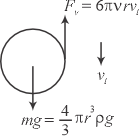 $6 \pi \eta r v_{t} = \frac{4}{3} \pi r^{3} \rho g$
$v_{t} = \frac{4}{3} \times \frac{\pi r^{3} \rho g}{6 \pi \eta r}$
$v_{t} = \frac{4}{3} \times \frac{\pi r^{3} \rho g}{6 \pi \eta r} = \frac{2 \times 10^{- 12} \times 10^{3} \times 10}{9 \times 1.8 \times 10^{- 5}}$
_=_ 123.4×10<$^{-6}$_m/s_
Question 2 • MCQ
4 Mark(s)
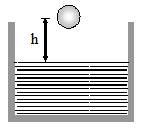
$\begin{matrix}\begin{matrix}A b a l l o f r a d i u s r a n d d e n s i t y \rho f a l l s f r e e l y u n d e r g r a v i t y\end{matrix} \\ \begin{matrix}t h r o u g h a d i s t a n c e h b e f o r e e n t e r i n g w a t e r . V e l o c i t y o f\end{matrix} \\ \begin{matrix}b a l l d o e s n o t c h a n g e e v e n o n e n t e r i n g w a t e r , t h e n t h e\end{matrix} \\ \begin{matrix}v i s c o s i t y o f w a t e r \left(\eta\right) , i n t e r m s o f h , r a n d \rho c a n b e e x p r e s s e d a s\end{matrix}\end{matrix}$
(A) $\eta = \left(\sqrt{\frac{g}{h}}\right) r^{2} \left(\rho - 1\right)$
(B) $\eta = \left(\sqrt{\frac{2 g}{h}}\right) r^{2} \left(\rho - 1\right)$
(C) $\eta = \frac{2}{81} r^{2} \left(\frac{\rho - 1}{h}\right)^{2} g$
(D) $\eta = \left(\sqrt{\frac{2 g}{h}}\right) r^{2} \left(\rho - 1\right)^{2}$
🚀 View Fast Shortcut Solution & Trap Defense
Correct Answer: N/A
Explanation: $= \left(\sqrt{\frac{2 g}{h}}\right) r^{2} \left( 1\right)$
$\begin{matrix} = \sqrt{2 g h} . . . \left(i\right) \\ T e r m i n a l v e l o c i t y o f b a l l i n s i d e t h e w a t e r \\ = \sqrt{2 g h} . . . . . . \left(i i\right) \\ E q u a t i n g \left(i\right) a n d \left(i i\right) w e g e t \sqrt{2 g h} = \frac{2 r^{2} g}{9 } \left( 1\right) \\ = \left(\sqrt{\frac{2 g}{h}}\right) r^{2} \left( 1\right)\end{matrix}$
Question 3 • MCQ
4 Mark(s)
A piston of cross-section area 100 cm$^{2}$ is used in a hydraulic press to exert a force of 10$^{7}$ dynes on the water. The cross-sectional area of the other piston which supports an object having a mass 200 kg is
(A) 100 cm$^{2}$
(B) 10$^{9}$ cm$^{2}$
(C) 2×10$^{4}$ cm$^{2}$
(D) 2 × 10$^{10}$ cm$^{2}$
🚀 View Fast Shortcut Solution & Trap Defense
Correct Answer: c
Explanation: 2×10$^{4}$ cm$^{2}$
$\begin{matrix}\begin{matrix}\begin{matrix}P_{1} = P_{2} \frac{F_{1}}{A_{1}} = \frac{F_{2}}{A_{2}} \\ \frac{1 0^{7}}{1 0^{2}} = \frac{2000 1 0^{3} 1 0^{3}}{A_{2}}\end{matrix}\end{matrix} \\ \begin{matrix} A_{2} = 2 1 0^{4} c m^{2} \left(g = 980 1 0^{3} c m / s^{2}\right)\end{matrix}\end{matrix}$
Question 4 • MCQ
4 Mark(s)
**Given below are two statements. Read them carefully and choose correct answer from the options given below:**
**Statement 1:** The terminal velocity of a sphere falling through a viscous fluid is inversely proportional to the coefficient of viscosity.
**Statement 2:** According to Stokes' law, the viscous force is directly proportional to velocity.
(A) oth statements are true, and Statement 2 is the correct explanation of Statement 1
(B) oth statements are true, but Statement 2 is not the correct explanation of Statement 1
(C) Statement 1 is true, but Statement 2 is false
(D) Statement 1 is false, but Statement 2 is true
🚀 View Fast Shortcut Solution & Trap Defense
Correct Answer: b
Explanation: Both statements are true, but Statement 2 is not the correct explanation of Statement 1
Both statements are true, but Statement 2 doesn't directly explain Statement 1.
At terminal velocity: Weight - Buoyant force = Viscous force, giving $v_{t} = \frac{2 r^{2} g \left(\rho_{s} - \rho_{f}\right)}{9 \eta}$. This shows $v_{t} \propto \frac{1}{\eta}$. While Stokes' law ($F = 6 \pi \eta r v$) shows viscous force is proportional to velocity, the inverse relationship with viscosity in terminal velocity comes from the force balance equation. This principle is used in viscometry and sedimentation analysis.
Question 5 • MCQ
4 Mark(s)
A monometer connected to a closed tap reads _4.5 × 10$^{5}$ pascal_. When the tap is opened the reading of the monometer falls to _4 ×10$^{5}$_ _pascal_. Then the velocity of flow of water is
(A) _7 ms$^{–1}$_
(B) _8 ms$^{–1}$_
(C) _9 ms$^{–1}$_
(D) _10 ms$^{–1}$_
🚀 View Fast Shortcut Solution & Trap Defense
Correct Answer: d
Explanation: _10 ms$^{–1}$_
$\begin{matrix}\frac{P_{1} P_{2}}{ g} = \frac{v^{2}}{2 g} \frac{4.5 10^{5} 4 10^{5}}{10^{3} g} = \frac{v^{2}}{2 g} \\ v = 10 m s^{ 1}\end{matrix}$
4. ❓ Frequently Asked Questions (Exam Strategy)
❓ How many questions appear from Mechanical Properties of Fluids JEE Main Physics: Authentic Shift PYQs (2021-2026) with 2.5-Min Shortcut Tricks & Trap Defense in JEE Main Session 1?
Typically 1 to 2 questions (4 to 8 marks) appear from Mechanical Properties of Fluids JEE Main Physics: Authentic Shift PYQs (2021-2026) with 2.5-Min Shortcut Tricks & Trap Defense, frequently featuring combined multi-topic concepts.
❓ What is the best approach to avoid negative marks in Mechanical Properties of Fluids JEE Main Physics: Authentic Shift PYQs (2021-2026) with 2.5-Min Shortcut Tricks & Trap Defense?
Master standard shortcut formulas, verify boundary states (e.g. t=0, infinity), and skip uncertain numerical value questions.
❓ Why does a needle float on water surface if placed gently?
The needle floats because the upward force of surface tension balances its weight. This occurs when the needle does not break the surface film by exceeding the critical surface tension force.
❓ Does Bernoulli's principle apply to viscous fluids?
No, Bernoulli's equation is strictly valid only for ideal fluids that are incompressible and non-viscous. In real fluids, energy is dissipated as heat due to internal friction (viscosity).
❓ How does terminal velocity vary with the radius of a falling sphere?
According to Stokes' Law, terminal velocity is directly proportional to the square of the sphere's radius (v ∝ r²). Therefore, a larger sphere falls significantly faster than a smaller one in the same viscous medium.
Official Complete Study Package
JEE Main & Advanced High-Yield Chapter Question Bank
Get full digital access to 500+ chapter-wise questions, comprehensive question banks, and authentic exam solutions.
Verified NCERT Curriculum • Instant Digital Access • 100% Satisfaction
💬
Join the Official JEE Main & Advanced WhatsApp Community for daily question drops & study notes
Join Channel
🎓Explore All QBNEXA Curriculum Hubs
Need more chapters and complete test sets?
Access our complete 12 Lakhs MCQ repository, solved past papers, and error-free test series.
← Back to Home
