Some Basic Principles of Organic Chemistry JEE Main Chemistry: Authentic Shift PYQs (2021-2026) with 2.5-Min Shortcut Tricks & Trap Defense
Published: October 31, 2026
Author: NEET & JEE STUDY HUB
🎯 Curriculum & Exam Overview
This chapter establishes the foundational nomenclature, electronic effects, and purification techniques essential for all subsequent organic chemistry modules. It carries high weightage because it serves as the prerequisite for mastering reaction mechanisms, which constitute nearly 40% of the Chemistry board and JEE paper.
🚀 NTA JEE Main 2027 Countdown
January Session 1 Sprint
JEE Main 2027 Engineering Focus: High-Yield Problem Solving & Negative Marking Defense
- Session 1 Registration Timeline: Registration for JEE Main 2027 Session 1 opens in November on jeemain.nta.nic.in. January exam performance sets your prime percentile baseline.
- Negative Marking Safeguard (-1): Eliminate blind guesswork. Prioritize question selection, dimensional checks, and options elimination to maximize net marks.
- Multi-Concept Problem Linkages: JEE questions integrate multiple domains (e.g. Calculus with Mechanics, or Thermodynamics with Equilibrium) into single composite problems.
- Timed Shift PYQ Practice: Solve at least 15-20 recent shift questions (2021-2026) under a strict 2.5-minute timer per numerical/MCQ.
⚡ JEE Main Exam Blueprint & Problem-Solving Guidelines
📊 Expected Weightage
Expected 4 to 8 marks in CBSE board exam (typically 1-2 MCQs + 1 Short/Long Answer or Case Study).
✍️ Examiner & Scoring Insight
Examiners award partial step marks for formula definition, intermediate substitution, correct SI units, and neat labeled diagrams.
1. ⚡ High-Speed Formula Sheet & Concept Limits
1
IUPAC Nomenclature: Systematic naming of organic compounds based on the longest carbon chain, functional group priority (suffix/prefix), and alphabetical order of substituents.
2
Electronic Displacement Effects: Inductive effect (I-effect), Resonance effect (R-effect), Electromeric effect (E-effect), and Hyperconjugation (σ-π conjugation) which dictate chemical reactivity.
3
Purification & Analysis: Chromatographic and spectroscopic techniques (distillation, crystallization, chromatography) used to determine purity and quantitative elemental composition.
⚡ High-Yield Formula & Reaction Sheet
- Inductive Effect: Permanent polarization of σ-bond due to electronegativity difference; represented by δ+/δ- charges showing electron density shift.
- Resonance Energy: The difference between the actual energy of the molecule and the energy of the most stable canonical structure; stability increases with more covalent bonds and charge delocalization.
⚠️ Common Board Trap Alert
The most common pitfall is the 'Priority Order' in IUPAC nomenclature where students often misidentify the principal functional group or incorrectly number the chain by ignoring lowest locant rules.
📺 High-yield video lesson for this chapter will premiere on @qbnexa_official.
▶ Subscribe Channel
3. ⚡ NTA JEE Shift Practice & Rank-Booster Problems
Question 1 • MCQ
4 Mark(s)
What is the IUPAC name of the given compound ?
${\mathrm{CH}}_{3}{\mathrm{CH}}_{2}\mathrm{C}\left(\mathrm{Br}\right)\quad =\quad \mathrm{CH}\quad -\quad \mathrm{Cl}$
(A) 2--bromo-1-chlorobutene-1
(B) 1-chloro-2-bromobutene-1
(C) 3-chloro-2-bromobutene-2
(D) 3-bromo-4-chloro but-3-ene
🚀 View Fast Shortcut Solution & Trap Defense
Correct Answer: a
Explanation: 2--bromo-1-chlorobutene-1
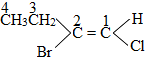 Minimum number is given to double bond (as alkene is a functional group) . Although bromine is given number 2 but is written first as per alphabetical order .
2-bromo-1-chlorobutene-1
Question 2 • MCQ
4 Mark(s)
No. of chiral compounds possible on mono chlorination of 2-methyl butane are
🚀 View Fast Shortcut Solution & Trap Defense
Correct Answer: a
Explanation: On chlorination of 2-methyl butane
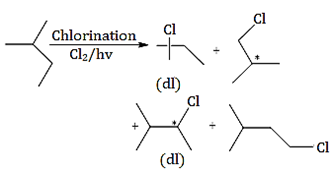
Question 3 • MCQ
4 Mark(s)
The yield in organic reactions is sometimes poor because the reactions are :
(A) Very fast
(B) Non-ionic
(C) etween covalent compounds
(D) ccompanied by side reactions
🚀 View Fast Shortcut Solution & Trap Defense
Correct Answer: d
Explanation: Accompanied by side reactions
The yield in organic reactions is generally poor because the reactions involves formation of side products along with the main product .
Question 4 • MCQ
4 Mark(s)
How many cyclic structural isomers are possible for C$_{5}$H$_{10}$ ?
🚀 View Fast Shortcut Solution & Trap Defense
Correct Answer: a
Explanation: $D B E = n \left(C\right) - \frac{n \left(H\right)}{2} + 1$
$= 5 - \frac{10}{2} + 1$
= 1
∴ Possible cyclic structural isomers =

Question 5 • MCQ
4 Mark(s)
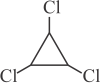
How many geometrical isomers are possible for the given compound ?
🚀 View Fast Shortcut Solution & Trap Defense
Correct Answer: c
Explanation: Geometrical isomers

4. ❓ Frequently Asked Questions (Exam Strategy)
❓ How many questions appear from Some Basic Principles of Organic Chemistry JEE Main Chemistry: Authentic Shift PYQs (2021-2026) with 2.5-Min Shortcut Tricks & Trap Defense in JEE Main Session 1?
Typically 1 to 2 questions (4 to 8 marks) appear from Some Basic Principles of Organic Chemistry JEE Main Chemistry: Authentic Shift PYQs (2021-2026) with 2.5-Min Shortcut Tricks & Trap Defense, frequently featuring combined multi-topic concepts.
❓ What is the best approach to avoid negative marks in Some Basic Principles of Organic Chemistry JEE Main Chemistry: Authentic Shift PYQs (2021-2026) with 2.5-Min Shortcut Tricks & Trap Defense?
Master standard shortcut formulas, verify boundary states (e.g. t=0, infinity), and skip uncertain numerical value questions.
❓ How do I determine the stability of carbocations?
Carbocation stability is determined by the electron-donating effect of adjacent groups, where 3° > 2° > 1° > methyl due to hyperconjugation and inductive effects. Remember that resonance stabilization significantly outweighs inductive stabilization.
❓ What is the difference between Inductive effect and Resonance?
Inductive effect is a distance-dependent, permanent displacement of σ-electrons due to electronegativity difference. Resonance is the delocalization of π-electrons across a conjugated system, which is not restricted by distance.
❓ Why is Hyperconjugation called 'no-bond resonance'?
It involves the overlap of a C-H σ-bond with an adjacent vacant p-orbital, causing delocalization without a formal covalent bond between the carbon and hydrogen. This interaction stabilizes unsaturated systems and carbocations through partial bond formation.
Official Complete Study Package
JEE Main & Advanced High-Yield Chapter Question Bank
Get full digital access to 500+ chapter-wise questions, comprehensive question banks, and authentic exam solutions.
Verified NCERT Curriculum • Instant Digital Access • 100% Satisfaction
💬
Join the Official JEE Main & Advanced WhatsApp Community for daily question drops & study notes
Join Channel
🎓Explore All QBNEXA Curriculum Hubs
Need more chapters and complete test sets?
Access our complete 12 Lakhs MCQ repository, solved past papers, and error-free test series.
← Back to Home
