Organic Chemistry _ Some Basic Principles JEE Main Chemistry: Authentic Shift PYQs (2021-2026) with 2.5-Min Shortcut Tricks & Trap Defense
Published: November 01, 2026
Author: NEET & JEE STUDY HUB
🎯 Curriculum & Exam Overview
This chapter forms the foundational language of organic chemistry, focusing on IUPAC nomenclature, electronic effects, and purification techniques. It is high-yield because it acts as the prerequisite for mastering all subsequent organic reactions in the JEE and CBSE syllabus.
🚀 NTA JEE Main 2027 Countdown
January Session 1 Sprint
JEE Main 2027 Engineering Focus: High-Yield Problem Solving & Negative Marking Defense
- Session 1 Registration Timeline: Registration for JEE Main 2027 Session 1 opens in November on jeemain.nta.nic.in. January exam performance sets your prime percentile baseline.
- Negative Marking Safeguard (-1): Eliminate blind guesswork. Prioritize question selection, dimensional checks, and options elimination to maximize net marks.
- Multi-Concept Problem Linkages: JEE questions integrate multiple domains (e.g. Calculus with Mechanics, or Thermodynamics with Equilibrium) into single composite problems.
- Timed Shift PYQ Practice: Solve at least 15-20 recent shift questions (2021-2026) under a strict 2.5-minute timer per numerical/MCQ.
⚡ JEE Main Exam Blueprint & Problem-Solving Guidelines
📊 Expected Weightage
Expected 4 to 8 marks in CBSE board exam (typically 1-2 MCQs + 1 Short/Long Answer or Case Study).
✍️ Examiner & Scoring Insight
Examiners award partial step marks for formula definition, intermediate substitution, correct SI units, and neat labeled diagrams.
1. ⚡ High-Speed Formula Sheet & Concept Limits
1
IUPAC Nomenclature: Systematic naming of organic compounds based on the selection of the longest chain, lowest locant rule, and alphabetical order of substituents.
2
Electronic Effects: Inductive effect (permanent polarity), Resonance (delocalization of pi-electrons), and Hyperconjugation (sigma-bond participation in stabilization).
3
Isomerism: Structural isomerism (chain, position, functional, metamerism) and Stereoisomerism (geometrical and optical) based on spatial arrangement.
⚡ High-Yield Formula & Reaction Sheet
- Inductive Effect (I-Effect): Displacement of sigma electrons due to electronegativity difference, represented as +I (electron-donating) or -I (electron-withdrawing).
- Hyperconjugation: Delocalization of sigma electrons of a C-H bond attached to an alpha-carbon into an adjacent p-orbital (also called 'no-bond resonance').
⚠️ Common Board Trap Alert
Students often fail to count the total number of alpha-hydrogens correctly when determining the stability of carbocations or alkenes, leading to errors in ranking stability.
📺 High-yield video lesson for this chapter will premiere on @qbnexa_official.
▶ Subscribe Channel
3. ⚡ NTA JEE Shift Practice & Rank-Booster Problems
Question 1 • MCQ
🔥 JEE Main (2018)
4 Mark(s)
The most polar compound among the following is :
(A) 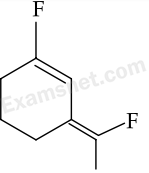
(B) 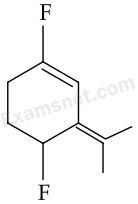
(C) 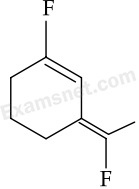
(D) 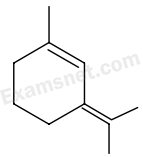
🚀 View Fast Shortcut Solution & Trap Defense
Correct Answer: (a)
Explanation: Detailed pedagogical breakdown based on official NCERT syllabus criteria.
Question 2 • MCQ
🔥 JEE Main (2022)
4 Mark(s)
The correct IUPAC name of the following compound is :
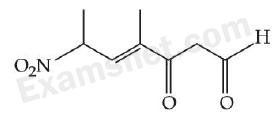
(A) 4-methyl-2-nitro-5-oxohept-3-enal
(B) 4-methyl-5-oxo-2-nitrohept-3-enal
(C) 4-methyl-6-nitro-3-oxohept-4-enal
(D) 6-formyl-4-methyl-2-nitrohex-3-enal
🚀 View Fast Shortcut Solution & Trap Defense
Correct Answer: (c)
Explanation: 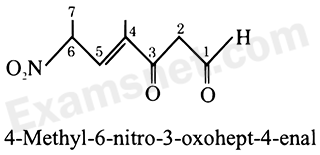
Question 3 • MCQ
🔥 JEE Main (2019)
4 Mark(s)
The increasing order of the b pK of the following compound is:
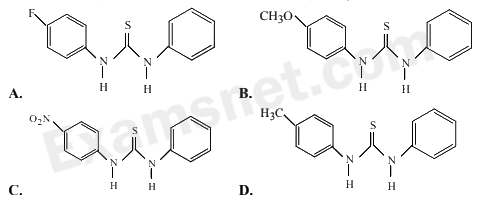
(A) (C) < (A) < (D) < (B)
(B) (B) < (D) < (A) < (C)
(C) (A) < (C) < (D) < (B)
(D) (B) < (D) < (C) < (A)
🚀 View Fast Shortcut Solution & Trap Defense
Correct Answer: (a)
Explanation: B > D > A > C
Question 4 • MCQ
🔥 JEE Main (2019)
4 Mark(s)
the following compound
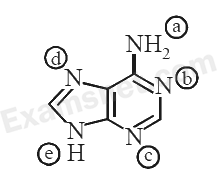
the favourable site/s for protonation is/are :
(A) (b), (c) and (d)
(B) (a)
(C) (a) and (e)
(D) (a) and (d)
🚀 View Fast Shortcut Solution & Trap Defense
Correct Answer: (a)
Explanation: Localised lone pair $e^{-}$ .
Question 5 • MCQ
🔥 JEE Main (2024)
4 Mark(s)
Relative stability of the contributing structures is :
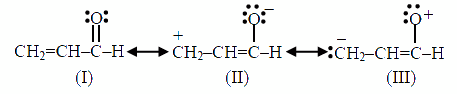
(A) (I) $>$ (III) $>$ (II)
(B) (I) $>$ (II) $>$ (III)
(C) (II) $>$ (I) $>$ (III)
(D) (III) $>$ (II) $>$ (I)
🚀 View Fast Shortcut Solution & Trap Defense
Correct Answer: (b)
Explanation: (1) Neutral structures are more stable than charged ones. Therefore I is more stable than II and III.
(2) +ve charge on less electronegative atom is more stable i.e., $\mathrm{C}^{\oplus}$ is more stable than $\mathrm{O}^{\oplus}$
$\therefore \;$ Order is $I > II > III$
4. ❓ Frequently Asked Questions (Exam Strategy)
❓ How many questions appear from Organic Chemistry _ Some Basic Principles JEE Main Chemistry: Authentic Shift PYQs (2021-2026) with 2.5-Min Shortcut Tricks & Trap Defense in JEE Main Session 1?
Typically 1 to 2 questions (4 to 8 marks) appear from Organic Chemistry _ Some Basic Principles JEE Main Chemistry: Authentic Shift PYQs (2021-2026) with 2.5-Min Shortcut Tricks & Trap Defense, frequently featuring combined multi-topic concepts.
❓ What is the best approach to avoid negative marks in Organic Chemistry _ Some Basic Principles JEE Main Chemistry: Authentic Shift PYQs (2021-2026) with 2.5-Min Shortcut Tricks & Trap Defense?
Master standard shortcut formulas, verify boundary states (e.g. t=0, infinity), and skip uncertain numerical value questions.
❓ How do I distinguish between the Inductive effect and Resonance?
The Inductive effect involves the displacement of sigma electrons through a chain, whereas Resonance involves the complete delocalization of pi-electrons or lone pairs. Resonance is generally a much stronger effect than Inductive effect for stability analysis.
❓ Which rule takes priority in numbering a chain with multiple functional groups?
According to the IUPAC priority sequence, the principal functional group is assigned the lowest possible locant. Substituted groups are then numbered alphabetically if multiple options arise.
❓ Is hyperconjugation applicable to all carbocations?
No, hyperconjugation requires the presence of an alpha-hydrogen atom on a carbon adjacent to the positively charged carbon. A carbocation lacking alpha-hydrogens cannot be stabilized by hyperconjugation.
Official Complete Study Package
JEE Main & Advanced High-Yield Chapter Question Bank
Get full digital access to 500+ chapter-wise questions, comprehensive question banks, and authentic exam solutions.
Verified NCERT Curriculum • Instant Digital Access • 100% Satisfaction
💬
Join the Official JEE Main & Advanced WhatsApp Community for daily question drops & study notes
Join Channel
🎓Explore All QBNEXA Curriculum Hubs
Need more chapters and complete test sets?
Access our complete 12 Lakhs MCQ repository, solved past papers, and error-free test series.
← Back to Home
